Full potential of the Internet still to be realized
The Internet is still very young. It was only November 1977 when a group of computer scientists successfully connected three networks around the world. It took until 1989 for the Internet to become commercially available and about another decade after that for it to achieve widespread household use in Europe and the United States. Only then did we emerge from what I think of as the "Internet comma" days, when its mention in the media was always followed by a comma and a short description.
This reflects that in a very short time the Internet has had a profound impact on the way we live, so it's hardly surprising that some people have expressed skepticism of its effects. Yet such a transformative technology is bound to ruffle a few feathers. I have no doubts that its social repercussions will take decades to be fully understood, but it has already done much to benefit the world. It has provided access to information on a scale never before imaginable, lowered the barriers to creative expression, challenged old business models and enabled new ones. It has succeeded because we designed it to be both flexible and open. These features have allowed it to accommodate innovation without massive changes to its infrastructure.
And innovation on the Internet happens at a rapid pace. Ten years ago, Google was simply an idea being explored by two graduates in California. The years to come will offer more that is new and exciting. It's easy to forget, however, just how far the Internet still has to go. Today, there are only about 1.4 billion users, representing a bit more than one-fifth of the world's population, and a substantial amount of the content on the Web is still written in English.
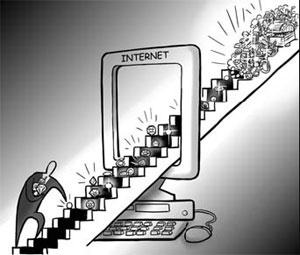
But the Internet is becoming more global. Asia has more than 500 million users and Europe nearly 400 million and Internet-enabled mobile phones will help extend the net to Africa, Latin America and the Indian subcontinent. We're about to see further waves of innovation.
There are more than 3 billion mobiles in use today and more than 80 percent of the world's population live within range of a network. In areas where wireline or WiFi access barely exists, many new users will first experience the Internet through a mobile phone.
In developing economies, people are already finding innovative ways to use mobile technology. Grameen's micro-finance and village phone programs in Bangladesh and elsewhere are known and respected around the world, but there are many less famous examples.
We're nearing the tipping point for mobile computing to deliver timely, geographically and socially relevant information. Researchers in Japan recently proposed using data from vehicles' windscreen wipers and embedded GPS receivers to track the movement of weather systems through towns and cities with a precision never before possible.
It may seem academic, but understanding the way severe weather, such as a typhoon, moves through a city could save lives. Further exploration can shed light on demographic, intellectual and epidemiological phenomena, to name just a few areas.
It's amazing how quickly those of us with Internet access have come to take for granted the remarkable amounts of information we have at our disposal, but we are only seeing the beginnings. The bulk of human knowledge remains offline. As more of us get access to the Internet, more of the world's information will find its way online.
The Web is already making strides toward becoming truly global. While I was chairman of ICANN, one of the organizations that helps ensure that the Internet works uniformly around the world, we adopted rules to allow the system of domain names to accommodate non-Roman characters, making the web more accessible to people whose languages use other scripts, such as Arabic, Korean or Cyrillic.
There are improvements in automatic language translation tools and, in particular, the field that we call machine learning. It is already possible to do a Google search and explore the results in English across Web content in 23 different languages, from Czech to Hindi to Korean. Speakers of any of those languages can now explore content on the web written in any of the others.
The technology isn't perfect yet, but it's rapidly improving. Even in its present form, it's easy to imagine a not-too-distant future in which automatic translation will allow two people in the world to message one another in real time, each experiencing the chat in his or her tongue. Just imagine what a significant step that will be.
The technological progress of the Internet has set huge social changes in motion. As with other transformative innovations before it, from the telegraph to television, people will continue to worry about the effects; the printing press and the rise in literacy that it effected were long seen as destabilizing forces. Similar concerns about the Internet are being raised, but if we take a long view, its benefits far outweigh the discomforts of learning to integrate it into our lives.
The author, a vice-president of Google, co-designed the architecture of the Internet
The Observer
(China Daily 08/29/2008 page9)