Steelmaker forges ahead
|
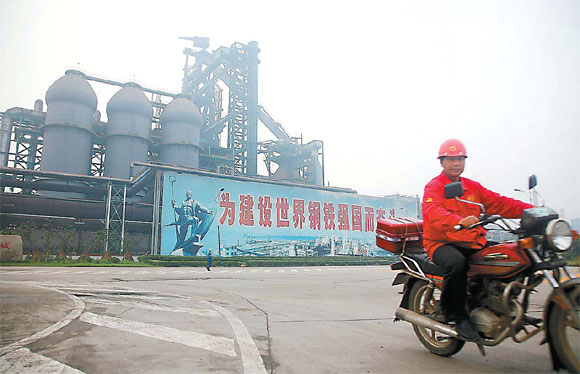
A worker rides on a motorbike at Shagang Group. The billboard behind him declares the company is striving for a world steel giant.? File photo |
Critics claim that China's steel industry has an unfair advantage because of government subsidies.
But Shen Wenrong, president of China's largest private steelmaker Jiangsu Shagang Group, says he envies the business environment of Indian steel magnate Lakshmi Mittal, chief executive officer of the world's largest steel producer Arcelor Mittal.
"If the financing conditions in China were half as good as those for Mittal, I could reach a capacity of 100 million tons of steel made solely in China," Shen says, from his office at Shagang's factory in Jiangsu Province, overlooking the Yangtze River.
"He was not as good as me 10 years ago."
With a capacity of 14.6 million metric tons of crude steel, Shagang Group is listed as the 16th-largest steelmaker in the world by the International Iron and Steel Institute. Sales reached 55 billion yuan in 2006.
Village factory
Unlike Mittal, whose business blossomed with the backing of international investment banks and capital, Shagang grew from a 450,000 yuan village factory into one of the biggest steelmakers in China - largely due to the industriousness and efficiency of its president and workers.
Shen first attracted industry attention in 2001 when Shagang acquired the Dortmund-Horde steel mill from German industrial giant Thyssen Krupp for 30 million euros and began shipping equipment back to China.
The decision to buy the mill was swift - only a month after it was offered for sale - prompting speculation of a secret agreement or that the deal had government backing.
One thing Krupp's workers knew for sure is that when the Chinese arrived to prepare factory equipment for shipment, they worked hard.
As the Germans demonstrated in favor of a 35-hour working week, 1,000 workers from Shagang, an obscure steelmaker from far-off China, were working over 12 hours a day with no weekends off. When German authorities cautioned Shagang to obey local labor laws, the Chinese began taking one day off a week - to work in their dormitories.
The 250,000 tons of equipment and 40 tons of reassembly documents from the steel mill were finally moved to Jinfeng, a town along the Yangtze River, after a trip of 5,600 miles, arriving a year ahead of Shagang's schedule and two years earlier than German estimates.
That kind of effort, perhaps impressive to Europeans, is nothing new for Shagang's workers. Shen's 70 sq m apartment is at the factory to save commuting time, but his wife says Shen often doesn't get home until after 11 pm.
Shagang's acquisition of the German factory was a turning point - it nearly doubled capacity. More importantly, German technology enabled the company to make more profitable high-quality steel products.
Humble beginnings
Shen grew up in the poverty-stricken 1960s. He lost his father in early childhood, and his mother and six children lived on one meal a day. He began working at a local cotton factory in 1968 after graduating from high school.
At that time, under the planned economy, the town of Jinfeng had difficulty getting the steel that it needed for industrial development.
The factory where Shen worked, the largest in town, was encouraged by the local government to build a steel mill, so the factory purchased equipment with a loan of 450,000 yuan.
When Shen became the head of the factory in 1984, Shagang's annual steel output was less than 10,000 tons. He soon found there was growing demand from the housing market, so the company looked into making steel for window frames.
Shen sent workers to Shanghai and to steel plants in Northeast China to study windowframes and learn the latest technology. Window frame steel earned the first big profit for Shagang as its output reached 130,000 tons and the company took 60 percent of the window frame market in China. By the end of 1988, Shagang had assets of 100 million yuan.
Many thought Shagang would be satisfied at that level, but it was just the beginning for Shen. He heard in 1988 that a 75-ton electric arc furnace capable of producing 250,000 tons of reinforced steel bars was up for sale in the United Kingdom and he decided to buy it.
The decision met with opposition from both the government and his factory workers, who thought the deal would be too bold even for a State-owned enterprise, let alone a privately owned company. But Shen insisted that importing new technology was the only way to catch up.
"If it fails, we will use the equipment for a museum and I will be there selling tickets," he said at the time.
It took him three years to ship and reassemble the furnace. Shortly after the project was completed in 1992, China experienced an infrastructure boom, which boosted Shagang's growth and expansion.
Slowdown ahead?
But Shen's bold expansion moves have not always turned out according to plan. Faced with a surging trade surplus, China removed tax rebates for exported steel this year and has begun to control the scale of steel companies.
"I can feel the winter is coming for the steel industry in China," says Shen. The withdrawal of tax rebates has had a significant impact on his business; it is estimated company profit could fall by 1 billion yuan in 2007.
He also foresees that domestic demand for steel will shrink as policies tighten on real estate development.
Shen's factory now has a capacity of almost 15 million tons of steel, and he's aware that it will be impossible to expand by building another factory.
Mergers and acquisitions are now an alternative strategy to reach his production goals of 25 million tons by 2010 and over 35 million by 2020.
Shagang purchased Jiangsu Huaigang Steel Co Ltd for $250 million in 2006. Although he declines to reveal what the next target might be, Shen says that his acquisition plan is to start with small, local steelmakers.
While his plan sounds feasible, rooms in Shagang's cafeteria are labeled with bigger names, like Mittal and Arcelor, representing bigger dreams.
"It is not impossible to go out and acquire a foreign steel mill when the right time comes," Shen says.
(Shanghai Start 09/07/2007 page11)