|
Shenzhen's new residence system help migrant workers
2008-08-01
China Daily
The lives of the 12 million migrant workers in the southern boomtown of Shenzhen look set for a major change starting Friday.
A new residence permit system that aims to provide equality for the city's workers and help ease the hassle of traveling, looking up personal records, accessing the local public education system - even visiting Hong Kong's Disneyland theme park - is being rolled out.
|
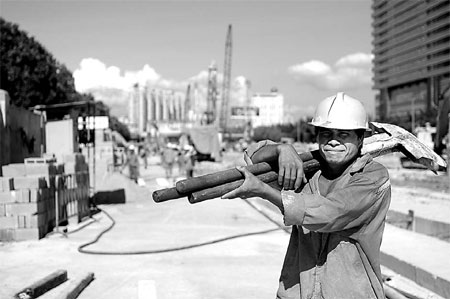
A worker at a subway construction site in Shenzhen, Guangdong province, one of the 12 million migrant workers in the city who are expected to be covered by a new residence permit system starting from August 1, 2008. [File photo]
|
About 5 million of the migrant workers who have been living in Shenzhen, Guangdong province, for more than a year are expected to get their residency status processed by the end of the year.
Another 7 million workers are expected to get their residents' cards next year.
All new job-hunters will also reportedly be able to apply for their residency status on the day of their arrival.
The moves have been hailed as the first of their kind in the country - after three decades of economic reform fueled by such migrant workers - and ones that will enable migrant workers to enjoy full rights as the city's permanent residents.
By putting in place such measures, Shenzhen, the first special economic zone of the country, is once again being seen as a pioneer in reform.
While there has been no explicit move as yet, other cities are widely expected to follow Shenzhen's footsteps - making a major impact on the national system to segregate urban and rural resident statuses that was introduced more than half a century ago.
Luo Li, who works at a local IT company, told China Daily she had planned with five other colleagues to have their residency status processed.
|
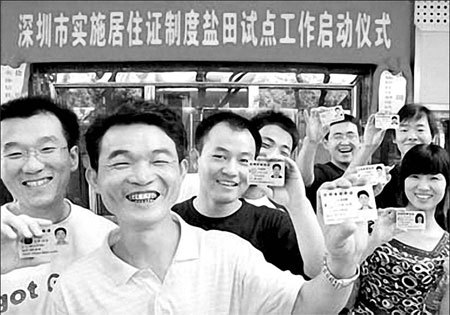
Migrant workers in Shenzhen, Guangdong province, display their residence cards in Yantian district in September last year, as part of a trial of a new residence permit system. [File photo]
|
"I've seen myself as a member of this free and dynamic city after living here for more than four years, but I've not been registered as a permanent resident all this time and am still labeled as part of the 'migrant population'," the 27-year-old said.
"I hope the situation can change with this new system."
The city of Shenzhen, which borders Hong Kong and nearly double the size of its cosmopolitan neighbor, has one of the largest migrant populations in the country.
Only 2.12 million people have registered their permanent residence, while another 6.2 million who have lived in the city for more than half a year have registered their residence with local police, latest official figures have showed.
The decision to implement the new system was made after a four-month trial in the city's Yantian district.
"The introduction of the new residence certificate system is aimed at gradually removing the barriers between the permanent and migrant populations, so they can enjoy equal rights here and regard the city as their home," said Wang Pu, director of the Shenzhen office of legislative affairs.
Under the new system, any Chinese person, aged between 16 and 60, who has been working in the city for more than 30 days, owns a property or has been running a business but does not hold permanent residency, are eligible for a new residence permit from the local police station. The permit is valid for 10 years.
Li Bing, a local press commentator, said the new system is better than the previous one in at least three aspects:
It weakens notions of a migrant population and permanent population, compared with the previous system that instead highlighted the "migrant" identity.
The new residential card records more detailed information of its holder, including employment history, social security, and credit and criminal records.
Obtaining the new card is voluntary. Previously, it was compulsory to apply for the temporary residential card and along with it came the discrimination toward the migrant population.
Under the new system, the unemployed can apply for a temporary permit that will be valid for half a year. The permit can be converted to a long-term one once its holder gets hired and updates personal information with the local employment agency, Wang Pu from the Shenzhen office of legislative affairs said.
The new permit holders will be entitled to a range of free public services, including being able to apply for driving licenses and business visas for Hong Kong or Macao, Wang said. Children of permit holders will also be entitled to the same compulsory education as their peers who hold permanent permits, and families will be able to apply for the government's low-cost housing.
Without the permits, migrant workers cannot even rent an apartment in the city.
Le Zheng, president of Shenzhen Academy of Social Sciences, said the new system will help create a fair environment for people living in the same city.
"The fiscal system of the Shenzhen government will care not just for registered permanent residents, but also for the migrant population," Le said.
"More public services, including social security, will gradually benefit the whole community," Le said.
Apart from improving residents' sense of social identity in the city, Le said the new system can also be used to better manage the expanding migrant population.
He suggested that the government consider a social security number system, which has been widely adopted in Western countries, to improve management.
Some members of the Chinese People's Political Consultative Conference Shenzhen committee, the advisory body to the local government, had suggested the new resident card be linked with the application of fixed-line telephones, mobile phones, bank accounts and household gas usage.
The government aims to issue 5 million new cards by the end of this year and cover at least 90 percent of the migrant population by June next year.
The local public security department hopes the new move can attract talent and protect law-abiding workers who have contributed to the city's economy, while keeping undesirable elements out of the city.
Still, some say more needs to be done.
"I don't feel a large difference between the new card and the old card," said Liu Kaiming, executive director of the Institute of Contemporary Observation, a local civil society organization dedicated to labor development and corporate social responsibility.
The new cards do not entitle the holders to unemployment benefits, Liu said.
"Neither do they have political rights within the local community," he said.
Liu said the situation cannot truly be improved if the nation's household registration policy remains unchanged.
For IT worker Luo Li, the resident's permit can possibly provide an easier way to obtain permanent status in the city, which could translate into better protection of rights from the local government and better medical and social security services.
|


.gif)



.gif)

