Comments
  Print
Print  Mail
Mail  Large Medium Small
For Simon Galpin, who has lived in Hong Kong since before his native Britain handed the territory back to China, things haven't changed much in the 15 years since the historic transfer.
Two constants, he says, are Hong Kong's vibrancy and capacity for change.
"I love the fact that it seems to be continually reinventing itself. It is very skillful at identifying new opportunities and adapting its businesses to new potential," says Galpin, who moved to Hong Kong in 1995, two years before the central government officially took control and reclassified it as a special administrative region under the "One Country, Two Systems" policy.
Of course, there have been notable changes. Galpin says, Mandarin, or Putonghua, is now used much more widely in the Cantonese-speaking bastion, and Western companies that come to do business in Hong Kong have gotten "younger and smaller".
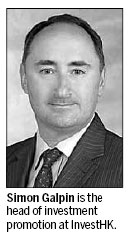
Galpin is the head of investment promotion at Invest Hong Kong, part of the special administrative region's government. Since 2000, the agency has been responsible for helping foreign and Chinese mainland companies set up operations in the city of 7 million people.
"One Country, Two Systems" is the model that has allowed Hong Kong to maintain the financial autonomy it enjoyed under British colonial rule, but the policy also has helped open fresh business opportunities, Galpin says.
Hong Kong has long been the "gateway to China" for companies seeking access to the mainland market. But as China's economy continues to grow, the region is increasingly a launch pad for mainland companies aiming to operate abroad.
"Some of these Chinese companies want to use their Hong Kong subsidiaries to make acquisitions around the world," the investment official says. "We are seeing a growing number of law firms, accounting firms and service providers who come to Hong Kong to assist these mainland companies in their global aspirations."
At the same time, the "One Country, Two Systems" principle has led to closer economic cooperation between Hong Kong and the Chinese mainland. In 2004, for example, State-owned Industrial and Commercial Bank of China acquired the Hong Kong banking subsidiary of Dutch-Belgian financial services firm Fortis NV.
Hong Kong is also becoming more international, largely due to "China becoming so much more important", Galpin says.
According to InvestHK, the region is becoming a favorite place for big corporations to establish global operations. In the past, Hong Kong was favored more as an Asia-Pacific regional base.
US-based General Electric Co, which does business in more than 100 countries, late last year began moving its Global Growth and Operations unit to Hong Kong's central business district.
Japan's Nissan Motor Co announced in November 2011 that it would relocate the global headquarters of its luxury-car brand, Infiniti, to Hong Kong.
"We see a lot of potential in the Hong Kong market," says Takeshi Nakajima, head of global planning for Infiniti. "The city has a wide talent pool, an international and open atmosphere, and is also a major hub for the global economy. Its proximity to the mainland and the ASEAN region makes it the ideal location to capture the growing market in these areas."
With China's GDP growing at as much as 9 percent a year, businesses opportunities from the mainland have clearly benefited Hong Kong. Of the 303 companies InvestHK assisted in setting up shop last year, 20 percent were from the mainland. While the mainland is the region's biggest investor, the US and Britain accounted for 39 companies that began operating in Hong Kong in 2011.
In 2009, Suning Appliance Co, China's leading retailer of electrical appliances, established a presence in Hong Kong through a HK$215 million ($27 million) takeover of Citicall, a digital-electronics retailer.
"Hong Kong is a vital platform for mainland companies to expand overseas," Sun Weimin, president of Suning, told the Southern Metropolis Daily. "It is an attractive market to Suning."
He says the region's retail market for appliances is estimated at HK$25 billion, which is on par with the biggest mainland cities - Beijing, Guangzhou and Shanghai. Suning plans to open 50 stores in Hong Kong in 2013.
Visitors from the mainland spell business for Hong Kong retailers. The region's retail sales jumped 25 percent in 2011 from a year ago, driven by mainland visitors' consumption of luxury and retail goods, according to Bloomberg News.
As Galpin sees it, Hong Kong is poised to be the undisputed business capital of Asia. "The fact that Hong Kong is part of China and China is such an important economy has helped Hong Kong's development," he says.
atung@chinadailyusa.com

 World's oldest male panda celebrates 30th birthday
 Rolls of grass: a beautiful landscape in Xinjiang
 Korla takes on a new look under ecological progress
 Villagers scoop up big profits by drying fish
 Seven killed as rainstorm triggers landslide in SW China
 People visit museum to mark 'Sept 18 Incident'
 Swans in Bayanbulak Wetland to start annual migration
 Fishing season begins in East China Sea
Copyright 1995 - . All rights reserved. The content (including but not limited to text, photo, multimedia information, etc) published in this site belongs to China Daily Information Co (CDIC). Without written authorization from CDIC, such content shall not be republished or used in any form. Note: Browsers with 1024*768 or higher resolution are suggested for this site.
License for publishing multimedia online 0108263 Registration Number: 20100000002731