Comments()
  Print
Print  Mail
Mail  Large Medium Small
A veritable fortress of skyscrapers stands guard over the heart of Hong Kong, each marked by a different financial institution. The iconic HSBC tower stands next to the Standard Chartered Bank building. Just a flight of stairs away is Citibank tower and next to it, the Bank of China tower.
Besides making up one of the most impressive skylines in the world, this collection of buildings is testament to the city's enduring strength as a financial center.
A decade and a half after China again took over the reins of Hong Kong, the city has emerged as a wedge, opening up global markets for the yuan.
Fears that rapid growth in Shanghai and Shenzhen would overshadow Hong Kong have proven groundless. Rather, Hong Kong has become a bridge between the Chinese mainland and the rest of the world, most recently by taking up the mantle as the largest offshore center for yuan trade.
 |
|
Buildings of financial institutions at Victoria Harbor define the skyline of the Hong Kong Special Administrative Region. [Photo/China Daily] |
"Hong Kong has gone from strength to strength. Its position as a financial center has massively developed since 1997," says Richard Harris, founder and chief executive of investment management firm Port Shelter as well as a long-term Hong Kong resident who started his career in Hong Kong in 1978.
Hong Kong was under British rule for 156 years before it was returned to Chinese sovereignty in 1997. By and large, Beijing has kept the city's local institutions intact. The legal system is unique to Hong Kong, as is the monetary and financial system. Banks are governed by local regulations. The stock exchange is independent of those on the mainland.
Yet the links between Hong Kong and the Chinese mainland have grown, alongside economic growth.
Since 1997, Hong Kong has become the listing market of choice for mainland State-owned and private enterprises looking for international capital. At the end of 2011, 640 Chinese mainland enterprises were listed on both the main board and the growth enterprise market board, making up 55 percent of the stock market capitalization and accounting for 66 percent of annual turnover.
"Hong Kong has always been a major fundraising center for Chinese companies," says Francis Lun, managing director of investment firm Lyncean Holdings.
 |
The listings started coming fast after the turn of the millennium. Some of China's largest State-owned companies beat one IPO record after another.
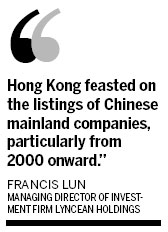
"Hong Kong feasted on the listings of Chinese mainland companies, particularly from 2000 onward," Lun says. "In recent years it has been helped by many international companies."
The Hong Kong Exchanges and Clearing Ltd is now focused on attracting more international IPOs and has been successful to some degree.
Hong Kong has steadily cemented its position as a global financial center. It was the largest market in the world for IPOs between 2009 and 2011 and the vast majority of yuan-denominated bonds are issued in Hong Kong. In 2009, Hong Kong attracted 22 percent of global IPOs to become the largest such center in the world and retained that leadership for two years. In 2011, around 101 newly listed companies raised HK$260 billion.
Since 2009, the city has been the trade settlement center for transactions in yuan, which means companies with business on the mainland can pay their bills in Hong Kong. Thanks in large part to this system, the percentage of China's international trade settled in yuan grew from 2 percent in 2010 to 8 percent in 2011, according to the Hong Kong Monetary Authority, the central bank of the city.
China's 12th Five-Year Plan (2011-15) also identifies Hong Kong as an offshore yuan center, a role that Vice-Premier Li Keqiang reaffirmed during a visit in August 2011.
"Hong Kong has long been the hub for trade between China and other parts of the world, intermediating around 30 percent of China's external trade in 2011," said HKMA Chief Executive Norman Chan during a roadshow to South America. "Hong Kong is also the gateway for China's inward and outward direct investments."
This role puts Hong Kong in an enviable position in Asia. Rather than fading away in the years since the return, it has flourished. Its $176 billion GDP in 1997 grew to $243 billion in 2011, while GDP per capita rose from $27,000 to $34,000 in the same period, according to the International Monetary Fund.
Since 1997 Hong Kong has survived the Asian financial crisis, weathered the downturn brought about by the SARS outbreak and, more recently, the global financial crisis. Every time it has come back a little stronger and a little more resilient.
The city's economy is focused on services, which account for about 90 percent of GDP and is much higher than elsewhere. There is very little manufacturing.
The emergence of Hong Kong as the pre-eminent offshore yuan center in the past couple of years is the latest example.
The strength of its legal system and its access to the mainland give it a strategic advantage, says Harris of Port Shelter. "If a place like Hong Kong didn't exist, they would have to invent it."
Copyright 1995 - 2010 . All rights reserved. The content (including but not limited to text, photo, multimedia information, etc) published in this site belongs to China Daily Information Co (CDIC). Without written authorization from CDIC, such content shall not be republished or used in any form. Note: Browsers with 1024*768 or higher resolution are suggested for this site.
License for publishing multimedia online 0108263 Registration Number: 20100000002731