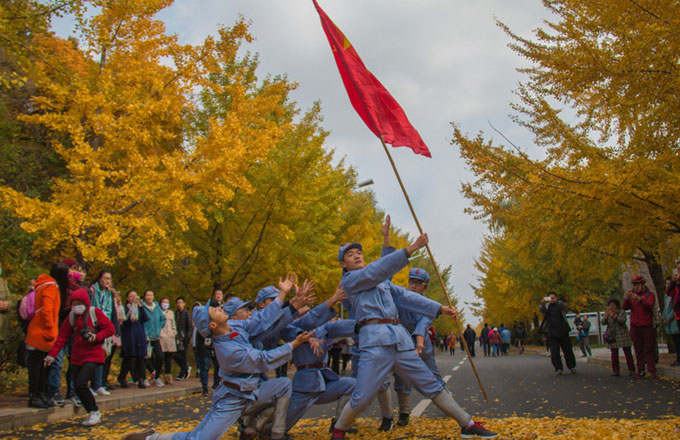
Everywhere you look in Sichuan province there is beauty to be found. From the mountainous landscapes and unique local architecture to the hospitality of the people, every day here brings with it some fresh delight.
Yet as we followed the rough line of the route taken by the Red Army 80 years ago, steadily snaking our way over hills and through valleys further and further from the provincial capital of Chengdu, something else became evident – Sichuan, in its hinterland, is not a rich place.
But everywhere you look there is progress - it can be seen in the newly-built concrete bridges that allowed us to traverse in seconds the rivers and streams that would have proved a major obstacle in the days of the Long March, and in the houses of far flung villages, where residents live in comfort and modern convenience despite their remoteness.
There are also ample efforts being made to stimulate the local economy and give the people a means of making a living that doesn't require them to become migrant workers and leave their place of birth.
On one farm in Lushan county, for example, we saw how cooperation with nearby universities and academic institutes was helping villagers turn a profit by applying the latest scientific methods to the planting of crops and rearing of animals. In 2015, the farm's first year of operation, it made 1.3 million yuan ($194,600) profit and employed around 50 local people. Costs were kept down thanks to government help with the provision of raw materials; while a portion of the kiwifruits, grapes and ducks that the farm produced were given away free to local families.
The following day, we visited Kangyuan eco-sightseeing village - mere kilometres away from the epicenter of a magnitude 7.0 earthquake that struck the region in 2013. In this one village alone, two people were killed, 284 were injured and more than 1,000 homes were destroyed.
With money from the local government, the houses were rebuilt to earthquake proof designs and the village was developed into a tourist attraction, offering holiday cottages for city dwellers. Organic fruit and vegetables are now grown in the fields and greenhouses surrounding the village, with visitors given the chance to pick their own produce, while bed and breakfasts offer wholesome, nutritional meals.
Progress can also be seen in the construction work being doing all along the old route of the Long March. At one point we passed through a tunnel that wasn't yet completed, burrowing through a mountain on an unfinished road with no lights and a metal barricade on one end that had to be swung open to let us through.
The concrete piles of partly constructed bridges were also visible in several places, part of the government's efforts to upgrade the area's infrastructure by building bigger, better roads.
In Baoxing county, an area renowned for its wild pandas, we visited the beautifully named Snow Mountain Village, which had also been badly affected by the 2013 quake, as well as an even larger one that hit the region in 2008. Here, all around, were newly rebuilt homes, guest houses, a visitor center and restaurants for tourists.
We heard how the Party head of a nearby Tibetan ethnic village had used his own money to help others, forsaking the rebuilding of his own house for nearly two years. In an attempt to diversify the local economy away from the rearing of oxen, he had subsequently opened a theme hotel to offer an alternative form of employment and also encouraged farmers to try planting more profitable crops, such as roses, as oppose to the potatoes that were so often uprooted and eaten by the area's roving wild pigs.
In some parts of Sichuan, such as Aba prefecture, large numbers of ethnic Tibetans and Qiang people make up a substantial portion of the population, and we heard how preferential government policies help them to build better lives.
By encouraging tourism, developing the local economy, upgrading infrastructure and providing modern facilities and attractions, all the areas we saw along the route of the famous Long March are being given fresh hope, and a chance to thrive and develop.
In the words of one billboard we spotted along the way, these areas have now become "an important part of the tourism routes in the west of Sichuan province, attracting numerous domestic and foreign tourists every year to enjoy the landscape and remember the Red Army."