|
|
China Daily |
 |
|
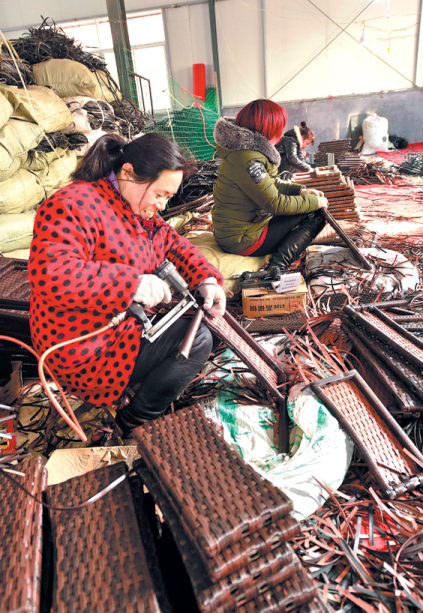
Women make camping stools in a workshop in Juancheng county, Shandong province.[Photo by Ju ChuanJiang/China Daily] |
Local governments are providing jobs for impoverished rural residents by establishing a number of small businesses in villages. Ju Chuanjiang and Zhao Ruixue report from Juancheng county, Shandong province.
The 300-square-meter building with the words "Targeted Poverty-Alleviation Workshop" emblazoned on the white, exterior walls stands in sharp contrast to the brick-built farmers' houses surrounding it.
Inside the building, in Xijie, a village in Juancheng county, Heze, Shandong province, dozens of farmers were sorting hair ready for distribution to wig manufacturers.
Sun Zhangcun was one of them. The 60-year-old's employment options are limited because his left leg was amputated after a traffic accident 17 years ago. Moreover, his wife has advanced rheumatism.
"We can't escape poverty: I'm disabled, so I can't leave the village for work, but I can't shoulder heavy farmwork either," he said, as he skillfully sorted a clump of hair.
In an attempt to solve his problems, Sun took a job at the workshop, which was founded last year by the local government to provide work for underemployed laborers. He earns about 1,000 yuan ($145) a month.
"Now I am useful to my family. I earn my own money, which gives me a sense of dignity," Sun said. Last year, he managed to save more than 3,000 yuan after covering daily necessities and medical expenses for him and his wife.
His workshop is one of 536 that have been established in villages across the county as part of a national campaign to lift farmers out of poverty.
Raising living standards
In 2015, Shandong recorded the third-highest GDP in the country, and the provincial government set the annual poverty level at 3,372 yuan per person.
Last year, 1.5 million people in the eastern, coastal province were lifted out of poverty, and the authorities aim to raise the living standards of a further 2.42 million by 2018.
By 2020, China plans to have eradicated poverty, as defined in 2011 by annual earnings of less than 2,300 yuan per person. On Sunday, at the two sessions, the government announced that it aims to lift a further 10 million rural people out of poverty by the end of this year.
To win the war against poverty, local governments have turned to specific sectors, such as e-commerce, finance, tourism development, relocation and infrastructure improvement.
The workshops in Juancheng provide jobs for the elderly, the disabled, women who need to take care of their parents and children, and others who are unable to leave the village for long periods.
At the end of 2015, Juancheng, located in the mudflats area of the Yellow River, was a designated national-level poverty-stricken county, with 89,600 of its population of 890,000 living below the subsistence line.
"Nearly one-in-10 was living in poverty, which put me under huge pressure," said Gu Ruiling, Party chief of Juancheng, who is responsible for poverty-alleviation in the county.
Gu didn't feel a sense of relief until last year, when a number of workshops had been built in villages across the county, providing an effective way of fighting poverty.
Inspiration
County officials conceived the "workshops model" in November 2015, when they conducted research into poverty-alleviation work in Daitang, a village in the county's Dongkou town.
"We saw several elderly women sorting hair in a shabby 10-square-meter shack made from plastic sheeting and simple wooden boards in a farmer's yard.
An 82-year-old woman told us she enjoyed working in the shack because she could earn hundreds of yuan a month. However, she had to stop working if it rained and the workshop was cold in winter," Gu said.
The sight was a revelation to Gu, who found himself asking: "Why don't we build large, well-equipped workshops in villages to provide more jobs for villagers?"
About six months later, more than 160 workshops had been constructed in villages across the county. Each cost an average of 150,000 yuan to build, so the county finance department provided a subsidy of 100 yuan per sq m and the rest of the money was provided by public organizations and businesses.
The workshops are equipped with modern amenities, including water and electricity, and the operators-mainly businesspeople from large cities, introduced by local governments-can use them as soon as the formalities have been completed.
"We chose to build workshops in places that are easily accessible and convenient for the disabled and the elderly. Locations near kindergartens and schools are best because that makes it convenient for farmers who need to send their kids to school before going to work at the workshops," Gu said.
Daitang resident Li Aiyun is employed in the workshop in her village. She goes to work after sending her grandson to school.
"I can earn some money while taking care of my family," she said, adding that she can earn about 500 yuan a month.
According to Gu, workshop operators are required to obey a stipulation that at least 40 percent of the employees in every workshop are unskilled laborers living below the poverty line. The policy is facilitated by financial support from local governments, such as subsidized loans, to encourage the employment of the worst-off in society.
Training sessions
To provide the new employees with the requisite skills, the local government held 320 training sessions to teach them about industries such as furniture manufacture, hair products, clothing and electrical parts.
To date, 536 workshops have been built in Juancheng, and the initiative has prompted similar programs in other counties. More than 1,800 workshops have been built in villages across Heze, which administers Juancheng, providing jobs for 200,000 farmers, who are able to work near their homes. The move resulted in 57,000 rural laborers being lifted out of poverty last year.
Juancheng is known for hair products and furniture making. For the past three years, the output of the county's hair-product outfits has registered an annual increase of 25 percent.
"Hair-processing enterprises usually need huge workforces. This is the type of work that farmers can easily do and their availability means the employers' labor costs are reduced," Gu said.
According to Fan Jifu, manager of Hongjuyuan Craftwork Co, a hair-processing company, sales hit 220 million yuan last year, a rise of 30 percent from 2015.
He said the business operates nine village workshops and employs more than 700 poverty-stricken farmers at competitive rates: "The workshop model has reduced our labor costs by 20 percent."
So far, 225 companies have been attracted to four industrial parks built by the county to lure hair-processing enterprises.
Meanwhile, the county is encouraging young people who have moved away to return and set up their own businesses.
Li Zhichao, who worked in South China for six years, learned about the workshop model when he returned to Juancheng at the end of 2015 to prepare for the upcoming Spring Festival. Impressed by the initiative, he rented a workshop for 15,000 yuan a year and started manufacturing cables for cellphones.
The workshop was quickly inundated with orders, so Li rented three more. He now employs about 400 people, half of them living below the poverty line.
In addition to providing jobs, the workshops are also generating tax revenue for the local government. Statistics supplied by the Juancheng government show that tax revenue from the furniture making businesses rose by more than 73 percent last year, compared with 2015, while the tax take from hair-processing operations rose by nearly 41.5 percent.
"The workshops provide places where poor farmers can work close to home and make a better living with their own hands, rather than relying on benefits. This year, we will encourage some operators to register as businesses and expand their sales networks through e-commerce channels," Gu said.
Contact the writer at zhaoruixue@chinadaily.com.cn