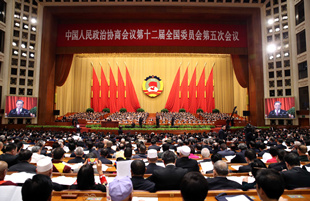
China's 2017 defense budget will expand by about 7 percent, a spokesperson for the annual session of the country's top legislature said Saturday.
"China's military capacity building will be continued. This is the requirement for safeguarding our national sovereignty and security," Fu Ying, spokesperson for the 12th National People's Congress (NPC) annual session, told a press conference.
The new increase could be the country's slowest defense budget rise in at least a decade.
Last year, the country's defense budget rose by 7.6 percent to 954 billion yuan (about 138 billion U.S. dollars), breaking a multi-year run of double-digit increases.
The country's 2016 economic growth registered a nearly three-decade low of 6.7 percent. However, the rate still outpaced most other major economies.
Premier Li Keqiang will unveil the government's GDP target for this year on Sunday. The exact figure for the new defense budget is also expected to be released in a budget report the same day.
At the press conference, Fu said China's defense budget in recent years has been in line with China's economic development and defense needs.
Her words were echoed by Major General Chen Zhou, who said China's defense budget increase is reasonable and moderate against the backdrop of "profound changes in China's overall strength, its security environment and the world's strategic situation."
"A rise of about 7 percent in defense budget is basically in keeping with last year's GDP output," said Rear Admiral Yin Zhuo of the People's Liberation Army Navy.
Yin said China's defense spending per soldier is considerably lower than that of other major countries.
The country's entire defense spending last year accounted for less than a quarter of that of the United States.
Last month, U.S. President Donald Trump pledged to further strengthen his country's military buildup.
In his first address to Congress after taking office, Trump proposed a huge 54-billion-U.S. dollar surge in the country's military spending, up 10 percent from the previous year.
Fu also noted that China's defense spending accounts for only about 1.3 percent of the country's GDP, compared with NATO members' pledge to dedicate at least 2 percent of GDP to defense.
"You should ask them what their intentions are," Fu told reporters, adding that China has "never inflicted harm on other countries."
"Of all the conflicts and wars in the world that have killed and displaced so many people and caused significant loss of property, which one is China to blame for?" she asked.
Yin Zhuo also said China, itself a victim of aggression in the past, would not inflict its own suffering on others.
"We know the price for peace," Yin said.
Concerning disputes between China and neighboring countries, Fu said China advocates dialogue and peaceful solutions in addressing those issues.
"But in the meantime, we must also have the capability to defend our sovereignty, our rights and interests," she said.
"In particular, we must guard against outside forces from interfering with such issues," Fu said without elaborating.
"The enhancement of China's capabilities is conducive to safeguarding regional peace and stability, not the contrary," she continued.
According to Fu, China and some ASEAN (Association of Southeast Asian Nations) countries have already returned to dialogue and consultation, and tensions in the South China Sea have shown trends of easing.
"As to the future development [of the settlement of these disputes], I think we also need to take into account the intentions on the U.S. side," she said, calling the United States' actions in the South China Sea a "weather vane" for the region.
Fu went on to say that concerns over navigational freedom in the South China Sea are misleading and uncalled for.
"In essence ... Washington is perhaps concerned that China could catch up with or surpass the United States in terms of capability," she said, noting that there is still a huge gap between the two countries.
Fu said whether a military poses a threat rests on its "strategic intentions."
"Thus the key question we should really ask is whether we are pursuing common security or exclusive security," Fu said.
"China wants common security for all, and this is the shared consensus of many Asian countries as well," she said.
Related Stories