Accouterments of beauty that tell a dynasty's tale
Song jewelry designers gave us something to sing about
|
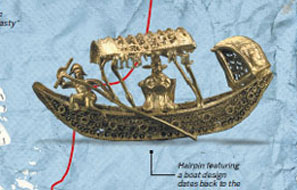
Top from left: Earrings from the Song Dynasty; gold bracelets; scarf weights; the Chinese words inscribed on the hairpin read zi jin zao, meaning made from self-provided gold. Below from left: A gold hairpin from the Song Dynasty features two heads-a gourd and a litchi fruit; phoenix hairpins; gold rings; gold earrings. [Photo provided to China Daily] |

When Shi Chao of the Zhejiang Provincial Museum was busy preparing last year for an exhibition on gold and silver jewelry and wares unearthed in the province, he found a line of words inscribed on a gold hairpin. The words read: zi jin zao, or made from self-provided gold.
"The hairpin is from the Southern Song Dynasty (1127-1279), one of China's most culturally accomplished era," Shi says. "The inscription indicates not only the source of material, but also the fact that the owner of the hairpin may have had a say in its making.
"Usually, a goldsmith produced his designs based on what was in fashion before trying to sell them to a potential buyer. In this case, he may have listened to what his customer had to say before picking up the hammer."
The final result is a combination of popular aesthetics and personal preference. With two flying phoenixes adorning its body, the hairpin widens and bifurcates toward one tip to feature two heads - one a gourd, the other a litchi.
"In traditional Chinese culture, gourd, with its entangled wines, symbolizes productivity, the continuity of a bloodline," Shi says. "The litchi seems to have been directly borrowed from the paintings of the time - an example of how painting, for which the Song era was famous for, had influenced jewelry design."
"While most hairpins from the era feature only one theme - either gourd or litchi fruit for example, this one has two," he continued.
In the exhibition nearly 200 pieces are on display in chronological order from the Tang Dynasty (618-907) all the way to the Ming Dynasty (1368-1644). However, the real emphasis, Shi says, is on the Southern Song period.
"It's impossible to have a deeper understanding of the exhibition without knowing the history of Song, a dynasty cut - both in time and space - into two parts: the Northern Song and the Southern Song."
Relocation
The Song Dynasty was founded in 960. In 1125 war broke out between Song, which had long passed its zenith, and Jin, a rising power set up by the horse-riding Manchus from the north. In 1127 two Song emperors, Huizong and his son Qinzong, were taken prisoners by the Jin army. Deeply ashamed, Song was forced to relocate its court from what is today Kaifeng city in central China to what is now Hangzhou, then called Lin'an, in southeastern China. The surrounding region is known as Jiangnan, meaning "area south of the Yangtze River".
The removal of the capital signaled the loss of control on Song's part of the vast land in central China. A return was never seriously discussed; successive Song emperors seemed to be equally impressed with the richness of their adopted home as they were with their enemy's military might. The regional culture, famed for its strong literary tradition, suited the artistically minded Song emperors very well.
Although on the defensive most of the time, Southern Song was not without military triumph in its continued wars with Jin. For the next hundred years the retreat and its surrounding region south to the Yangtze River enjoyed a period of peace and prosperity. Population expanded and arts and crafts flourished.