Striving to keep a New Year tradition alive
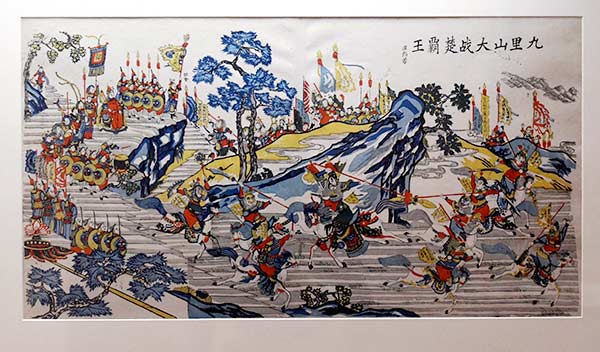
A Taohuawu New Year woodcut print of the Qing Dynasty (1644-1911) on display at a Taohuawu nianhua exhibition held in Suzhou, Jiangsu province in November. [Photo/Xinhua]
Elderly craftsmen fear for future of their art, a part of China's intangible cultural heritage that is fast disappearing
Spring Festival is supposed to be a joyous occasion, but it has left Fang Zhida, 83, anxious. Days before the Lunar New Year, he locked himself in his studio to focus on an ancient folk art.
Taohuawu New Year woodcut prints, or nianhua, are a type of traditional art that people put on their doors to ward off evil and express good wishes for Chinese New Year.
But in recent years, business has been poor, leaving Fang worried that his beloved craft may eventually die out.
The craft was born on Taohuawu street in Suzhou, Jiangsu province.
It involves a craftsman drawing a sketch on a piece of paper before carving it on to a set of boards and painting it. The print is complete once the boards are pressed onto a piece of paper or other surface.
The art, which dates back more than 350 years, was added to China's intangible cultural heritage list in 2006.
Fang began learning nianhua at age 14, and describes it as the love of his life.
Since 2004, he has been teaching the traditional printing technique at the Taohuawu Woodcut New Year Print Society. Four students are chosen every two years, with 28 students graduating so far.
"It is important that we introduce the art to the young and pass it down," he said.
From painting to woodcutting and printing, it can take as little as a week or as long as a year to finish a single piece, and if any mistakes are made then the whole thing must be redone from scratch.
"Printing one piece after another all day long can be very tiring," Fang said.
"So, you must be really interested in it, be hardworking, and you need to handle loneliness very well."
Some of Fang's students are building on the master's techniques and looking to innovate to appeal to a wider audience.
Fu Xiangpeng, 31, has designed a series of products with New Year prints on them, such as fans, plates and lucky red envelopes.
"We hope the products will be popular, but we must not lose the essence of the art," Fang said.
In 2006, a museum was opened that aims to preserve the art. Wang Zude, 77, serves as its senior adviser.
He encourages his students to innovate and create new prints, teaches nianhua on weekends and tells primary school students stories about it.
"Kids love stories, and the stories behind the art help shape a sense of our own cultural identity," Wang said.
In 2012, he designed a series of New Year prints for the 12 zodiac signs, to appeal to a younger audience.
Suzhou No 1 Middle School has offered selective courses teaching local traditional art, such as New Year prints and Kunqu Opera, since 2010. Students from the United States have come to learn at the school every summer since 2014.
Wishes and worries
Fang's biggest wish is to teach as many students as he can.
"A New Year print craftsman now earns around 50,000 yuan ($7,270) a year, not enough to make a decent living," he said.
Of the 28 students Fang has taught in the past decade, only 10 have chosen to continue with the craft, and in Suzhou, only about a dozen craftsmen are still in the trade.
When exhibitions are held at home and abroad, few people show interest in actually learning the art, Fang said.
"It is more important that we attract more people to learn it and devote themselves to Chinese cultural heritage," he said.
According to the local heritage protection office, half the inheritors of intangible cultural heritage are now older than 65.
"Our own awareness of our culture should be raised to better protect and pass down intangible cultural heritage," said Wang Yan, deputy director of the office.
A local regulation came into effect in Suzhou this week to preserve endangered intangible cultural heritage.
A national project is also under way to collect historical materials and build archives for 100 folk arts, including Taohuawu New Year printing and Thangka, or Tibetan scroll painting.
"We must pass down the arts that our ancestors gave us," Fang said.