White paper sets out China's vision as a space power
 |
|
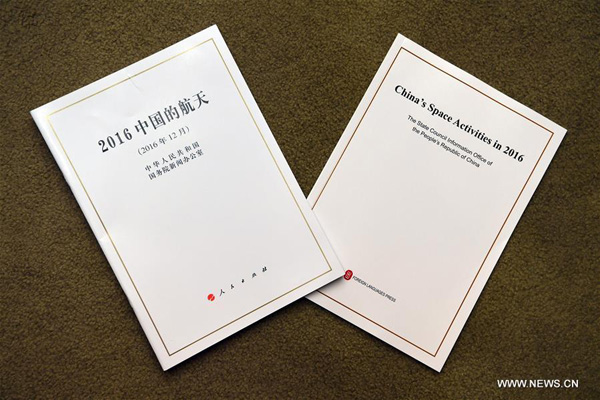
Photo taken on Dec 27, 2016 shows the white paper, titled "China's Space Activities in 2016," issued by the State Council Information Office in Beijing, capital of China. [Photo/Xinhua] |
BEIJING -- China aims to become a space power, according to a white paper on the nation's space activities issued on Tuesday.
The white paper, titled "China's Space Activities in 2016," was the fourth white paper on the country's space activities issued by the State Council Information Office, following the previous three in 2000, 2006 and 2011.
"The white paper sets out our vision of China as a space power, independently researching, innovating, discovering and training specialist personnel," said Wu Yanhua, deputy chief of the China National Space Administration at a press conference.
China's space industry took off 60 years ago and April 24 was declared National Space Day in 2016 as a focus for pioneering spirit and enthusiasm for innovation, Wu said.
PEACEFUL USE OF SPACE
China always adheres to the principle of the use of outer space for peaceful purposes, and opposes the weaponization of or an arms race in outer space, the white paper said.
The country develops and utilizes space resources in a prudent manner, takes effective measures to protect the space environment to ensure a peaceful and clean outer space and guarantee that its space activities benefit the whole of mankind.
In the next five years and beyond China will uphold the concepts of innovative, balanced, green, open and shared development, and promote the comprehensive development of space science, space technology and space applications, so as to contribute to both serving national development and improving the well-being of mankind, according to the white paper.
RAPID PROGRESS SINCE 2011
The new developments are "manifested by markedly enhanced capacity in independent innovation and access to outer space," and "constant improvement in space infrastructure," said the white paper.
The progress is also evidenced by "smooth implementation of major projects such as manned spaceflight, lunar exploration, the BeiDou Navigation System and high-resolution earth observation system, and substantial achievements in space science, technology and applications."
According to the white paper, "the Long March carrier rocket series completed 86 launch missions, sending over 100 spacecraft into target orbit" from 2011 to November 2016.
In September and October 2016, the Tiangong-2 space laboratory and Shenzhou-11 manned spacecraft were launched and formed an assembly that operates steadily, with the mission of carrying out science and technology experiments in space, the white paper said.
The mission indicates that "China has mastered technologies concerning astronauts' mid-term stay in orbit, and long-term ground mission support," according to the white paper.
TASKS FOR NEXT FIVE YEARS
China will continue its lunar exploration project in the next five years, and strive to attain the automated extraterrestrial sampling and returning technology by space explorers.
Around 2018, the nation will carry out the Chang'e-4 mission to achieve the first soft landing of mankind's probe on the far side of the moon.
The Chang'e-4 lunar probe will "conduct in situ and roving detection and relay communications at earth-moon L2 point."
China plans to launch its first Mars probe by 2020 and grasp key technologies for orbiting, landing and roving exploration.
It will conduct further studies and key technological research on the bringing back of samples from Mars, asteroid exploration, exploration of the Jupiter system and planet fly-by exploration, according to the white paper.
China plans to form a BeiDou network consisting of 35 satellites for global navigation services by 2020, and to start providing basic services to countries along the Silk Road Economic Belt and 21st-century Maritime Silk Road in 2018.
China will activate the heavy-lift launch vehicle project in next five years, according to the white paper.
"Endeavors will be made to research key technologies and further study the plans for developing heavy-lift launch vehicles," said the document.
Breakthroughs are expected in key technologies for the overall system, high-thrust liquid oxygen and kerosene engines, and oxygen and hydrogen engines of such launch vehicles.
INT'L COOPERATION
Since 2011 China has signed 43 space cooperation agreements or memoranda of understanding with 29 countries, space agencies and international organizations.
China has taken part in relevant activities sponsored by the United Nations and other relevant international organizations, and supported international commercial cooperation in space. These measures have yielded fruitful results.
In the next five years China will conduct extensive international exchanges and cooperation concerning space in several key areas, such as construction of the BRICS remote-sensing satellite constellation, and construction of the Belt and Road Initiative Space Information Corridor.
Moreover, cooperative researches on space law, policy and standards and personnel exchanges will be further enhanced in the space field.
"China always adheres to the principle that international exchanges and cooperation should be strengthened on the basis of equality and mutual benefit, peaceful utilization and inclusive development." the white paper said.