Giving sick children dignity in death

Suspicion and fear
Morphine is a sensitive word in contemporary Chinese culture. It is strongly associated with addiction and therefore arouses suspicion and fear.
"It's no exaggeration to say that in past decades the prejudice the Chinese medical world has long held against morphine has resulted in a tremendous amount of pain for patients. That pain that could have been tamed by the well-guided administration of drugs," Zhou said.
She believes that children, especially very young children, bear the brunt of this prejudice. "Despite a common misconception, children actually have a much higher tolerance of physical pain and complain much less than adults. That's partly because they are more easily distracted and therefore less focused on their suffering.
"It's not unusual to see a child fall asleep after crying out in pain for some time," she said. "This has led many to believe that the child isn't suffering 'that much' or that the pain is relatively short-lived. In fact, neither is true," she said.
According to Zhou, before the end of 2014, morphine was only available via injection at the Beijing Children's Hospital, one of the best of its kind in China. "At my insistence, in early 2014, our hospital introduced morphine pills. That was a huge step forward since it allowed morphine to be used by outpatients at home as a prescription drug," she said. "If you listen to the World Health Organization, there's no better place to have a peaceful death than at home."
Sun Yang, a volunteer with Zhou's team, has firsthand experience of that: "I once drove a 13-year-old girl and her family to the railway station. The girl had terminal blood cancer, and had entered the countdown of her life. She had been very cooperative and very quiet during her stay at the hospital. But on that homecoming day, I could see that excitement had tinted her cheeks."
But not every child has a home to return to. That's why Gould, who has been interested in China since childhood, opened the Butterfly Home, where the team tries to imbue vitality in children with "no life in their eyes" when they arrive "shocked and devastated" after being abandoned.
This is despite the fact that the majority of the children will die, Fu, the director said. "Most of them have multiple illnesses and complications with no medical solutions. Over the past six years we have cared for more than 176 babies and children - sadly, more than half of them had conditions where they could not have a long life" she said. "Death doesn't diminish the meaning of what we do - it increases it."
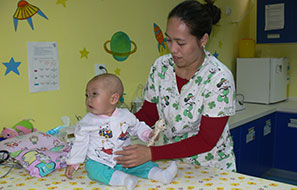
The carers' daily routine involves feeding, massaging and a lot of hugging and play-kissing. The carer-to-child ratio is kept at 1-to-3 at all times to make sure that each child - there are currently 15 in the home - enjoys enough love and attention to develop the kind of emotional bond essential to their well-being. Meanwhile, the hospice's four trained pediatric nurses are always ready to react to changes in a child's condition. "No two days are the same at Butterfly," Gould said.
Respect
Gould believes the home's success is underpinned by an understanding and respect of local culture, and a willingness to be patient before real change starts to take place. "At first, even our Chinese nannies who loved the children would refuse to be near a dying child. But slowly, as they came to recognize the child as a real person and love them, they began to want to be with them in their last hours, holding them, singing to them and grieving for them when they had gone," she said.
She is nonjudgmental when it comes to the issue of abandonment: "I have seen so many children who were obviously loved by their families and were abandoned simply because the family could not get the care and support needed to keep them, make them comfortable and cope with their deaths."
Zhou, from the Beijing Children's Hospital, has experience of the ordeals that dying children and their families go through.
"A few years ago, after the death of a 10-year-old girl at midnight, her mother, despite her suffocating grief, bowed deeply to everyone of us, thanking us for allowing her to stay until the last minute," she said. "People are so afraid of being 'driven' from hospitals because no support - medical or emotional - is available once they are outside."
Since 2014, Zhou's team has tried to fill the void by making follow-up phone calls to patients, many of whom are approaching death and have been "persuaded" to leave hospitals because active treatment is no longer meaningful.
"We try to listen to them and offer advice on pain control - we give patients morphine pills and advice before they leave the hospital," Zhou said. "The most-asked question is: Will my child die a horrible death?"
In March last year, Zhou used money donated by the public and businesses to rent a 100-square-meter space a few minutes' walk from the Children's Hospital. There the children can read and play with volunteers while their parents take a yoga class or a counseling session with professional psychologists. "Children are little sponges capable of absorbing any mood from those around them, including anxiety and despair. If we are genuinely concerned about the children, we have to take care of their parents."
Zhou has helped to establish the Chinese Children's Palliative Care Work Group, comprising like-minded medical professionals from 31 public hospitals in China. "Apart from sharing experiences, I can also refer some of my terminally ill patients to hospitals within our work group located in smaller cities. They are not as crowded as ours and can offer a more relaxed environment for palliative care."
A heavy toll
Last winter, the father of a 13-year-old who had been receiving treatment for four years in Zhou's department asked her to talk with the dying boy. "He had a serious relapse after a stem cell transplant. Both the doctors and the parents knew it was the end," she said. "But the boy was adamant about surviving. In fact, his refusal to reconcile with reality and his insistence on continuing treatment at all costs - financial, physical and mental - ravaged those who loved him.
"The boy was quite sensitive - so sensitive that he must have guessed why I had turned up in his little room. The first thing he said was: 'Nothing is worse than giving up hope'. I didn't blame him. I believe that a patient's wishes should always be respected, but I also realize that a lack of proper education about death has exerted a heavy toll."
Katie Hill, head nurse at the Butterfly Home, found solace in the last hours she spent with Sophie, a 10-month-old girl who had "a large, aggressive cancer that caused her face to swell".
"One weekend, she spent her nights not in her crib, but snuggled in bed with me in the treatment room," Hill said.
"On her final morning, she woke early after a comfortable night. We cuddled in bed while waiting for the rest of the house to stir. We listened to music, and Sophie gazed steadily into my eyes. She was alert, calm and unafraid," said Hill, who has a bachelor's degree in Children's and General Nursing. "Somehow Sophie understood that her suffering was almost over. That quiet morning was a sacred goodbye before she went."
The girl died an hour later, but Hill has no doubts that she's "still shining". "Throughout Sophie's short life, her light never grew dull in spite of everything she suffered," she said. "We are blessed by that light."
Contact the writer at zhaoxu@chinadaily.com.cn