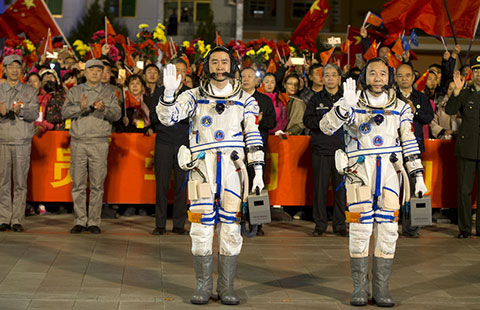
China launches longest-ever manned space mission
JIUQUAN - China on Monday successfully launched manned spacecraft Shenzhou-11 carrying two astronauts who will remain in space for 33 days, the longest mission in the country's manned space program to date.
Shenzhou-11, China's sixth manned spacecraft, will dock with space lab Tiangong-2, marking a step closer to its space station ambitions.
The spacecraft was launched at the Jiuquan Satellite Launch Center in northwest China's Gobi desert at 7:30 a.m. Beijing time Monday with a Long March-2F Y11 carrier rocket.
The spacecraft has entered its designated orbit.
The launch was declared a success by Zhang Youxia, commander-in-chief of China's manned space program, about 19 minutes after the blast-off.
President Xi Jinping sent a message of congratulations for the successful launch, expressing the hope that "Chinese people will take bigger steps and march further in space probe, to make new contribution to the building of China into a space power."
After docking with Tiangong-2, the astronauts will enter the space lab and stay there for 30 days.
The two astronauts are commander Jing Haipeng, a 50-year-old veteran who participated in the Shenzhou-7 and Shenzhou-9 missions, as well as Chen Dong, 38, who is on his first space mission.
A ceremony to see the two astronauts off was held at the Jiuquan Satellite Launch Center ahead of the launch on Monday morning.
In an interview with Xinhua, Chen said he was inspired by his idol, China's first astronaut Yang Liwei, to become one of the country's elite space explorers.
Tiangong-2 was launched into space on Sept. 15. The rendezvous will happen at an orbit about 393 kilometers above Earth, the height at which the future Chinese space station will operate.
Wu Ping, deputy director of China's manned space engineering office, said at a press conference Sunday that Tiangong-2 has already reached its preset orbit 393 km above the earth, adding it is in stable and normal condition and can meet the requirements for docking with Shenzhou-11 and accommodating astronauts.
The mission aims to transport personnel and materials between Earth and Tiangong-2, and test rendezvous, docking and return processes.
Other objectives include aerospace medical experiments, space science experiments and in-orbit maintenance. Astronauts will conduct three experiments designed by middle school students from Hong Kong, including raising silkworms in space.
Jing and Chen will also be special correspondents for Xinhua, sharing their work and life in space via text, photo, audio and video through Xinhua's global media services.
After that, Shenzhou-11 will undock from Tiangong-2 and return to Earth within one day.
During their 30 days in the space lab, astronauts will work eight hours per day, six days a week, according to the Astronaut Center of China.
"It is synchronized with the sleep-wake cycle on the Earth and marks a transitional design to long-term flight in a space station," said Huang Weifen, deputy chief designer of the astronaut system with the center.
As the last manned space flight before China's space station mission, Huang said Shenzhou-11 offers a precious opportunity to verify the technology needed to support astronauts' life, health and work, as well as to gather data for the space station mission.
The astronauts will have access to almost 100 kinds of food, contact with Earth through video, audio and emails and exercise through a stationary bike and treadmill.
The mission will prove China's capability to carry out a medium-term manned space mission.
In June 2013, three astronauts spent 15 days in space with the Shenzhou-10 mission, which docked with Tiangong-1, the predecessor of Tiangong-2.
Zhang Yulin, deputy commander-in-chief of China's manned space program, said Shenzhou-11 marks the imminent end of the exploratory stage of China's manned space program. The program will carry out manned space missions on a regular basis with the establishment of its own space station.
China's space station, which is expected to debut around 2020, may become mankind's only foothold in space when the International Space Station retires in 2024.




- Facts about the 6th plenary session of the 18th CPC Central Committee
- Palace Museum to build new branch in northern Beijing: curator
- Military blind date attracts hundreds young women to attend
- Britain's Red Arrows arrive at Zhuhai for China air show
- How well do you know world's largest political party CPC?