|
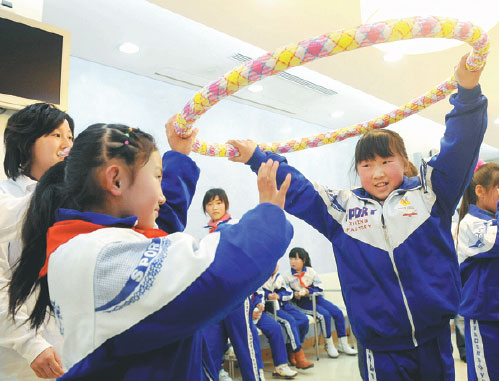
Volunteers play games with students from Beijing Zhiquan School in December 2009. Yuan Zhou / For China Daily |
Student numbers decline
Qin, of Beijing Zhiquan School, which was also founded to educate migrant workers' children, said many similar schools will close as more migrant workers leave the city.
The impact has been noticeable for several years, and student numbers have fallen to about 500 since 2014, when one of the school's two campuses was demolished for urban development.
"Students usually quit school before their parents leave Beijing," he said. "They return to their hometowns and continue their education while their parents make preparations to leave the capital."
In the past two years, the stringent entry requirements have resulted in Qin's students finding it increasingly difficult to register with the compulsory education system, so most of the students at grades one and two are unregistered. That means most will be ineligible for enrollment in the capital's middle schools when the time comes, he said.
A report published by the 21st Century Business Herald said that in 2014 about 60,000 migrant children in Beijing's primary schools were unregistered, he said, adding that although the schools are getting bigger, the number has fallen to about 100 from nearly 500 in 2004.
Yi Benyao, principal of Xingzhi Experimental School in the Haidian district, said the students are finding it much harder to register in Beijing, and the number of schools for migrant children has declined at a "dramatic rate" in recent years as a result of demolition programs and the transfer of migrant workers to areas near the capital.
Xiong Bingqi, vice-president of the 21st Century Education Research Institute in Beijing, has spent many years conducting research into the education of migrant children. He said the entry requirements in urban schools nationwide were progressively eased from 2008, when the central government released policies to allow migrant children to be educated in the cities in which their parents worked.
However, in the past few years, the admission policies have been tightened again. Guidelines released by the Beijing Municipal Commission of Education in 2012 stipulated that students without Beijing hukou, including those from migrant families, must provide five documents to be admitted for compulsory education in the capital.
In theory, five documents, including the parents' temporary residence permits and work permits, should be sufficient, but in reality parents often have to submit many more - sometimes as many as 28 - and sometimes it can take years to assemble the required paperwork.
Xiong believes the tightened policies are the result of population-control programs in cities such as Beijing and Shanghai, which are concerned that they may be flooded by migrants if the enrollment threshold is lowered, thus increasing the burden.
Chu Zhaohui, a senior researcher at the National Institute of Education Sciences, said national education policies stipulate that local governments should pay students' fees during the period of compulsory primary and junior middle school education, and financial pressures mean many urban schools are reluctant to accept migrant children.
"However, if the children follow their parents to a city in a different province and receive compulsory education there, the government of the city in which they reside is obliged to bear the expense, rather than the city they came from. So, to avoid great financial pressure, these cities have raised the entry bar to control the number of migrant children who enroll," Chu said.


Copyright 1995 - . All rights reserved. The content (including but not limited to text, photo, multimedia information, etc) published in this site belongs to China Daily Information Co (CDIC). Without written authorization from CDIC, such content shall not be republished or used in any form. Note: Browsers with 1024*768 or higher resolution are suggested for this site.
License for publishing multimedia online 0108263 Registration Number: 130349