BEIJING - With China's 13th Five-year Plan beginning next year, the focus of reform will start with addressing the quality of ordinary people's lives.
At the latest meeting of the central leading group for comprehensively deepening reform on Wednesday, the leadership decided to implement the five development ideas put forward at the plenary session of the Communist Party of China (CPC) Central Committee in late October: innovation, coordination, sharing, environmental protection and openness.
At the beginning of the 13th Five-year Plan, efforts need to be "focused on building a moderately prosperous society," said a statement issued after Wednesday's meeting.
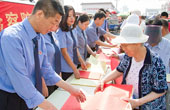
The group approved several reform measures, one of which is that unregistered citizens are to be given household registration permits known as "hukou," a crucial document entitling them to social welfare.
China has around 13 million unregistered people, one percent of the entire population. They include orphans and second children born illegally during the period of strict enforcement of the one-child policy, the homeless and those who have yet to apply for one or who have simply lost theirs. Those parents who violated family planning policy often refrained from getting hukou for their children to avoid fines.0 "It is a basic legal right for Chinese citizens to register for hukou. It is also a premise for participation in social affairs, to enjoy rights and fulfill duties," the statement said.
Wan Haiyuan with an institute of macro-economics of the National Development and Reform Commission said the difficulty lies not in hukou itself, but in related matters such as healthcare, health insurance and education.
In China, various social benefits such as medical insurance and access to basic education are based on this permit and are supposed to be in line with long-term places of work and residence.
Many people without household registration have moved to cities and become tramps. According to Wan, their birth certificates might have been lost and authorities must address this issue. Those who have come to China to seek asylum should also be taken into consideration, as they are permanent residents, despite their lack of Chinese nationality.
Education is also central to plans for the next five years, said Zhang Li, director of the Ministry of Education's development center. The reform meeting statement declared that education should advance innovation-driven development and serve the objectives of the Belt and Road Initiative.
Zhang added the statement showed that opening up in education should take the concepts and experience of developed countries as reference.
The meeting decided to integrate basic medical insurance for urban employees and the new rural cooperative medical scheme, creating a unified basic health insurance system.
Currently China has three separate medical insurance schemes -- basic medical insurance for urban employees; the new rural cooperative medical scheme; and basic medical insurance for city dwellers not covered by the first two schemes, mainly the young or unemployed.
The three schemes have been perceived as unequal for a long time, as the benefits in urban areas are much greater than those in rural parts of the country.
"Even members in one family may have different health insurance," said Meng Qingyue, a professor in health economics with the Peking University. "The integration of different medical insurance schemes is a must for achieving equal access to basic health care for every one."
Another measure is the reform of government's "power list." Since the 18th National Congress of the CPC in late 2012, administrative powers have been streamlined and delegated, with hundreds of items abandoned.
Ma Qingyu of the Chinese Academy of Governance said the power and responsibility list system can clarify responsibilities of different departments and prevent them from shirking their responsibilities or taking responsibilities that are not rightfully theirs.
"It will make the border between public powers and private rights more clear," said Ma.


Copyright 1995 - . All rights reserved. The content (including but not limited to text, photo, multimedia information, etc) published in this site belongs to China Daily Information Co (CDIC). Without written authorization from CDIC, such content shall not be republished or used in any form. Note: Browsers with 1024*768 or higher resolution are suggested for this site.
License for publishing multimedia online 0108263 Registration Number: 130349