|
|
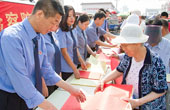
Music therapist Wang Lujie (second from left) and her colleagues are on their way to a session in Chengdu, Sichuan province. YU PING/CHINA DAILY |
A government program is seen as helping lonely elderly and children in need, Huang Zhiling reports in Chengdu, Sichuan province
Nearly a dozen elderly men and women sat in a circle shaking maracas and beating bongo drums while three young women musicians hummed a song. After the song had ended, one of the older women asked guitarist Wang Weijia to create a song about a grandmother and her granddaughter.
Having thought for while, Wang came up with a song about how a grandmother bought paper and a painting brush for her granddaughter to make an artwork.
The men and women in their 60s and 70s applauded in appreciation of Wang's wit.
The scene was from a hall of the Yulin Donglu Neighborhood Committee in Chengdu in Southwest China's Sichuan province, where people gathered last month for a music therapy session offered by the Yueling Center for the Development of Philanthropy, a rare organization in the area that specializing in such therapies. The center was set up two years ago by Wang Lujie, a 31-year-old teacher from Sichuan Conservatory of Music.
A native of the province's Dazhou city, Wang Lujie started to play the piano at age 5, and studied the instrument in Sichuan Normal University from where she graduated in 2006. At the time, Beijing's Central Conservatory of Music began to recruit postgraduate candidates for their music therapy courses.
"When I was a sophomore, I had a rare disease in my right arm which would be detrimental to my career as a pianist," Wang Lujie told China Daily at the Chengdu event. "So, I applied to Central Conservatory of Music and became a candidate for their music therapy program."
Before she got her master's degree, Wang Lujie had served as a volunteer for a month in the aftermath of a devastating earthquake in Sichuan's Wenchuan county in 2008. She and her classmates from the central conservatory tried to offer some relief with their music classes to young children at camps for the victims.
She recalled a particular 6-year-old boy whose mother had died in the quake. And while the traumatized child wouldn't speak with other people until after two months of the quake, he liked attending the classes. When he became familiar with Wang Lujie, he cried aloud one day, finally narrating the story of his mother's death. "Having talked about the incident, he may have felt better," Wang Lujie said.
After working in Sichuan Conservatory of Music, she offered free music therapy for three years to youngsters staying at Chengdu Center for the Protection of Minors, a facility under the city administration. Music therapy means more than just singing or playing music. It is multidisciplinary and involves music and psychology, with teachers and psychologists often using songs and music as topics for conversations with students or patients.
Wang Lujie met a teenager at the center who couldn't get along with his mother and left home. While discussing his favorite music, Wang Lujie discovered his favorite song was one in praise of mothers, although his own mother was "strict" with him. She told him that his mother must have undergone hardships while raising him. This made him see his mother in a different light and he returned home, assisted by center officials.
Wang Lujie and her colleagues have also noticed that a few autistic children could remember cellphone numbers of their respective mothers and their own birthdays by using songs.
The Yulin Donglu community in Chengdu is home to 1,100 people, of whom more than 100 are too old to live alone. "The old people did not mingle with others. Thanks to the music therapy once a week, many are able to socialize now," said Yang Jinhui, a community official.
She cited the example of Zeng Fanhui, an 80-year-old pensioner who lives alone because his son and three daughters are not in the city, and he fails to communicate with his neighbors. "He is happy due to exchanges with others during the therapy session," Yang said.
According to Gao Tian, a professor at Central Conservatory of Music, the field of music therapy opened up for research in the United States in the 1940s. It started to become relevant in China in 1997.
He said he hoped the government-backed therapy model in Chengdu is introduced in other parts of the country as well.
Contact the writer at huangzhiling@chinadaily.com.cn


Copyright 1995 - . All rights reserved. The content (including but not limited to text, photo, multimedia information, etc) published in this site belongs to China Daily Information Co (CDIC). Without written authorization from CDIC, such content shall not be republished or used in any form. Note: Browsers with 1024*768 or higher resolution are suggested for this site.
License for publishing multimedia online 0108263 Registration Number: 130349