10 in Belt and Road Initiative interested in Chinese programs
 |
|
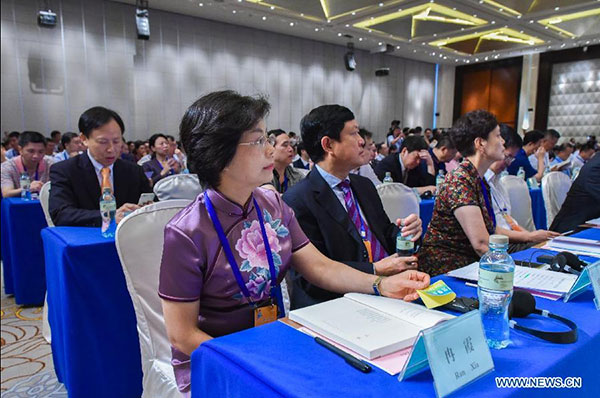
The eighth China-ASEAN Education Cooperation Week opened in Guiyang, capital of Southwest China's Guizhou Province, Aug 3, 2015.[Photo/Xinhua] |
Countries involved in China's Belt and Road Initiative welcome China running schools in their areas, but difficulties exist, education officials and other experts said on Tuesday.
The initiative launched by President Xi Jinping is aimed at promoting economic and cultural ties with neighboring countries.
More than 10 countries involved have expressed an interest in China running schools or education programs on their territory, according to an Education Ministry official.
Yan Bingchen, from the ministry's International Cooperation and Exchange Department, was commenting during the eighth China-ASEAN Education Cooperation Week.
The weeklong event opened on Monday in Guiyang, capital of Guizhou province.
The cooperation week, which acts as an exchange and communication channel between China and the Association of Southeast Asian Nations, has been held annually in the city since 2008.
Yan said countries involved in the Belt and Road Initiative, including Egypt and Jordan, have invited Chinese schools that specialize in vocational training to open branches and programs.
"When we visited Egypt in March, education officials told us that many items that Egyptian people use every day, such as mobilephones and automobiles, are made in China.
"So, local people hope Chinese universities, especially those specializing in applied technologies, can open branches to teach local students," Yan said.
Wuhan Textile University, which specializes in textile engineering and garment design in the capital of Hubei province, is preparing to open a school under a private university in Bangladesh and plans to recruit students from next year.
Wei Yiliang, president of the Wuhan university, said, "Education officials in Bangladesh invited us to ... pass on China's rich experience in the textile industry and to help Bangladesh cultivate talent in the industry."
Yan, the education ministry official, said China has four educational institutions and 98 education programs running overseas, a majority of which are in Southeast Asian countries.
The popular majors at these institutions and their programs reflect some of China's strengths, such as Chinese medicine, language and traditional culture, Yan said.
But he added that there are some obstacles to be overcome in running educational institutions and programs overseas. The lack of teachers who can speak Chinese and local languages is one of them.
Wang Jiexian, vice-president of Soochow University in Vientiane, capital of Laos, said it is planning to cut costs by gradually introducing a localization policy.
"We plan to select some of the best Laotian students at our universities, offer them the chance to study for Chinese-language and postgraduate degrees in China and then recruit themas teachers at our university in Laos," he said.
The Soochow university is one of four from China that have overseas branches, the other three being Xiamen University in Malaysia, Beijing Language and Culture University in Japan and Yunnan University of Finance and Economics in Thailand, Yan said.
Wei said financial issues are another major difficulty, and the cost of running an educational institution in Bangladesh is quite high.
"Although Chinese textile enterprises in Bangladesh-which need industrial talent offered some financial support, it was far from sufficient," Wei said, adding that he hopes the Chinese government can set up some special funds to support Chinese universities operating abroad.
Dong Xianwu and Zeng Jun in Guiyang contributed to this story.
Contact the writers at zhaoxinying@chinadaily.com.cn


Copyright 1995 - . All rights reserved. The content (including but not limited to text, photo, multimedia information, etc) published in this site belongs to China Daily Information Co (CDIC). Without written authorization from CDIC, such content shall not be republished or used in any form. Note: Browsers with 1024*768 or higher resolution are suggested for this site.
License for publishing multimedia online 0108263 Registration Number: 130349