|
|
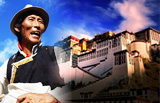
Olo Tsering carves mantras in his workshop, a skill he describes as a valuable gift from his ancestors.[PALDEN NYIMA/CHINA DAILY] |
Travelers to the Tibet autonomous region often come across piles of stones inscribed with scriptures and Buddhist images.
These Mani stones are the work of Tibetan craftsmen such as Olo Tsering, who spends his days focused on meticulously carving a religious mantra on stacks of stone plates.
When Tibetan nomad Tashi Penpa commissioned the mantra Yikgya, Olo Tsering took four days to complete it.
The 46-year-old craftsman has spent 30 years working on religious carvings. He considers his skill to be a valuable gift to him from his ancestors, and he strives to pass it on.
In early March, Tibetans revel in celebrations to mark the Tibetan New Year Festival. Many temples welcome flocks of pilgrims during this time, and prayer-stone carvers see it as an opportunity to sell their work.
"As people get wealthier, the demand for prayer-stone carving is also increasing," Olo Tsering said.
He comes from the Yushu Tibetan autonomous prefecture in Qinghai province. Yushu boasts the world's largest prayer-stone pile of its kind, the Jana Mani Heap.
Olo Tsering headed to Tibet's regional capital of Lhasa two decades ago. He dabbled in various kinds of work before finally choosing to focus on prayer-stone carving.
His pieces include various Buddha images and Tibetan scriptures, such as the famous Om mani padme hum and the mantra of the bodhisattva of compassion, Avalokiteshvara, which are important parts of Tibetan culture.
"I am the third-generation prayer-stone carver in my family, and I hope this tradition will last forever," he said.
Olo Tsering said he has trained more than 10 apprentices, including his son.
"Prayer-stone carving dates back about 1,300 years. It is like a venerable river, and I don't want see to it drying up one day," he said.
Olo Tsering's son is in middle school, and he trains him during the school holidays.
It takes about two years to become a qualified prayer-stone carver, he said.
"Learning how to carve the scriptures requires at least two months. It takes two years for the images," he said.
OloTsering said carvers also have to be religious. They must wish to inherit the traditional art, be able to read and write, and work diligently.
A short mantra of four to six syllables takes several minutes to complete.
"The shortest mantra has four syllables, and I can carve 300 to 400 plates in one day," he said.
Carving a long mantra takes more time and energy. He can carve four to five pageswithin a day. In the past, the stones were carved by hand, but craftsmen now also use machines.
Carving a 142-page mantra requires 160 stacks of stone plates, Olo Tsering said. It takes more than three months by hand but about 26 days using a machine.
The Lhasa Kyagyur Chenmo took 16 years to complete, and dozens of carvers took part in the project. Olo Tsering was involved for two years.
Demand for stone carvings and an efficiency in producing them are both increasing, although Olo Tsering said using more machines means the quality of the work has been affected.
Tibetans usually place the prayer stones on a fixed pile, at places where Tibetans circumambulate religious relics in a clockwise direction. They also order prayer stones to pray for world peace and all living beings.
Olo Tsering said he takes great pleasure from his work because he is passing on an ancient tradition, and he also considers it as a way to accumulate virtue.
"I have to make a brighter path for my next life, and I consider carving mantras to be the same as reading them," he said.
"I never feel tired. The more I carve, the more mantras I read."
Contact the writer at palden_nyima@chinadaily.com.cn


Copyright 1995 - . All rights reserved. The content (including but not limited to text, photo, multimedia information, etc) published in this site belongs to China Daily Information Co (CDIC). Without written authorization from CDIC, such content shall not be republished or used in any form. Note: Browsers with 1024*768 or higher resolution are suggested for this site.
License for publishing multimedia online 0108263 Registration Number: 130349