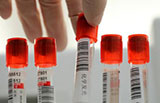
Improved HIV screening procedure will lower risk of infection from transfusion
As 5-year-old Maomao and her family struggle to live with the HIV she got via a blood transfusion, China's top HIV/AIDS specialist revealed that each year about 10 people suffer the same plight due to limitations of screening technology.
Wu Zunyou, head of the National Center for AIDS/STD Control and Prevention, told China Daily that despite gradual updating to the far more sensitive RNA-based HIV screening at the nation's blood banks, the risk of contracting blood-borne diseases like HIV/AIDS and hepatitis C still exist for blood transfusion recipients.
Volunteers' blood donations in China are required to go through such tests before use to ensure safety.
In Maomao's case, the local health authority in Fujian province announced over the weekend that she got infected by receiving blood from someone recently infected with HIV, and the test couldn't detect the virus.
Maomao, who has congenital heart disease, was found to be carrying the virus during a physical exam in September.
After her parents were cleared of HIV infection, the only source of infection the parents could think of pointed to an operation involving donated blood that Maomao received when she was 8 months old.
They are now working on a plan to offer the girl's family a humanitarian aid subsidy.
In the first 10 months of last year, 2,237 HIV/AIDS cases were detected through screening volunteers' blood donations, accounting for 2.6 percent of the newly found cases, according to Wu, who cited a nationwide HIV surveillance network. The figure stood at 2,500 in 2011 and has fluctuated slightly in recent years.
"However, due to limited screening technology, we report about 10 HIV cases each year of people who are infected via transfusion of infected blood,"he conceded.
Also, a number of gay men have been found to have used blood donations to get tested for HIV, Wu said.
"They don't want to go to the government-designated HIV screening clinics for fear of possible discrimination and privacy leakage,"he explained.
At present, most blood centers use the antibody test for HIV screening, and sufferers test positive about 22 days after initial infection.
Starting this year, the test will be gradually updated to an RNA-based test, which could shorten the 22 days to 11 days.
Wu said that, in theory, the update would help cut HIV infections via blood transfusion in half.
"Current technology doesn't allow for a condition of zero-risk and the rest of the world is facing the challenge as well,"he said.
Lai Dongsheng, deputy director of the Fujian provincial blood center, said that in order to lower the risk of infection it's also important to secure regular donors who are at a lower risk of HIV and to strictly regulate clinical use of blood transfusions.
Wu agreed, urging susceptible gay men to go for tests at proper outlets.
China banned gay men from donating blood, citing their high HIV risk.
In China, HIV prevalence in the group stands at about 5 percent nationwide, compared with a national average of 0.07 percent.
Notably, the US is moving to fine-tune a blood donation ban on gay men, which would allow them to donate if they haven't had gay sex for at least one year, citing screening technology limits.
Wu, in response, said China would maintain a total ban.
On the clinical side, Huang Linping, a professor of general surgery at the China-Japan Friendship Hospital, said they were highly cautious about blood transfusions.
"Patients must be informed of potential risks like infection by some blood-borne viruses before necessary blood transfusions,"he said.
Currently, most blood transfusions are used in handling emergency injuries, like those suffered in traffic accidents, he added.
But he stressed that blood transfusions are necessary to save lives under certain circumstances.
"There is no need to panic just because of highly individual cases. The overall HIV prevalence remains quite low in China,"he said.
Worldwide, the risk of getting HIV via blood transfusion is estimated at between 1 out of 38,000 and 1 out of 300,000 depending on the amount of blood used.
Sun Li contributed to this story.


Copyright 1995 - . All rights reserved. The content (including but not limited to text, photo, multimedia information, etc) published in this site belongs to China Daily Information Co (CDIC). Without written authorization from CDIC, such content shall not be republished or used in any form. Note: Browsers with 1024*768 or higher resolution are suggested for this site.
License for publishing multimedia online 0108263 Registration Number: 130349