 Comments
  Print
Print  Mail
Mail Large Medium Small
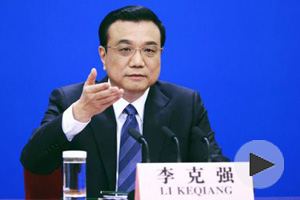
The Prime Minister's work report for 2014 presented at the National People's Congress yesterday confirms that the government plans to start implementing a fairly comprehensive set of reforms this year. Following the details of the communique released after the third plenum in November, the government work report this year discusses plans to increase the role of markets and private enterprise and, in conjunction, a recalibration of the role of the government.
However, the approach to changes in economic policy remains cautious and gradual in several ways. First, growth remains the key objective. The report stresses that "development (that is, growth) remains the key to solving all our country's problems" and that China "must keep economic development as the central task and maintain a proper economic growth rate". Accordingly, the GDP growth target remained unchanged at 7.5 percent.
In the government's terminology, fiscal policy will remain "proactive" and monetary policy "prudent" in 2014, although these labels do not say much about the actual stance. The government's budget aims to keep the official fiscal deficit unchanged at 2.1 percent of GDP. The total fiscal deficit, including the borrowing by local governments from banks and the shadow banking system, is likely to be substantially higher, as it was in recent years, but it is hard to know how high. The report does not contain many specifics on the planned monetary policy stance, other than announcing that the M2 growth target has remained at 13 percent. It stresses the need to "foster a stable monetary and financial environment" and "strengthen macro-prudential management to encourage an appropriate increase of monetary credit and nongovernmental financing."
What does this all mean for the outlook for growth and policy this year? In the fairly benign base scenario of RBS, with sufficient "organic growth", the government can make progress with reining in the pace of the rise in the credit to GDP ratio while protecting its bottom line on growth. In a less benign scenario, with less organic growth, the government is likely to be less forceful on reining in credit growth, given the emphasis on growth. In that case, systemic financial problems or instability remain unlikely any time soon. However, financial risks would rise further and financial market sentiment would remain bearish.
Second, the approach to rebalancing the pattern of growth seems to have evolved, and investment remains the key for the government. Many experts and China's 12th Five Year Plan (5YP) call for a rebalancing of the pattern of growth away from investment and industry towards consumption and services. However, nowadays the government puts the objective somewhat differently. It calls for increasing domestic demand and boosting consumption. But it also wants to "fully leverage … the key role of investment" and says it "will take investment as the key to maintaining stable economic growth."
Third, the government plans a pragmatic approach on how quickly to move in different areas of reform. Even though the government calls for “breaking vested interest”, the report also calls for a "focus on areas where the public call for reform is strongest" and "links on which there is extensive public consensus". Thus, the reform areas that are likely to see significant progress are the ones where there is broad agreement and no strong vested interest resistance. Indeed, looking at the various reform areas, the plans are relatively concrete in areas where there is good agreement and no strong vested interest resistance.
This is especially the case for financial and monetary reform, where the reports' language is quite concrete on the direction – toward a deposit insurance scheme, liberalizing interest rates, expanding the yuan's trading band, and more Renminbi convertibility under the capital account – although there are no indications on timing.
Also, the government plans further progress on administrative reform and delegation of power to lower levels of government, reducing red tape, and making the formation and operations of businesses easier.
On the other hand, the approach is more gradual and cautious in areas where reform is more difficult, such as in the case of fiscal reform, rural land reform, and SOE-related reforms. In the fiscal area, the plans and intentions on changing the fiscal relations between local and central governments, as well as on tax policy, remain particularly cautiously and gradual.
Having said that, the report has more concrete language than previous top level documents on the complicated area of improving the quality of urbanization and Hukou reform. The government commits to "progressively grant urban residency to rural migrant workers and their families who are both willing and able to stay in cities and towns where they have had jobs or done businesses for a long time" and "steadily extend basic public services to fully cover the permanent population of cities and towns so that the rural people who live in them can contribute to the development of modern urban life and enjoy it together with the urban people." In this vein, the government has set itself three tasks involving 100 million people, on granting urban residency to migrants, rebuilding rundown urban areas, and guiding further urbanization in the central and western regions.
In all, the government plans to start a fairly comprehensive set of reforms, although the approach to changes in economic policy remains cautious and gradual.
The author is chief China economist at Royal Bank of Scotland Group Plc in Hong Kong.

Copyright 1995 - . All rights reserved. The content (including but not limited to text, photo, multimedia information, etc) published in this site belongs to China Daily Information Co (CDIC). Without written authorization from CDIC, such content shall not be republished or used in any form. Note: Browsers with 1024*768 or higher resolution are suggested for this site.
License for publishing multimedia online 0108263 Registration Number: 20100000002731 


