In October, a court case about a disputed will attracted widespread public attention. The case revolved around a fortune estimated at about 2.1 billion yuan ($343 million), and the defendant was 95-year-old Wang Lingwen, the widow of a painter and calligraphy master named Xu Linlu. The case had been brought by Wang's children and grandchildren.
When Xu passed away in August 2011, apparently intestate, Wang inherited the lion's share of his estate. However, a year later Xu's third son, Xu Huayi, and four grandchildren sued Wang, demanding that the fortune be split fairly, in accordance with China's Law of Succession. The dispute really became rancorous when, in September 2013, Wang presented the court with a document she claimed was a will her husband had written in 2010. The children refused to believe the document was genuine.
According to the disputed will, Wang was Xu's sole heir and was therefore entitled to his entire estate, including 72 valuable paintings and pieces of calligraphy made by Xu, as well as several pieces by masters such as Xu's teacher Qi Baishi.
The problem for the court was that it was difficult to establish the authenticity of the will. Although Wang claimed Xu wrote the document himself, the signature was hard to read. Xu's children, some of whom are renowned experts on Chinese paintings and calligraphy, said the handwriting was not their father's. They also questioned why Wang hadn't made the will's existence known immediately after Xu's death.
On Oct 18, the court of Beijing's Fengtai District finally ruled that the will was genuine. The plaintiffs were outraged, leading Xu's youngest daughter to cry: "This is our mother's 95th birthday, and yet we are sitting here to sue her. It's so sad."
Chen Kai, 37, director of the management committee of the China Will Bank, said: "This case revolves around issues that aren't covered by the Law of Succession - the registration and management of wills. Once a will has been drawn up, who manages and executes it? That's a blank under the existing law, but it's something the Will Bank can resolve."
The China Will Bank is a nonprofit organization that provides free services to people aged 60 and older, advising them how to make, register and manage their wills.
"If we had helped to register and manage Xu's will, this dispute wouldn't have happened," Chen said. "If anyone questions the credibility of a will, we can provide third-party evidence, such as a video of the testator reading the will at our center."
Legal professionals have long discussed the need to amend China's Law of Succession, which came onto the statute books 29 years ago.
"Decades have passed, and the economic and family structures have changed tremendously, so the existing law cannot solve the increasing number of problems individuals face when they need to deal with the disposal of their property after their deaths," Chen said. "These days, people are more willing to deal with their property according to their own ideas."
In March 2012, a draft proposal to amend the Law of Succession was placed on the legislative program by the Legal Committee of the National People's Congress, but by 2013, it was no longer on the list.
|
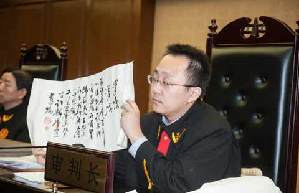 A judge in a court in Beijing displays an original copy of a will during a case about disputed inheritance. An increasing number of elderly people in the capital are turning to professional organizations or law firms for help in dealing with their property after they die. PU DONG FENG / FOR CHINA DAILY |
"The proposal was dropped because, judging by the number of cases brought, the courts didn't see any need to amend the law. In their view, the law is sufficient as it stands," Chen said.
The decision came after lawyers, judges and legal scholars from across China gathered at the Southwest University of Political Science and Law in June 2012 to discuss the proposed amendment.
At the conference, Xia Zhengfang, presiding judge at the High People's Court of Jiangsu Province, said inheritance disputes accounted for just 0.06 percent of the lawsuits the province's courts heard in 2011, although he conceded that the number of cases was rising every year. In Guangdong province, disputed wills accounted for just 0.3 percent of cases in 2011, according to Yang Huiyi, deputy presiding judge of the province's High People's Court.
Tan Fang, senior partner at Watson & Band, a Shanghai-based legal firm, said: "Few lawsuits involving inheritance disputes go to court. Most of them are solved through negotiations by lawyers or in notary offices.
"However, in recent years, we have dealt with a growing number of disputes about inheritance. Litigation and non-litigation cases accounted for about 10 percent of our family practice in 2009, but last year, the proportion passed 30 percent. So far this year, the number has reached 40 percent. Usually these disputes are solved via non-litigious mediation with the help of lawyers," she said.
"Society has changed so much in the past three decades, and personal property has also changed in terms of category, amount and content. It's very urgent and necessary to amend the Law of Succession," she added.
Chen, of the China Will Bank, is convinced his organization can help to fill in the blanks in the existing legislation.
"We can help testators to register legally effective wills, and we manage them free of charge. In the future, we will help to process wills, too. Our goal is to see fewer inheritance disputes. When we can process wills, family members, brothers and sisters, will be able to sit together and relive precious memories of their lost relatives. The testators are aiming to maintain family harmony, and by helping them do that, we are trying to protect their rights."
yangyangs@chinadaily.com.cn


Copyright 1995 - . All rights reserved. The content (including but not limited to text, photo, multimedia information, etc) published in this site belongs to China Daily Information Co (CDIC). Without written authorization from CDIC, such content shall not be republished or used in any form. Note: Browsers with 1024*768 or higher resolution are suggested for this site.
License for publishing multimedia online 0108263 Registration Number: 130349