 |
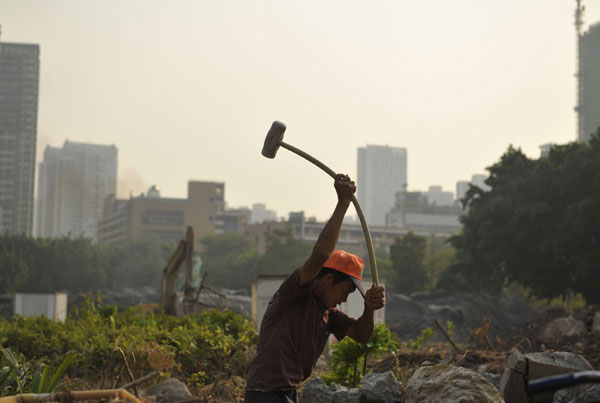
| A construction worker at Chengjiaci Square in Guangzhou, Guangdong province. The square, once regarded as one of the city's cultural calling cards, was a major part of an 800-million-yuan($130 million) urban refurbishment project designed to celebrate the 2010 Asian Games. LIANG WEIPEI/FOR CHINA DAILY |
|
Concrete measures required for building waste BY Zheng Jinran In the wake of mass demolitions, experts said untreated construction waste has become a major problem for the Chinese economy, and the low utilization rate poses a threat to the environment. They have called for tougher legal measures, improved recycling technologies, and preferential policies to solve the problem. In 2013, the volume of construction waste reached 1 billion metric tons, 74 percent of which came from demolition work, according to the National Development and Reform Commission's annual October report on the utilization of resources. With just 50 million tons recycled to make materials such as aggregate, which is used in concrete, the utilization rate of the trash - waste soil and other materials cast off during construction, demolition and development work - was just 5 percent. In 2005, the Ministry of Housing and Urban-Rural Development released guidelines on recycling the trash into resources, and highlighted measures to prevent environmental pollution. The ministry said the current low utilization rate won't solve the pollution problem, and in some cities poor recycling of trash has actually exacerbated the situation. For example, in Guangzhou, Guangzhou province, only 1 million tons of construction trash was utilized in 2013, a mere 2.5 percent of the city's total, while the remainder was dumped in landfill sites. Experts voiced concerns about the piles of trash - which pollutes the soil, water, and other natural resources - at a building forum organized by the Energy Foundation in September. In Singapore, 98 percent of construction trash is utilized. In Japan the figure is 97 percent, while in the United States, it's about 70 percent, according to Sun Jinying, a senior executive at the China Architecture Design & Research Group. "The lack of specific, detailed laws on the recycling and treatment of construction trash has been a major cause of China's current low utilization rate," Sun told the forum. In addition to learning from strict legal controls governing the sources of trash in countries such as Singapore, China needs to develop or introduce more technologies to utilize and treat the waste. In addition, preferential policies should be introduced to encourage greater utilization and attract a larger number of people and companies into the recycling sector, she said. |
Liu Huilian never imagined that the grand, green square, which seemed the perfect place for her small hotel, would be demolished just four years after it was built and become a giant construction site that would ruin her business.
The expansion of the woodland area in the eastern part of Chenjiaci Square, once regarded as one of the cultural calling cards of Guangzhou, Guangdong province, was a major part of an 800-million-yuan ($130 million) urban refurbishment project designed to celebrate the Asian Games, which were held in the city in 2010.
Liu opened her 40-room hotel in a street near the corner just before the work on the square started in 2009.
"At the time, the construction work affected me very little, since it only took a short time and was a good distance from my hotel," the 38-year-old Hunan province native said, adding that the pleasant view from her hotel windows was a major attraction for guests.
Now, the demolition of the green space has left her confused and frustrated. "What a waste of resources, destroying an almost-new square," she said, "Also, the fence around the construction site is only 3 meters from my door, and the noise has driven my guests away."
In September, the local government announced that the square would be razed to make way for the extension of a subway line. The demolition and subsequent construction work is scheduled to last more than three years.
The government's announcement raised many eyebrows because media reports stated that the plan for the subway extension had originally been announced in 2007, two years before work began on the Chenjiaci project.
"Why didn't the government notice the plan to extend the subway before it spent so much money on the green square?" asked 50-year-old Deng Ruixiang, who has lived in the area for 20 years.
The company that operates the subway explained that the extension plan didn't receive official approval until work on the square had finished, but many residents questioned the poor coordination between government and business, and complained about the waste of public money.
Chenjiaci Square is just one example of buildings and public spaces across China that have been demolished long before the ends of their designed lives.
Soccer fan Dai Tianjiao, from Shenyang, Liaoning province, remembers the excitement in China when the national team won a place in the 2002 World Cup Finals, the only time that the men's side has featured in the tournament.
However, the 28-year-old wasn't so happy when the local Wulihe Stadium, which was built in 1988 at a cost of 250 million yuan, was torn down in 2007, just 19 years into its 50-year designed lifespann. It was replaced by a modern business center with high-end offices and residential buildings. Dai said the stadium was the only place in the neighborhood where the local residents could exercise out of doors.
According to China's national design code for buildings, the service life of major projects should be 100 years, and regular buildings should stand for at least 50 years. However, Qiu Baoxing, who was vice-minister of housing and urban-rural development in 2010, said many demolished buildings had an average lifespan of just 30 years.
A recent report published by the China Academy of Building Research, the largest institution in the domestic construction industry, estimated that buildings with a combined average floor space of 460 million square meters have been demolished every year since the start of the 12th Five-Year Plan (2011-15). It also said that about 460 billion yuan has been wasted annually by tearing down buildings long before they reach their expiration dates.


Copyright 1995 - . All rights reserved. The content (including but not limited to text, photo, multimedia information, etc) published in this site belongs to China Daily Information Co (CDIC). Without written authorization from CDIC, such content shall not be republished or used in any form. Note: Browsers with 1024*768 or higher resolution are suggested for this site.
License for publishing multimedia online 0108263 Registration Number: 130349