 |
|
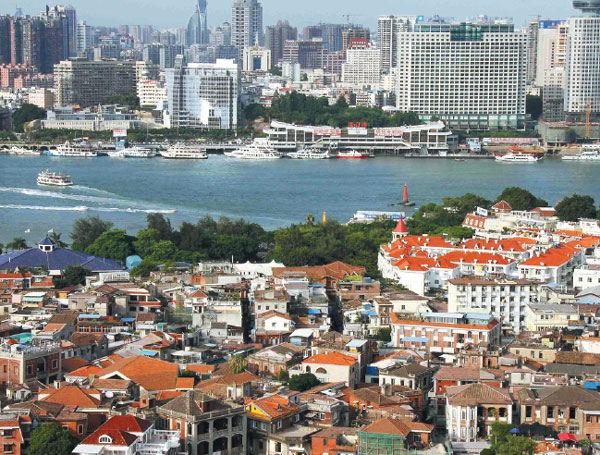
Gulangyu Island, famous for its winding lanes and diverse, historic architecture, is situated opposite the developed downtown area of Xiamen, a coastal city in southeast China's Fujian province. Zhu Xingxin / China Daily |
During a recent business trip to Xiamen, Cai Zhenzhen cringed at the thought of visiting Gulangyu Island, a tourist magnet near the city.
Cai, a sales representative from Shanghai, discovered that the 2-square-kilometer islet in Fujian province was visited by about 70,000 tourists every day during the National Day holiday in October, and felt it would be "torture" to squeeze onto the tiny space along with a huge number of visitors.
However, remembering the old saying that "A trip to Xiamen is incomplete if one does not go to Gulangyu", Cai headed there anyway. When she arrived, she discovered that the situation was much better than she had expected.
"It was not terribly packed with tourists, and I felt an easy tranquility as I explored some of the island's winding alleyways," she said. Having enjoyed the pristine beaches, distinctive shops, and diverse architectural styles, Cai was pleased she made the trip.
Ye Xizhi, deputy director of the Gulangyu Management Committee, said the serene atmosphere has been brought about by a decision to reduce tourist numbers by raising ferry prices and extending travel times to the island.
The adjustments, which came into force on Oct 20, means that tourists have to take a 20-minute ferry ride from Dongdu to Sanqiutian Wharf for 35 yuan ($5.70) or the more-distant Neicuoao Wharf (50 yuan). However, residents pay 8 yuan to take the ferry from the Lundu ferry terminal and the journey takes just five minutes.
The change has resulted in a reduction in the number of visitors to around 20,000 per day, although the Xiamen Urban Planning and Design Institute has determined that the ideal daily number is 30,000, but the island can accommodate 65,000 if stretched to the limit.
Ye said the move to cap tourist numbers is important because it will improve the island's chances of acquiring World Heritage Site status in 2016, as it seeks to win out against nine other sites in China.
Zhan Zhaoxia, a researcher at the Xiamen Academy of Social Sciences who specializes in the study of Gulangyu, said the island has a "wonderful foundation" to become a World Heritage Site.
Zhan, who moved from the Tibet autonomous region in 1995 to work in a convalescent hospital in Gulangyu, said initially she had no special feelings about the island, apart from being impressed by the laid-back lifestyle and the sky, which appeared "as pure as the one above Tibet".
In 2007, Zhan wrote a thesis on Gulangyu's development strategy as part of her Master's in Public Administration, and was fascinated that a large number of talented people were raised on the small island.
Although she knew that Gulangyu was the home of Lin Qiaozhi, a pioneer of gynecology in China, and Yin Chengzong, a pianist whose best-known composition was the Yellow River Piano Concerto, Zhan was amazed at some of the other talents the island has produced
She discovered that all 12 students in a class at the local primary school achieved great renown as adults, including the famous marine biologist Zeng Chengkui, and Dai Wensai, one of the founders of modern astronomy in China.
She said some of the children came from wealthy families, while others were poor - including one student whose mother worked three jobs to pay his school fees - but they supported and helped each other at school.
"The reason Gulangyu could cultivate so many refined talents is mainly due to the island's history," Zhan said.
Gulangyu, which became an important trading port in the 1840s, attracted Western religious groups, global commercial and financial institutions, consulates, and diplomatic missions.
Under the influence of this cultural diversity, the island began a transformation from a traditional settlement into a modern residential community featuring advanced community facilities and good education and medical services.
"Gulangyu's competitive advantage in its bid to become a World Heritage Site lies in the fusion of historic buildings in diverse architectural styles and a number of matching community functions that are still working after more than a century," Zhan said.
Gulanyu native Xie Miancong, who has worked in the tourism industry for decades, said applying for World Heritage Site status could help to revitalize the island, as long as the move doesn't lead to aggressive commercialization.
"Many places of interest in China that have gained World Heritage Site status have been affected by overcommercialization," Xie said, citing the example of Lijiang, an ancient town set in a picturesque mountain landscape in Yunnan province.
Designated a World Heritage Site in 1997, Lijiang, home to the matriarchal Dongba ethnic group, receives tens of millions of visitors a year, which has resulted in the original residents renting their houses to businesses and moving away.
Pollution problem
In fact, Gulangyu has already encountered similar problems, even though it has yet to become a World Heritage Site, Xie said.
In 2008, the same year Gulangyu began preparatory work for its application, the island's customary serenity was shattered by a large rise in the number of tourists.
To boost the tourism industry, the local government encouraged the establishment of family inns and hotels. Commercial investors began building inns and many residents, refurbished their houses and turned them into hotels. Some even moved away from the island, according to Xie.
The situation deteriorated as more travelers flocked to the island, and unlicensed business activity, roadside stalls, and illegal construction projects caused massive pollution.
Xie said the hotel trade is highly lucrative, but transforming the old houses into hotels has damaged their historical and cultural value. So, rather than modifying his own home, Xie invested more than 3 million yuan to refurbish the 1932 building, and simply serves coffee in his courtyard which is dotted with lush foliage. Customers are not allowed access to the whole house.
The business just about allows Xie to make ends meet, but he said the relaxing cafe culture, combined with the history of his home, is representative of the quality of life on Gulangyu, and he would never give it up simply for money.
He said Gulangyu is now cleaner than it has been for a long time because in recent years, local authorities have started to tackle the problems caused by overcrowding and rampant commercialization. The authorities launched a series of campaigns designed to clear away people involved in unauthorized businesses, and implemented a series of projects to protect the environment.
"In terms of curbing the number of tourists, the current price system and adjusted ferry routes have worked well. The move will damage the interests of people who run catering and lodging businesses on the island, but it's necessary to maintain order and community peace," Xie said.
Ye, of the Gulangyu Management Committee, said becoming a World Heritage Site would definitely boost the local economy, but the island's application is really a method of protecting Gulangyu: "World Heritage Site status is not the ultimate goal, and even if the island doesn't attain it, measures such as limiting the number of tourists and renovating historic buildings will be still undertaken to protect the island."
Contact the writer at sunli@chinadaily.com.cn and humeidong@chinadaily.com.cn


Copyright 1995 - . All rights reserved. The content (including but not limited to text, photo, multimedia information, etc) published in this site belongs to China Daily Information Co (CDIC). Without written authorization from CDIC, such content shall not be republished or used in any form. Note: Browsers with 1024*768 or higher resolution are suggested for this site.
License for publishing multimedia online 0108263 Registration Number: 130349