 |
|
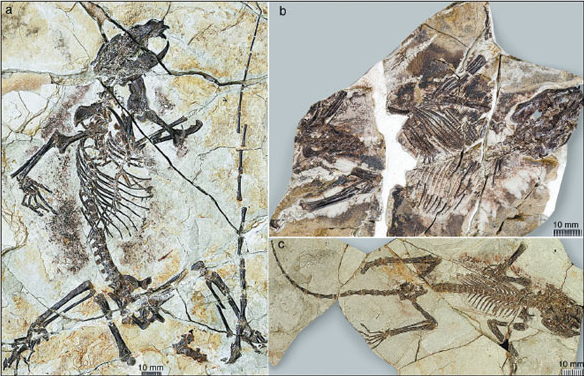
Fossils of the three newly identified mammal species from Northeast China's Liaoning province, which have scientific names of Shenshou lui (a), Xianshou linglong (b) and Xianshou songae (c). The species date from about 160 million years ago. Photo Provided by Chinese Academy of Sciences |
Scientists announced on Wednesday the discovery in China of fossils belonging to the three creatures in a find that sheds light on a poorly understood collection of ancient mammals, and indicates that mammals as a group appeared earlier than some experts thought.
The three species come from a group called haramiyids that previously had been known only from isolated teeth and fragmented jaws. Scientists had not even been sure they were mammals at all.
The nicely preserved fossils from Liaoning province proved definitively they were mammals, in part because of the presence of three bones of the middle ear characteristic of all mammals from shrews to whales to people.
The three species - whose scientific names are Shenshou lui, Xianshou linglong and Xianshou songae - date from about 160 million years ago, a time when dinosaurs ruled the land. But a number of recent fossil discoveries have shown that mammals were far more diverse during that period than previously recognized.
The three species likely looked like small squirrels, with slim bodies and elongated fingers and toes, indicating they were dedicated tree dwellers. They had long and probably prehensile, or grasping, tails, another feature that helped them stay in the tree branches.
"I would predict that they spent even more time in the trees than squirrels," said Jin Meng, a vertebrate paleontologist at the American Museum of Natural History in New York, who led the study published in the journal Nature.
Based on the shape of their teeth, they probably were omnivorous, eating insects, nuts and fruit, Meng said. The remains were so well preserved that they showed more than just the hard parts such as teeth and bones that commonly fossilize, but also soft parts such as fur and the animal's guts, he added.
The three species had an estimated weight ranging from about that of a mouse, 28 grams, to that of a small squirrel, about 280 grams. While they may have looked and acted like today's squirrels, they were only very distantly related to them.
The researchers said these fossils, along with other evidence, suggest that the first true mammals that evolved from mammallike ancestors appeared perhaps 208 million years ago. Some scientists have contended that mammals entered the picture millions of years later than that.
Reuters


Copyright 1995 - . All rights reserved. The content (including but not limited to text, photo, multimedia information, etc) published in this site belongs to China Daily Information Co (CDIC). Without written authorization from CDIC, such content shall not be republished or used in any form. Note: Browsers with 1024*768 or higher resolution are suggested for this site.
License for publishing multimedia online 0108263 Registration Number: 130349