 |
|
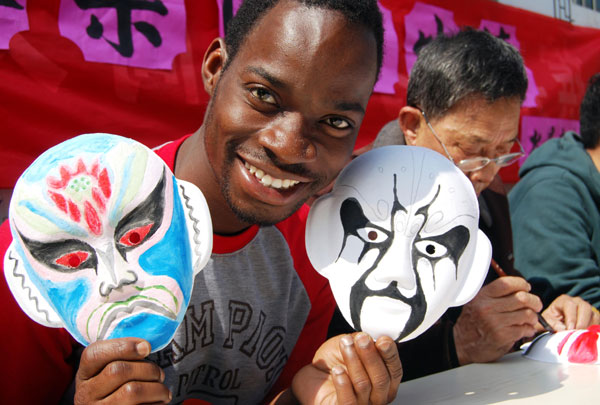
Osei Boateng, a Ghanaian student at Jiangsu University who is learning Chinese, shows Peking opera masks during a visit to a community theater in Zhenjiang, Jiangsu province, in March. Shi Yu Cheng / for China Daily |
|
 |
The 26-year-old master's student at Beijing Language and Culture University will graduate in July.
But Li, who is in her seventh year majoring in Teaching Chinese to Speakers of Other Languages, has yet to find a full-time job.
"None of the girls living on the same dorm floor with me, all majoring in TCSOL, has found a teaching job so far," she said.
"Most of them are signing job contracts that are not closely related to the major."
BLCU was among the first four universities approved by the Ministry of Education in 1985 to offer the TCSOL program, formerly known as the Teaching Chinese as a Foreign Language program.
There are 342 universities offering it. By the end of 2012, there were 63,933 students studying the major.
Shi Jiawei, former director of the university's TCSOL department and a professor of the major, said that among graduates with a bachelor's degree in TCSOL in the past three years, less than 10 percent of them have clinched jobs closely related to the major. More than 40 percent of them will continue to study for a master's.
"The major has long been popular among liberal arts students and attracts outstanding candidates," she said. "But we do have problems sending students out for the right jobs, especially undergraduates."
Shi gave two reasons TCSOL students have trouble landing a job after graduation.
"First, the major aims at cultivating Chinese teachers for foreign students. Yet it's extremely difficult to get a teaching position in any university. Most universities now require a doctorate. Second, many students who now aim to work overseas cannot do so due to visa problems and also because they do not have relevant teaching certificates in other countries."
Shi was enrolled in BLCU's TCSOL program in the mid-'90s, and Li was enrolled in the major at Zhengzhou University in Henan province in 2007. They had similar notions of the major when they signed up for it, including the dual emphasis on English and Chinese.
But the situation has changed, Shi said. While English-speaking adults made up most of the foreigners who studied Chinese in the past, more children are doing so now. That means a different set of teaching skills are needed. Foreigners learning Chinese also come from diverse backgrounds, including non-English speaking ones.
At a seminar on improving courses for the TCSOL program in October 2013, Zhou Shangzhi from the School of Education at Shanghai International Studies University said that the courses should focus more on non-English languages and not just offer courses in Chinese and English.
While landing a teaching position in foreign universities is tough, some TCSOL students are still willing to become Chinese teachers in private language schools. Many of them also realize that schools prefer teaching experience to master's degrees.
Ged Scheuber, general manager of Culture Yard, a private language school in Beijing, has been recruiting Chinese teachers for more than a year.
"Almost all the teachers we've recruited so far hold a master's degree in the major," he said. "Yet that does not necessarily mean they are qualified for the job. We emphasize on how well teachers are able to give students the confidence to speak. Teachers with good experience can identify the areas that foreign learners may find confusing."
Also, some foreign students and expats in China still heavily rely on self-study to improve their Chinese.
Magdalena Lowczynska, 31, a Polish student learning Chinese at the School of International Education and Exchange at Shanxi University, said learning a language is more about using it in real life conversations than memorizing vocabulary and grammar.
To help more students in the program get opportunities to work overseas, East China Normal University also started a cooperation program two years ago with universities in the United States, through which Chinese students are able to gain a local teaching certificate. This will enable the students to become Chinese teachers in the US.
Shi Jiawei, the former TCSOL director at BLCU, said the university is also working on similar programs in the US.
Contact the writers at zhangyue@chinadaily.com.cn and sunxiaochen@chinadaily.com.cn


Copyright 1995 - . All rights reserved. The content (including but not limited to text, photo, multimedia information, etc) published in this site belongs to China Daily Information Co (CDIC). Without written authorization from CDIC, such content shall not be republished or used in any form. Note: Browsers with 1024*768 or higher resolution are suggested for this site.
License for publishing multimedia online 0108263 Registration Number: 130349