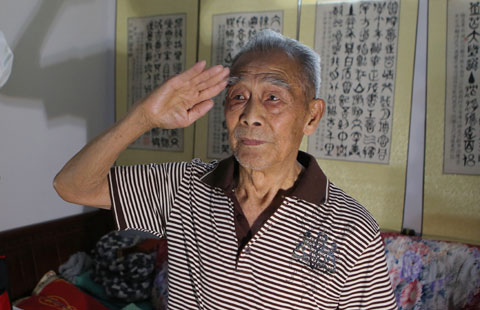
CHANGSHA - Rolling up a sleeve, 76-year-old Hu Lanzhen exposed her left arm, which was covered in brown flecks.
"I am too itchy. Sometimes I cannot help but scratch so hard that my skin breaks," she said.
Hu is suffering from arsenic poisoning. In the area where she lives, Shimen County in Central China's Hunan rovince, more than 1,000 villagers have fallen victim to the illness.
China's central government has put a growing focus on the environmental woes that threaten the health and safety of citizens. Last Thursday, the Standing Committee of China's National People's Congress (NPC) approved the most sweeping revisions to the environmental law in 25 years, promising tougher penalties for polluters. But in China's battle against soil pollution, assigning responsibility for a problem that has been decades in the making is a challenge, and treating the soil has proven even more difficult.
Shimen County is located in an area with a large realgar (mineral consisting of arsenic sulphide) ore mine. Since its establishment in 1950, the mine extracted and refined arsenic until 2011, when it was closed by local government. The mining activities have seriously contaminated soil and water in the area.
According to the county government, a total of 35 square kilometers of soil is polluted, including 12 square kilometers of farmland. The arsenic content in the local surface water and soil are 34 and 30 times the national standards, respectively. High levels of arsenic were also found in crops such as wheat, rice and vegetables.
From 1951 to 2012, more than 1,000 people in the county were diagnosed with chronic arsenic poisoning, and 400 people died from all types of cancer.
Zhao Guangming, head of a local hospital, said that arsenic poisoning can cause skin itch and physical pain. People with severe poisoning are at high risk of developing skin and lung cancers.
There is no radical cure for the poisoning, and all medicines can do is to ease the pain by reducing the toxins in the body, he said.
County officials said the local government has been addressing the problem since 2009. Besides giving compensation and subsidies to the pollution victims, the county is also working to clean up ore residue and is planning to treat the polluted water and soil.
Yi Jianxin, environmental recovery expert with Yonker Environmental Protection Co., Ltd. in Hunan, said that compared to cleaning up the residue, recovering the polluted soil is much more difficult, as it requires advanced technology and huge investment.
The technology to restore arsenic-polluted soil is still in the primary stage in China, and there has been no successful case yet, he said.
A hidden problem
Soil pollution has grabbed the public's attention following the exposure of food safety scandals in recent years.
Last year, dangerous levels of cadmium were discovered in rice produced in Hunan Province. The pollution was caused by the non-ferrous metals industry in the area.
According to an official report issued jointly by the Ministry of Environmental Protection and the Ministry of Land and Resources on April 17, about 16.1 percent of China's soil and about 19.4 percent of farmland are polluted.
It was based on a survey conducted from April 2005 to December of last year on about 630 square km of land across the country.
The report said the main pollution source is human industrial and agricultural activities.
"Compared with air and water pollution, soil pollution is more difficult to control and remedy, taking a much longer time and needing more resources," said Chen Tongbin, research fellow with the Institute of Geographic Sciences and Natural Resources Research with the Chinese Academy of Sciences.
Twenty years ago, almost no one knew about soil pollution, and even today, many people are not fully aware of the severity of the problem, he said.
According to Chen, soil pollution is more hidden than air and water pollution.
"When a piece of land is polluted, it is usually hard to discover and sometimes it takes as much as 50 years for the problem to be found," he said.
Search for a remedy
Chinese Premier Li Keqiang declared war on pollution during the March parliamentary session and pledged to fight it with the same determination the country battled poverty.
Following Li's words, a plan was passed in April to set up pilot projects in six heavily polluted regions, according to the Ministry of Environmental Protection. The government will allocate more than 1 billion yuan to each demonstration pilot to support soil pollution treatment.
The plan, together with a soil pollution law in the drafting stage, is expected to focus on protecting food supplies and ensuring that contaminated crops do not enter the food chain.
However, the pilot projects are small and cannot begin to redress the extent of the problem, according to experts. One of the major concerns is who will eventually pay for clearing up polluted soil.
Lan Hong, professor at Renmin University of China, said that the "polluter pays" principle has always been taken as an iron law for pollution treatment, but soil pollution has a long incubation period and many of its polluters are hard to find.
"Farmers who themselves are already victims of soil pollution should not be responsible for treating the problem, and it is necessary for the government to establish a special fund for soil remediation," he said.
Chen Tongbin is now studying phytoremediation, the engineered use of green plants to clean up contaminated soil.
"At present, foreign countries also lack successful experience in restoring polluted farmland on a large scale," he said. "New green methods that cause no secondary pollution are the way forward to treating soil pollution."
Wu Longhua, researcher with Nanjing soil research institute of the Chinese Academy of Sciences, said phytoremediation is still in a research and trial stage, and it also faces severe challenges, such as improving treatment efficiency, lowering costs and deciding who will pay for the treatment.


Copyright 1995 - . All rights reserved. The content (including but not limited to text, photo, multimedia information, etc) published in this site belongs to China Daily Information Co (CDIC). Without written authorization from CDIC, such content shall not be republished or used in any form. Note: Browsers with 1024*768 or higher resolution are suggested for this site.
License for publishing multimedia online 0108263 Registration Number: 130349