Comments
  Print
Print  Mail
Mail  Large Medium Small
 |
|
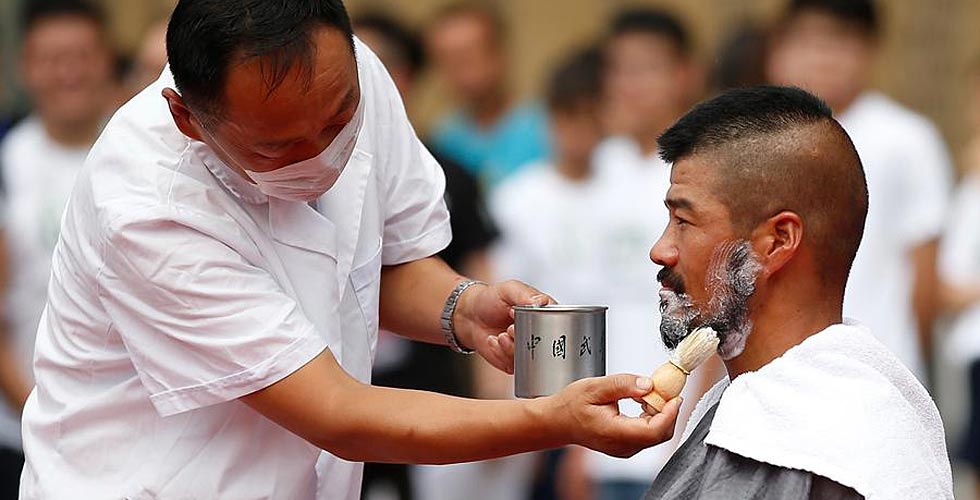
Survivors receive treatment at Mianzhu People's Hospital's rehabilitation department. [Photo by Huo Yan/China Daily] |
The destruction of the earthquake led to the building of Mianzhu People's Hospital's rehabilitation capacity, its staff says.
The hospital's outpatient rehabilitation department had only four people when it opened in 2004.
"We had no idea about modern rehabilitation before the quake," Chen Hao, the hospital's vice-president, says. "So we weren't very effective."
The temblor brought hundreds of disabled patients and scores of experts from home and abroad — volunteers, physical therapists and NGOs, who helped in 7,000 sessions with survivors and turned the department into one of the country's best county-level rehabilitation centers.
The department now has 30 doctors, nurses and therapists. All have been trained at top hospitals and coach lower-level hospitals.
Mianzhu's hospital had 500,000 yuan ($81,000) worth of rehabilitation equipment before the quake.
It now has 2.5 million yuan worth, thanks to donations from Handicap International and Caring for Children.
 |
|
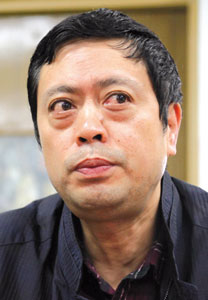
Chen Hao, vicepresident of Mianzhu People's Hospital. |
"The quake was a disaster, but it was also an opportunity to improve disability rehabilitation," Chen says.
"Gradually, we'll deal with fewer quake survivors and with more patients disabled in other ways. We can treat them now because of the disaster."
The hospital has already started rehabilitating stroke patients. People disabled in the quake receive free checkups.
"Now, rehabilitation begins once a patient's vital signs are stable," Chen says. "It continues after they leave the hospital. We visit the communities to train officials on how to help them. With growing need and awareness comes a growing market we can serve."
The hospital's most recent Happiness Index survey of the 26 residents paralyzed in the quake puts them around the same scores as non-disabled people.
They are more independent than in previous years and spend an amount of time by themselves comparable with those without disabilities.
Experts noticed changes over the three surveys. In the first, most respondents were concerned about their physical abilities; in the second, they worried most about livelihoods; today, sexuality and social participation are their greatest worries.
"But their index scores have increased on all fronts," rehabilitation department director Zhao Zheng'en says. "Many have found ways to earn money raising animals, running shops, operating small workshops, making handicrafts and planting vegetables."
The experts say patients' concerns about making a living often are not so much about income as about having purpose and being productive.
Tang Siqiong, 39, who was paralyzed when the wall of her house fell on her, says her initial distress was physical.
"I cried every day because I knew I'd never walk again. I especially feared getting a disease from sitting so long. Later, my concerns were more about my mental well-being."
She has overcome her initial depression, she says. "Everything lost meaning; everything was also hard to do. I couldn't leave the house before a ramp was installed."
Handicap International modified her kitchen so she can cook.
But some physical concerns remain, she says.
"My biggest problem is I can't control my bodily functions. The smell is embarrassing. If there were a pill that would help, my life would be better."
Tang also worries about her livelihood. She worked in a sewing factory founded and run for people paralyzed in the quake. The machines were modified to be operated by hand rather than by pedals.
"But I got pressure sores sitting at work, so I couldn't do full shifts," Tang says.
The workshop also temporarily closed to revamp its business approach.
So Tang spends much of her days cross-stitching.
"I'd never done it before the quake; it gives me something to do. It has become interesting, but it would be more interesting if I could sell more of them," she says, laughing.
Tang is concerned not only about her career but also her son's. The 18-year-old will start university in autumn.
"I hope my boy can get a good job and be happy. Overall, I'm satisfied. I just hope no new complications arise."
Yang Fachun's story mirrors Tang's.
"I was very distressed at first but now face the reality that I'm disabled," Yang says.
"A big difference is that I'm now independent. If there's something I really can't do or buy, my family or neighbors will."
But this took time, the 37-year-old says. "I had to learn how to bounce my wheelchair over the lip on the ground in the doorway, for example."
Yang also sells cross-stitching and does online editing. She ran the sewing factory before its hiatus.
"The factory enabled us to complete tasks with confidence," she says. "It was a great experience, even if it wasn't profitable."
It also provided peer contact, Yang says.
"It's very important to interact with others in our situation. I've made many new friends who also have spinal cord injuries. We learn from one another."
These friends have taught her how to cook and clean more efficiently, move around better without her wheelchair and exercise.
Yang and her husband supports a 12-year-old daughter, and Yang worries about her husband's post office job.
"I am also anxious about coming down with any diseases or injuries and becoming a burden on my family. We worry about safety more since the quake. We always call one another whenever we leave the house now."
She says she is satisfied with life but has one task to accomplish: "My goal is to get a good job that pays well."
Mianzhu People's Hospital continues to offer free support for all concerns of people disabled by the quake. Patients can call the hospital if they experience problems. If needed, the hospital will send therapists to their homes.
However, former Handicap International project manger Cai Sheng believes it is not just hospitals but all of society that is responsible for rehabilitation. He says both top-down and bottom-up approaches are needed.
"Then, all Chinese and the world could work together to empower ordinary disabled people to realize their rights and know they can turn to others. We must all work together."

 Cherry blossoms turn Tongji University must-see site
 How Chinese companies are contributing to US society
 Fantastic 'tree paintings' seen in Anhui province
 Tracing nationwide Tomb-sweeping Day travel rush
 Ex-inmate runs free school for poor children
 Shanghai's iconic Grand World reopens on 100th anniversary
 Spring scenery across China
 Making a living with fine-feathered friends
 Heart-shaped pond found in Chongqing, Southwest China
 Ten photos from across China: April 1-6
 British PM May, EU's Tusk meet on Brexit, talks positive on both sides
 French presidential debate reveals schism over Europe
 Chinese F1 Grand Prix: 10 fast facts
 China beat Croatia 2-0 at CFA Team China International Football match

Copyright 1995 - . All rights reserved. The content (including but not limited to text, photo, multimedia information, etc) published in this site belongs to China Daily Information Co (CDIC). Without written authorization from CDIC, such content shall not be republished or used in any form. Note: Browsers with 1024*768 or higher resolution are suggested for this site.
License for publishing multimedia online 0108263 Registration Number: 20100000002731