Comments
  Print
Print  Mail
Mail  Large Medium Small
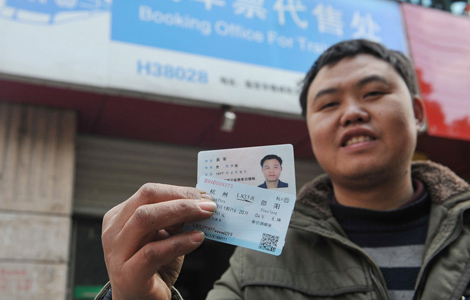
CHONGQING -- After 15 years in the booming province of Guangdong, migrant worker Liu Yong finally decided to settle in Longshe Township near his hometown in southwest China's Chongqing Municipality.
Liu, a former villager from Dadi Village, bought a new house in the town in 2010 and his family changed from "agricultural household" status to "non-agricultural". Despite that, he still has to seek work in coastal regions.
China's "hukou" system (household registration) is tied to one's place of residence and was set up in 1958 to control the movement of people between urban and rural areas. The way hukou works has created an urban-rural divide.
To shrink this divide and make it easier for rural residents to settle in urban areas, gradual reform is taking place in many places, including Shanghai, Chongqing, and the provinces of Sichuan and Guangdong.
Changes to Chongqing's system in 2010 are scheduled to turn 10 million rural migrants into urban citizens by 2020.
Migrant workers must now choose to stay in big cities or return to small towns. In both circumstances, they can get urban hukou, but the cost of living varies wildly.
"Of course, I'd love to live in Guangzhou, but it is too expensive for us to settle down there," Liu said.
The new house in Longshe cost 130,000 yuan ($21,500), while Guangzhou's average housing price has exceeded 10,000 yuan per square meter since 2010.
An urbanization conference in mid-December promised to fully remove hukou restrictions in towns and small cities, gradually ease restrictions in medium cities, and set reasonable conditions for settling in big cities.
Wang Xiaoguang of the Chinese Academy of Governance believes the move shows the government providing help for migrant workers to gradually adapt to urban life and gain urban status.
So far, around 70 percent of the 4 million rural migrants in Chongqing who have obtained urban hukou have shunned the megacity and stayed in small towns or counties.
Tan Aiping, a farmer from Baiguo Village, Kaixian County in Chongqing, chose to transfer his rural hukou to the nearby township.
"Living in a small town has not harmed my lifestyle and is very convenient. Since my land is very close to town, I can go to work on the farm at any time," Tan said. "But it would be costly if we moved to the county seat."
Zhao Xiaode, an economics professor at the Chinese Academy of Governance, thinks living costs and housing prices are the main factors rural people consider when they settle in neighboring small towns.
Small towns, especially in the underdeveloped west, cannot provide enough job opportunities, so residents have to seek jobs in eastern coastal provinces.
Although Liu Yong and his family have urban hukou, he must continue his life as a migrant because he can't make a living in the small town.
Yi Xiaoguang, head of the Chongqing Economic Information Center, said urbanizing their hukou helps migrant workers and their families access better education and medical services, but cannot solve all of their problems, especially that of employment
China is cranking up urbanization, helping rural people settle in cities and towns and improving the quality of their lives, according to the rural work conference which ended on Tuesday.
Local governments need proper projects and long-term plans for developing local industry and providing enough jobs to allow people to settle down, Yi said.
About 500 of those who have obtained city hukou settled in Luoping Township, Wushan County in Chongqing.
Tang Shude, deputy director of Wushan poverty alleviation office, said the county government introduced a textile enterprise to the county from the eastern port city of Yantai, offering jobs for their new residents.

 Xiamen-Shenzhen High Speed Railway opens to traffic
 China releases video of wild Amur leopards
 China builds 4th research station in Antarctica
 Foreigner teaches at China's rural schools
 Four killed in shopping mall fire
 Life in Tibet
 Missile destroyer Zhengzhou joins navy fleet
 Baby Yuan Zai to meet the public soon

Copyright 1995 - . All rights reserved. The content (including but not limited to text, photo, multimedia information, etc) published in this site belongs to China Daily Information Co (CDIC). Without written authorization from CDIC, such content shall not be republished or used in any form. Note: Browsers with 1024*768 or higher resolution are suggested for this site.
License for publishing multimedia online 0108263 Registration Number: 20100000002731