


City and people are one
The resilient Guilin has withstood the ravages of war and fire to become one of China's most popular tourist destinations, write Li Yang and Huo Yan.
There are numerous ways to take in the beauty of Guilin, a world-acclaimed tourist destination famed for its karst landscape. One of the best ways is climbing up to the top of Duxiu Hill.
The 66-meter-high peak stands in the center of a stretch of plain encircled by two rivers, four lakes and ranges of bamboo-shoot-shaped hill forests in the distance.
The 2,000-year-old Guilin has prospered into a city of 700,000 people.
|
The Jingjiang Princes' City, built in the 14th century, is one of the best preserved historic sites in Guilin, Guangxi Zhuang autonomous region. Photos provided to China Daily |
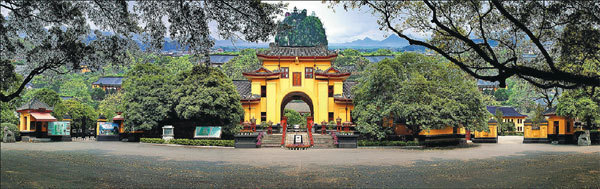
Looking down from the Duxiu Hill, visitors can easily discern the two "necklaces" of Guilin. One is a rectangular ring of mossy ancient city wall piled with bluestones and the other jade-green rivers and lakes convoyed by flourishing trees.
The city wall divides the old Guilin from the modern.
The rectangular ancient city, called Jingjiang Princes' City, covers an area of 150,000 square meters and was built between 1372 and 1392 by Jingjiang King Zhu Shou-qian, the great-nephew of Zhu Yuanzhang, the founder of the Ming Dynasty (1368-1644).
The Princes' City had been home for 14 princes of the royal Zhu family of the Ming Dynasty.
The Princes' City's wall is 7.92 meters high and has a thickness of 5.5 meters. There are four gates in four directions opened for different people at different times for different purposes.
Main buildings in the Princes' City, arranged on an axis, include administration buildings, royal quarters and a garden.
The subsidiary buildings on both sides of the axis are symmetrical. From east to west are the Imperial Divine Temple and Ancestral Temple. There are four halls, four pavilions and 40 other buildings.

The Duxiu Hill stands in the north of the Princes' City, accompanied by an artificial pond in its north. It used to be the exclusive asset of the ancient city owners from 1372 till 1649, when the Manchu cavalries swept away the last Han resistant in Guilin.
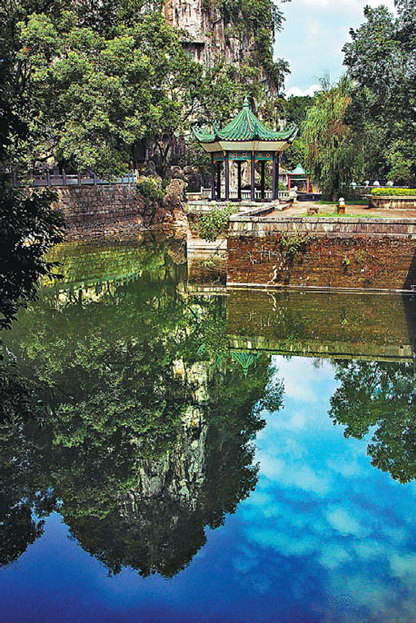
According to feng shui theories, the delicate location and combination of rivers, lakes and hills near or in a city brings good geomantic potency in the form of political stability, represented by hills, and sustainable wealth, embodied by the water to the city, making the city an ideal choice for capitals.
Because of the perfect combination of the small pond, Lijiang River, Duxiu Hill and the Princes' City, as local people say proudly, Guilin has been the capital of China twice in the difficult war against the invading Manchu troops during the late Ming Dynasty and in the War of Resistance Against Japanese Aggression from 1942 to 1944.
The main buildings of the Princes' City were burned to ruins by the Manchu troops in 1652 and rebuilt as exam sites in 1657 for imperial exams throughout the Qing Dynasty (1644-1911).
After the Qing Dynasty, the city served as the provincial government of Guangxi, until 1943 when it was destroyed by Japanese bombers.
Guangxi Normal University was moved to the Princes' City after it was established in the suburb of Guilin in 1932. The buildings were built on stone bases and surrounded by delicate ancient stone balustrades of the Ming Dynasty.
The main structures were designed in Gothic style and the roofs took the traditional Chinese style of cornices covered with black glazed tiles.
It feels comfortably cool walking in the quiet and spacious Princes' City, which is immersed in a green sea of osmanthus, gingko and loquat trees.
Students and teachers painted Chairman Mao Zedong's words on the 136 valuable ancient stone inscriptions on the Duxiu Hill in the "cultural revolution" (1966-76) and successfully protected the inscriptions from the Red Guards' sabotage.
One fourth of the Princes' City in its south was occupied by exam takers in the Qing Dynasty and is now lived in by the Guilin people.
In the mid-1990s, the normal university campus was opened to the public as a city park and most students were transferred to a suburban campus.
Deng Jinhao, 74, a retired teacher in Guilin, says: "I cannot imagine Guilin without the Princes' City. I studied and lived in it from 1959 to 1963. That is one of the most beautiful memories for me."
From the 1950s, local people started building houses at the foot of the ancient city wall. A kind of symbiotic relationship between the Princes' City and local people was formed, physically and mentally.
"I am proud my hometown has the Princes' City. I used to plant vegetables on the city wall and played games in it when I was a child. Now I take a walk in it every day," says Qin Lin, 68, a retired doctor.
Yang Huihong, 21, a college student born in Guilin, says: "The history of the Princes' City seemed sleeping silently in local people's hearts. But the temperament of royalty has been passed on by the Princes' City and the anima of the beautiful scenery has permeated in every Guilin citizen's spirit."
When asked about the Princes' City, most young locals reply in one voice: "It's just there as always." This may be an ideal relationship between a city and its people.
Yang Min and Yang Huihong contributed to the story.
Contact the writers through liyang@chinadaily.com.cn.
|
The Jingjiang Princes' City is designed according to feng shui theories, featuring a perfect combination of hills, ponds, rivers and buildings. |
(China Daily 09/21/2013 page10)

















Registration Number: 130349


