Comments
  Print
Print  Mail
Mail  Large Medium Small
Investigations part of overall enforcement of anti-monopoly law
An official at China's top economic planning body said antitrust investigations aren't targeting foreign companies but are instead part of an overall effort at tougher enforcement of the anti-monopoly law.
Six infant formula makers, five of them foreign, were fined for price-fixing and anti-competitive practices earlier this month. It's been reported that the vehicle and pharmaceutical industries are also being investigated, raising concerns among companies over what industry will be the next target of antitrust investigators.
 |
|
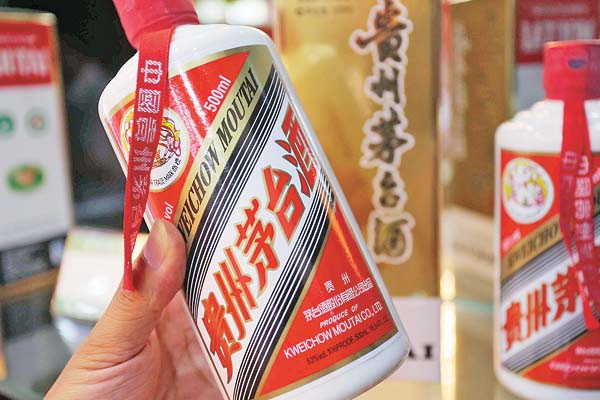
In June, domestic premium liquor makers Kweichow Moutai Co Ltd and Wuliangye Yibin Co Ltd were fined a total of 449 million yuan ($71.3 million) by the National Development and Reform Commission for resale price maintenance. [Provided to China Daily] |
"Most investigations result from public tip-offs and there is no intention of targeting a specific type of companies … we treat domestic and foreign companies equally," said Xu Kunlin, director-general of the Department of Price Supervision under the National Development and Reform Commission.
He reiterated the regulator's determination to enforce the antitrust law.
"Any company that violates the law will be thoroughly investigated, no matter what kind of enterprise it is," Xu said on Sunday during an interview with the State broadcaster, China Central Television.
Investigations in other sectors are underway, but it's too soon to release details due to the complexity of enforcing the anti-monopoly law, an NDRC official who declined to be identified told China Daily.
"There is no such a thing as specially targeting foreign companies. Our investigations focus on monopolistic conduct, not the entities behind it," the official said.
Recent high-profile antitrust cases have reminded companies to comply with China's anti-monopoly law, said Huang Yong, deputy head of the expert advisory group of the State Council's Anti-monopoly Committee, in an interview with China Daily.
"To avoid potential legal risks, all companies doing business in China, foreign and domestic, should ensure their compliance with the anti-monopoly law," said Huang.
Five foreign milk powder producers were fined a total of $110 million for violating the law for entering into contracts with distributors to ensure a minimum sales price, according to the NDRC.
"These companies might not act like that in their own countries because generally, such behaviors also present grave legal risks in Western countries," said Huang.
The infant formula case was the second case filed by the NDRC against setting floor prices for items resold to third parties, also called resale price maintenance. That's the most common form of vertical price-fixing.
In June, domestic premium liquor makers Kweichow Moutai Co Ltd and Wuliangye Yibin Co Ltd were fined a total of 449 million yuan ($71.3 million) by the NDRC for resale price maintenance.
Legal experts said similar vertical price fixing also exists in the auto and pharmaceutical sectors, where companies are in danger of violating the law.
In the United States, a requirement by a manufacturer that a distributor sell the manufacturer's product at a certain price is no longer automatically illegal under the federal antitrust law, but it is still automatically illegal under the laws of some US states and the laws of other Western jurisdictions, said Steven Cernak, counsel of law firm Schiff Hardin LLP.
"So Western companies still know to be careful about such practices ... I don't know if the infant formula companies were not as careful as they should have been or if some of their actions were misinterpreted," said Cernak.
"Companies doing business in China must take anti-monopoly compliance seriously ... foreign firms must be careful about the anti-monopoly law, like they are about the antitrust laws and competition laws in so many of the other countries in which they operate," he said.
Attracting attention
Xu said that China may target oil or telecommunications companies and banks next in its investigations.
"The regulator will look at ‘industries closely related to the lives of ordinary people with unreasonable pricing"," he said.
State-owned companies play a major role in areas such as energy and banking.
However, in the past few years, these industries also have seen a lot of transactions, some involving foreign investors, said Gregory Puff, Asia practice head of law firm Akin Gump Strauss Hauer & Feld LLP.
"Further regulatory oversight in these large industries in the antitrust area would not be surprising. Meanwhile, in many countries, these industries are geopolitically sensitive, so regulation should be expected to be careful and thorough," he added.
The NDRC, one of three government bodies that enforce the anti-monopoly law, completed a host of probes over liquid crystal display panels, premium liquors, infant formula and jewelry since January.
In two cases — LCD panels and infant formulas — foreign companies were involved.
"Foreign companies investing in China often are making high-profile investments, and frequently large investments. Naturally those type of transactions might attract regulatory scrutiny," said Puff.
Huang said there is no doubt the purpose of the law is to protect fair competition in the market, and it's equally applicable to domestic and foreign companies.
However, compared with other countries' detailed competition laws that date back a century or more, the 5-year-old anti-monopoly law needs further development.
Enforcement in many cases "requires detailed guidance from the law, but now the anti-monopoly law only has eight articles and 57 items," making it too abstract, said Huang.
Anti-monopoly investigations now mainly focus on some urgent and influential sectors or cases that were reported, but they will be extended to more areas in the future, said Huang.
With the enhancement of regulatory bodies' power, enforcement of the anti-monopoly law will become "the new normal," said Huang.
More transparency
The anti-monopoly law is enforced by three government bodies: The Ministry of Commerce enforces merger provisions; the State Administration of Industry and Commerce focuses on non-price related actions and the NDRC takes on pricing arrangements.
"The Ministry of Commerce was more active and visible at the beginning, especially because of the premerger notification requirements. However, the NDRC seems to be catching up, especially with the recent infant formula cases," said Cernak.
"Both have quickly joined the ranks of important competition agencies globally ... it would be helpful if all three agencies were more transparent and explained to the parties why they are investigating and explained to everyone why they took certain enforcement actions," he said.
The State Administration for Industry and Commerce set up a new online portal in late June to post the results of completed anti-monopoly investigations, which has been welcomed as a new step toward transparent enhancement.
In the long run, if Chinese and foreign companies have a better understanding of what they must do to comply with the anti-monopoly law and, if the actions are based on competition principles, the results will be better for Chinese consumers, said Cernak.

 New girls get a lesson in combat
 Chinese navy starts escort mission at Gulf of Aden
 In you go
 Removal of illegal villa unfinished within deadline
 Chaos as landslides and mud torrents swell South
 Floods cut off roads in NE China's county
 Sign language spoken at cafe in C China
 Weekly Photos: Aug 19-25
Copyright 1995 - . All rights reserved. The content (including but not limited to text, photo, multimedia information, etc) published in this site belongs to China Daily Information Co (CDIC). Without written authorization from CDIC, such content shall not be republished or used in any form. Note: Browsers with 1024*768 or higher resolution are suggested for this site.
License for publishing multimedia online 0108263 Registration Number: 20100000002731