Comments
  Print
Print  Mail
Mail  Large Medium Small
Xiao Li (not her real name), 30, walked into a clinic in the corner of Zhongshan County Hospital, Guangxi Zhuang autonomous region, greeted the doctor as an old friend and left about 40 minutes later with a three-month supply of medication, free of charge.
An AIDS patient, the tall, thin mother of two has been on antiretroviral therapy for a year at the health consultation clinic, which takes care of about 420 HIV/AIDS sufferers in the county, which has a population of 400,000.
 |
|
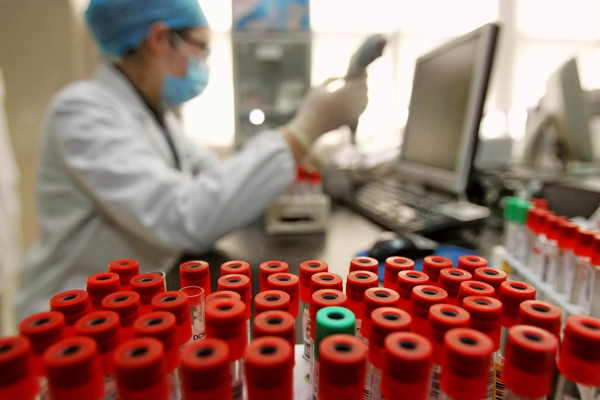
A medical worker enters blood sample information at an HIV testing lab at a hospital in Nantong, Jiangsu province. Hospital-centered AIDS treatment has made getting care easier.Xu Congjun / for China Daily |
"I set alarms to remind me to take my medicine every 12 hours and will strictly stick to that to survive — to see my children growing up," she said.
Xiao manages a smile when talking about her disease but tears flood her eyes whenever she mentions her children.
According to her doctor, Zhong Jie, Xiao is doing well and gave birth to a healthy boy in January thanks to the therapy that blocked mother-to-child HIV transmission.
When she was first diagnosed with AIDS last year, Xiao was weak and had poor immunity.
One-stop service, a new model project initiated last year, facilitated her quick access to the lifesaving antiretroviral therapy, taking only about eight days from HIV screening to receiving medication.
The process previously took two months on average, Zhong said. Patients also had to travel between facilities such as the county's disease control center, the county hospital and the city's CDC for different procedures, including HIV confirmation testing and treatment.
Under the new model, patients need only go to the county hospital. Public health workers at the county CDC help handle issues such as sending patients' blood samples to designated institutions for tests and contacting patients for health education and doctor visits.
"That helps both keep the patients on track and not lose a single patient for early treatment and behavior intervention," said Zhao Yan, deputy director of the AIDS treatment and care division of the National Center for AIDS and Sexually Transmitted Diseases Control and Prevention.
Qiu Xuejun, director of the county health bureau, said 90 percent of sufferers detected during the project period got antiretroviral therapy, or ART. The figure stood at 70 percent in the past.
The death rate from AIDS among newly detected patients also plummeted to below 7 percent, from 25 percent before the project.
Moreover, hospital-centered AIDS treatment coupled with coordination and assistance by public health departments also brought easier access for patients to medical care necessities other than antiretroviral therapy, Zhao said.
Previous reports said medical care denial due to a patient's HIV status still existed in China.
Model expanded
Encouraged by the achievements of the Zhongshan project, the one-stop service model has been expanded to nine other provinces, including Yunnan, Hunan, Sichuan, Guangdong and Henan, which have all been hit relatively hard by an epidemic on the mainland, Zhao said.
"The model makes the process much easier for the patients and helps with the nation's entire HIV/AIDS control efforts by providing as many sufferers as possible with treatment," she said.
Despite the clear benefits, some difficulties are also evident.
Tang Qian, a public health worker at Yongzhou county CDC in Hunan province, conceded that the county hospital was reluctant to get involved in the project.
The hospital was worried about related investments in the workplace and payments to medical staff that would not translate to earnings for the hospital, she said.
In China, public hospitals are poorly subsidized by the government, so they have to make money on their own to maintain the payroll and operations.
Under such circumstances, the health administration should also offer a hand to solicit more involvement by county hospitals, said Qiu.
In the HIV/AIDS clinic at Zhongshan County Hospital, the wages of the four medical staff — two doctors and two nurses — are paid by the hospital. However, the county health bureau gives favorable policies to the hospital and additional economic incentives to medical staff working there.
Zhong said he gets 600 yuan ($98) extra each month for being part of the project.
But to sustain such a model, administrative power and measures alone are far from enough, Qiu said.
He suggested the central government allocate special public health funding for hospitals taking up such a responsibility.
ART for all sufferers?
Until now, those on the mainland who tested positive only got free antiretroviral therapy when their CD4 count — the white cells that fight infection — fell below 350 cells per cubic millimeter, according to the nation's AIDS treatment guidelines.
However, with an ample supply of drugs, earlier antiretroviral therapy could help prevent or delay sufferers from developing full-blown AIDS and a series of complications, which cost much more in medical bills due to longer hospitalization and cost more lives, Zhao explained.
The World Health Organization last month issued new HIV/AIDS treatment guidelines that recommend earlier antiretroviral therapy.
"That also helps lower the viral load in sufferers, thus reducing the possibility for them to infect others," Zhao said.
Currently, China has about 400,000 sufferers of HIV/AIDS registered, and nearly 200,000 receive free antiretroviral therapy, statistics from the center's nationwide surveillance network showed.
The drugs alone cost around 800 million yuan each year, she said. Under the new strategy of earlier antiretroviral therapy for all, "that increases the bill to 1.5 billion yuan each year".
"But that's worth spending given it's about paying now or much more later," she said, adding it usually takes three to five years for sufferers to develop full-blown AIDS.
"To facilitate such a strategy, we need to improve services, like in Zhongshan, to encourage more patients to take antiretroviral therapy," she said.
Wu Zunyou, director of the National Center for AIDS and Sexually Transmitted Disease Control and Prevention, acknowledged great challenges in pushing forward an earlier treatment strategy, including the funding problem and difficulties in collaboration and coordination between medical and public health institutions.


Copyright 1995 - . All rights reserved. The content (including but not limited to text, photo, multimedia information, etc) published in this site belongs to China Daily Information Co (CDIC). Without written authorization from CDIC, such content shall not be republished or used in any form. Note: Browsers with 1024*768 or higher resolution are suggested for this site.
License for publishing multimedia online 0108263 Registration Number: 20100000002731