


Project focuses on unmarried youths
Card-operated condom dispensers to reduce abortions, say authorities
Yuan Fengkai, 23, often goes to a nearby Carrefour beyond the northeast Fourth Ring Road in Beijing, not only for the groceries, but also the free condoms.
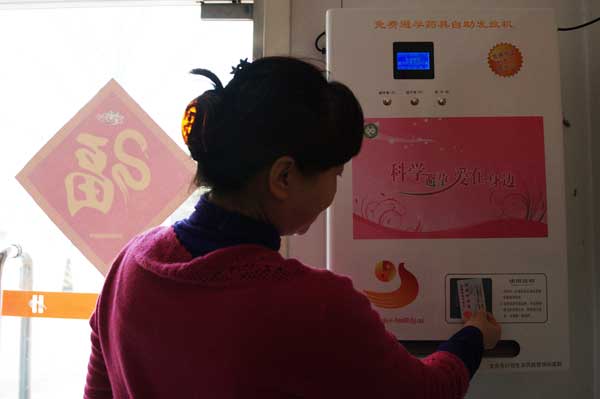
At an automatic contraceptive dispenser attached to a wall, he selects a button, presses his ID card against the dispenser and a box of condoms drops down, free. The whole process takes less than a minute.
 |
|
Beijing residents can use their second-generation ID cards at automatic dispensers across the capital to receive free contraceptives. Wei Xiaohao / China daily |
"They're not bad, although the package design looks a bit outdated compared with those on sale," said the Henan native, who moved in with his girlfriend a few months ago.
The dispenser saves him money, he said, but also the embarrassment of buying condoms in a shop.
He said his plan once went awry. "I was very embarrassed because the machine kept dropping condoms and I had to unplug it to make it stop," he said.
Yuan is one of more than 228 million youths aged between 15 and 24 years who have benefited from the free distribution of contraceptives in recent years, according to the National Population Census.
"The goal is to prevent unwanted pregnancies, particularly among the unmarried, and to improve reproductive health in general," said Lu Jiehua, a professor of social demographics at Peking University, ahead of World Population Day, which falls on Thursday.
This year's World Population Day focuses on adolescent pregnancy.
Statistics from the National Health and Family Planning Commission show that the government spent 2.47 billion yuan ($402.5 million) on distributing contraceptives during the course of China's 11th Five Year Plan (2006-10).
"That's actually not enough because we are now looking at unmarried youths as new targets," he said.
Historical concern
Back in the late 1970s, the government began distributing free contraceptive tools, along with related services, mainly to facilitate China's family planning policy, which limits most Chinese couples to just one child. The efforts targeted married couples and were applied through their official working units.
To date, China has 37 provincial-level distribution outlets involving more than 700,000 workers, full and part time, according to the National Health and Family Planning Commission.
The service continues today and mainly includes contraceptive medicines, condoms and intrauterine devices, which satisfy the reproductive health and family planning demands of people at a reproductive age, said Yuan Xin, a professor of population studies at Nankai University in Tianjin.
"It became an important public service and population management policy on the mainland, unique to China, and it played a role in controlling population size at first," he noted.
The first 100 automatic dispensers were put into use in Beijing in 2004 to allow married women to get condoms and pills for free with an ID card, which could be obtained at local communities.
In recent years, however, the population management authority has started to consider a further expansion of the policy to curb the rise in unwanted pregnancies and abortions, particularly among the unmarried young.
According to previous media reports, China has at least 10 million abortions each year, half involving unmarried women. The situation is largely due to a lack of education in reproductive health among youths in school, according to Lu.
He supports the distribution of free contraceptives to unmarried youths, who are highly sexually active, and he says regional pilot projects are already under way, making use of a wide range of user-friendly distribution channels, such as online ordering and automatic dispensers such as that used by Yuan Fengkai.
High-tech ID cards
Targeting unmarried youths has required a shift in emphasis, with a more anonymous distribution system, allowing young people to access contraceptives through various channels and for free. And it is here that second-generation ID cards have come into their own, since they carry a range of data on the owner and can be used to swipe for services without face-to-face contact.
According to Gao Jianzhen, director of the family planning office for the Xiaoguan area of Beijing's Chaoyang district, anyone aged between 18 and 60 can get a box of condoms with their second-generation ID card, which has a computer chip.
"They can use the card again and get another box after 20 days," she said.
The dispenser installed late last year in the reception hall of the Xiaoguan community's office is one of 20,000 manual and automatic dispensers installed across Beijing from which contraceptive pills and tools, including condoms, are accessible.
"Although now only those below 60 years old can get condoms through dispensers operated with second-generation ID cards, those above 60 may be included in the future after further evaluation," she said.
Throughout Chaoyang district, more than 400 automatic dispensers have been installed in public places, such as community areas, shopping malls and streets with bars. They include 70 dispensers operated with second-generation ID cards, which altogether issued about 2 million boxes of condoms in 2012, according to Ma Tenglin, deputy director of Chaoyang's management station for family planning tools and pills.
"Dispensers operated with second-generation ID cards enjoy advantages over other automatic dispensers or manual facilities, as they are linked with the intelligent system based at the stations, which collect and display information on the use of such dispensers," Ma said.
The monitors at the stations can show real-time information on how many condoms are left in each of the dispensers, he said, so the station can replenish condoms when necessary.
"A total of 130 new dispensers operated with second-generation ID cards will be installed in Chaoyang district this year," Ma said.
Tang Xuebo, who works for Changsu Express, said the company cooperates with the family planning station in the Chaoyang district and he replenishes dispensers on the orders of his company when there are few condoms or pills left.
In Beijing, such tools and pills are most needed in communities with a large number of migrant workers, Ma said. "And about 80 percent of the users are men."
Two-thirds of people using the dispensers operated with second-generation ID cards are migrant workers and about 60 percent of users are between 25 and 40 years old. Meanwhile, those between 50 and 60 years old use the dispensers least, accounting for only 4 percent, according to information collected through ID cards.
Expanding the system
Having proved a hit in parts of Beijing, the system is now being piloted in other parts of the country. In Nangchang, capital of Jiangxi province, for example, a dispenser was installed at a university in June.
"This trend should continue in the future, so as to better reach unmarried youths," Lu Jiehua noted.
To consolidate such efforts, "the government needs to formally include unmarried youths as service targets while allocating funds and making it an item under family planning work evaluation," he noted.














Registration Number: 130349


