Nesting birds halt work at homes site
Work at a construction site in Xinzheng, Henan province, has been halted to protect thousands of birds nesting in sidewalls of the foundations.
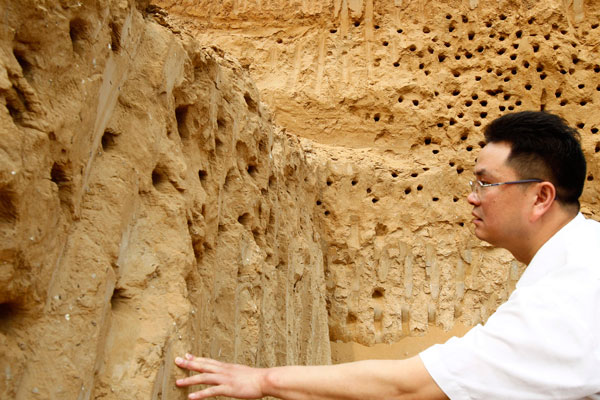
The western and southern sidewalls of one foundation pit are pockmarked with thousands of holes, each with a diameter of about 7 centimeters.
 |
|
A reporter checks holes dug by nesting sand martins at a construction site in Xinzheng, Henan province. Wang Zhongju / For China Daily |
Sand martins fly out of the holes from time to time to join others circling as an excavator works noisily nearby and workers labor in other foundation pits.
The site is the relocation project for Zhenglaozhuang village in Longhu town. Part of the work there has stopped to protect the unexpected guests, with Internet users describing it as "a construction site with love".
"I've never seen nests on a wall of earth. We should definitely protect them," said villager Zheng Changxing, 63, who lives in a simple mobile home nearby while waiting for a new house to be built at the site.
Sand martins are migratory birds in the swallow family. They like to nest close together, especially on mud beaches and in sand cliffs near rivers, lakes and streams.
The construction project had been halted several times for different reasons, and the birds started to build nests when construction was suspended in April. The hatching period of the sand martin lasts about two weeks and it takes another two weeks for the nestlings to fledge.
Niu Huichuang, director of engineering at Zhengzhou Haochuang Real Estate Developing Co, said he discovered the nests in the middle of May and left them to be protected. Villagers will now have to move into their new homes later and more money will have to be paid to the construction team for working overtime.
Yang Weizeng, deputy director of Xinzheng's Forestry Bureau, said: "It's a dilemma. On the one hand, we should protect wild animals, but on the other hand time for the relocation project is very pressing."
He said the bureau sent professionals to investigate after reading a media report about the birds on May 20. After negotiating with village committees and the construction company, and consulting with experts, an agreement was reached to suspend construction where there were nests, while speeding up construction nearby.
Some baby birds have hatched and will leave the site in July, when construction will continue.
Villager Zheng added, "Although some work has stopped, other construction work is continuing. It won't affect us much."
Li Changkan, curator of Zhengzhou Museum of Natural History said: "The construction work does affect the sand martins because they will fly out of their nests when there are too many people around. But it's OK, because they're not afraid of humans."
He said the birds stay in Zhengzhou and surrounding areas from mid-March to late September, before flying to spend winter in the Philippines. Sand martins are common in most places in China, but are rarely seen by humans because they often nest in non-residential areas and their numbers are not large.
Cui Sheng, a volunteer from Green Henan, an environmental protection NGO, visited the construction site with several Internet users when they read the media report.
"Nests were well-preserved, although some were ruined. We called the forestry police and staff from the Forestry Bureau. They came to talk to us and were supportive of the temporary shutdown of construction," he said.
Internet users were moved by the construction company's care for the birds after Cui and some netizens posted photos on Sina Weibo, China's Twitter-like service.
This is not the first time sand martins have nested at a construction site in the city. Last May, work at a site had to be stopped for about two months after sand martins nested in the sidewalls of a foundation pit.
Li said five sand martin habitats have been identified in Zhengzhou and surrounding areas, two of which are in Xinzheng. Sand martins were first found in the areas by villagers from Xingyang city in 1999.
Li and Cui took part in a seminar on Friday along with bird experts, university students and bird lovers to discuss how to protect sand martins.
They agreed to call for the public to help the local government protect the birds' habitats so that they can breed.
Non-governmental organizations such as Henan Wild Birds Association and Green Henan will observe, record and analyze the birds' breeding behavior, their distribution and habitat choices to see whether a reserve or habitat can be built for sand martins.
"There should be a volunteer system so that similar habitats can be protected immediately they are discovered," Cui said.
The sand martin is just one example of how urbanization can affect wild creatures, Li said.
He said increasing urbanization has affected barn swallows the most. As many people now live in blocks rather than homes with tiled roofs, it is difficult for the birds to nest on smooth ceramic tiles. With green fields disappearing, swallows also have less food as there are fewer insects.
But Li said the public can take some measures to assist the birds by simply leaving several nails in windowsills or under eaves to help the swallows to build nests.
Zhang Zhengwang, an ornithologist and conservation biologist, agrees.
As urbanization will continue in China in coming decades, Zhang suggests that cities should build a complicated ecosystem with a greater variety of plants.
"We want to live with fresh air, green mountains, clear water and singing birds. Everybody should make efforts to maintain such an environment," Zhang said. "If we don't pay enough attention, wild creatures will disappear in cities after the ecology is damaged."
Liu Xiangrui in Beijing contributed to this story.






- Shanghai's rail mileage now ranks first in the world
- Hidden in wasteland: Subway station that's nearly impossible to find
- Soldiers who safeguard China's 'green treasure'
- 'Hawks of Thunder': PLA South China Sea Fleet conduct advanced flight training
- DPP to blame for international exclusion of Taiwan, official says