Defining middle-class
The hottest market sector of the Chinese population will stimulate the country's development in many ways, one analyst tells Liu Wei.
John Ross, senior fellow, Chongyang Institute for Financial Studies, Renmin University, analyzes the Chinese middle class in relation to both China and the Western world.
|
 John Ross, senior fellow, Chongyang Institute for Financial Studies, Renmin University. [Photo/China Daily] |
To be meaningful, 'middle class' must refer to international standards for incomes equivalent to developed countries. That would include ownership of a house, ownership of a car, the ability to take an annual foreign or prosperous domestic holiday. Chinese households able to afford these would be considered middle class by international standards.
Compared to the middle class in Western countries, what's unique about the Chinese?
The main specific feature of Chinese middle-class families is the extremely high proportion of their income that goes to housing. This is far higher than in Western countries. For example, the price of an apartment in Beijing or Shanghai is not greatly below the price of an apartment in London but, of course, average income in Beijing and Shanghai is much lower than in London. In all countries, the cost of buying a house is considerable but the cost relative to salary is much higher in China.
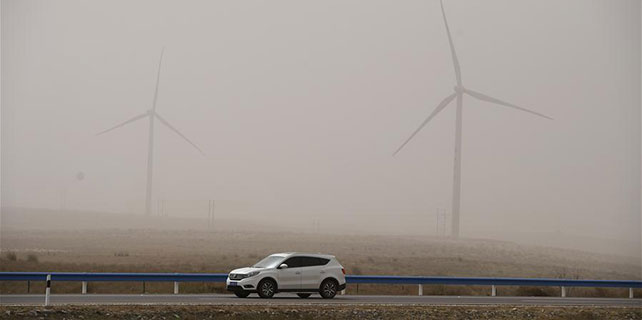
The Chinese middle class can afford houses, cars and shopping abroad, but some basic elements of life, like clean air, water and food are hard to come by. How do you see that?
This is a feature of China's specific stage of development. China's GDP per person is equivalent to the UK at the beginning of the 1950s, although China's current economic growth rate is far higher than the UK at that time. As such, it will not take 50 years for China to catch up.
There was the catastrophic London smog of 1952 from which 12,000 people died. It took approximately 15 years of very determined policies to overcome this problem in London. This was symbolized in the UK's Clean Air Act.
If China adopts similarly strong policies for reducing smoke and vehicle emissions, reducing pollution by power stations etc, these problems will also be overcome.
It is for these reasons that the development of a middle class requires not only increases in personal income but also increases in government expenditure as only State action can deal with such problems as pollution.
Therefore, the middle class' calls for relevant policies by the government will rise as well.
Owning a house has been an obsession in China. Many agree that one cannot qualify as a member of the middle class if you do not own your home. What is the situation in your country? And what is your opinion on this obsession in China?
Owning one's own house seems to be an obsession in Anglo-Saxon countries (US and UK) and in China. But it is not so in most of Europe or other countries. In Germany, for example, the most economically successful country in Europe, only a minority own houses and the majority live in rented accommodation.
Actually owning property is simply a form of ensuring security of tenure, saving and an anticipation of a possible capital gain - in particular saving for one's children.
Where there is a serious economic problem is if people expect to achieve a capital gain on owning property. This is economically dangerous.
A house in which you live is not a productive asset which increases output. So an increase in the value of a house is simply a transfer from someone else - someone who does not own a house. This type of transfer is not economically productive and therefore the economy should not be organized in such a way that people make large capital gains on houses.
The Anglo-Saxon and Chinese obsession, is to some degree, economically destabilizing. The financial benefits used by the Anglo-Saxon states to increase house ownership are very big, however, and for that reason, I own my own house despite the comments I made.
What do you think the Chinese middle class can do to become more involved in social issues and develop their own voice?
As the Chinese middle class develops it will find, like the middle class in any other country, that it requires social and government action to improve standard of living and that increases in personal income alone is not enough.
Problems such as clean air, freedom from pollution, education, and health all require government as well as personal participation. Demand for social and government action to improve living standards will increase as the middle class grows in China.
Do you think the Chinese middle class will change the country, and perhaps, the world in some way?
The emergence of a very large Chinese middle class will change the entire world. The present total population of all countries defined by the World Bank as 'high income' is 16 percent of the world's population. The definition of a 'high income' economy is one with a GDP per capita of slightly over $12,000 per year. It will take China about 15 years to achieve that level.
But China has 19 percent of the world's population.
China becoming a 'high income' economy, accompanied by the creation of a very large Chinese middle class, will more than double the percentage of the world's population living in high-income economies and double the size of the world's middle class. This will equivalently double the world's demand for cars, higher quality electrical goods, high quality health care, foreign travel, entertainment and so on. The creation of a large Chinese middle class will change the entire economic structure of the world.
Within China, the creation of a middle class will particularly boost the demand for service sectors such as education, health, media, travel, entertainment. This will be an even greater increase than for high quality manufactured goods. This is because expenditure on service sectors rises much more rapidly than on physical products.