Shipping: A hard life on ocean wave
Oversupply, falling profits
 |
|
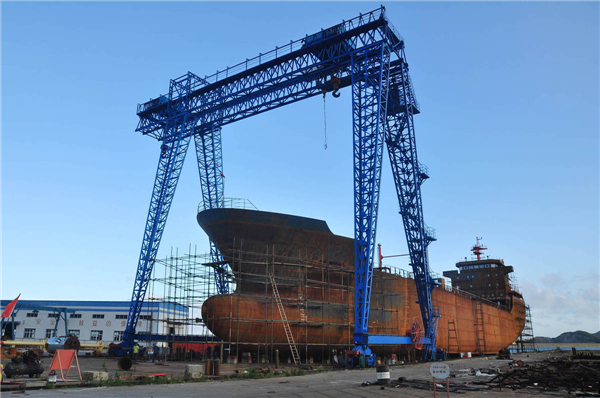
Beilun Yisida Shipyard in Ningbo city, Zhejiang province, is struggling to survive amid a global decline in the shipping industry. [Photo by Hu Xuejun / for China Daily] |
The shipbroker Clarkson PLC estimates that there is a 20 percent oversupply in the global fleet, but owners are ordering new and more-fuel-efficient ships in almost record numbers.
And, given the time lag between ordering a ship and receiving it, 2014 is not likely to be much better for the industry.
"The margin between revenue and operational costs today is extremely narrow. Owners are finding things extremely tough," said Martin Rowe, managing director at Clarkson Asia Ltd.
The addition of new shipping capacity to an already weak market is likely to extend those difficult times well into 2015.
Shipping companies have generally reported weak results for the last year and few expect to do much better in the year ahead. Meanwhile, freight rates for Capesize vessels have dropped from a peak of $90,000 per day in January 2009 to a little more than $10,000 during the last quarter of 2012 and the first quarter of this year.
According to Drewry Maritime Research, the average daily bulk-shipping rate for a Capesize vessel rose to $40,300 in 2010, before falling sharply to $11,700 in 2012.
AP Moller-Maersk reported a 33 percent drop in annual profits in February 2012. The company's profits have rebounded this year, but only after the Scandinavian shipping giant reduced capacity and raised fees. In a statement released in February, the company said it expects profits to be lower this year than in 2012 because its container shipping operations have come under pressure.
Meanwhile, COSCO, largest operator of dry bulk ships by capacity, warned in January that it faces significant losses for 2012. In common with other shipping companies, COSCO has been hit by low freight rates. In 2011, it lost $1.7 billion and expects similar losses this year.
All the doom and gloom has created another problem for the industry; financing is drying up. Banks are increasingly unwilling to extend loans to buy new and better ships and it can be difficult for companies to restructure to deal with existing debts.
The troubled times in the industry have attracted private equity investors looking for opportunities to buy cheap. While banks such as HSBC, Lloyds and Royal Bank of Scotland are all trying to get out of their shipping loans, alternative investors such as Apollo, Blackstone and Centerbridge are snapping them up at prices they hope will prove to be bargains.
The challenges for the container shipping industry are not dissimilar to those facing the oil-shipping sector.
"(It's) the usual reason: It's the overhang of new building in the order book," said shipping expert Peter Illingworth.
Saving grace
 |
|
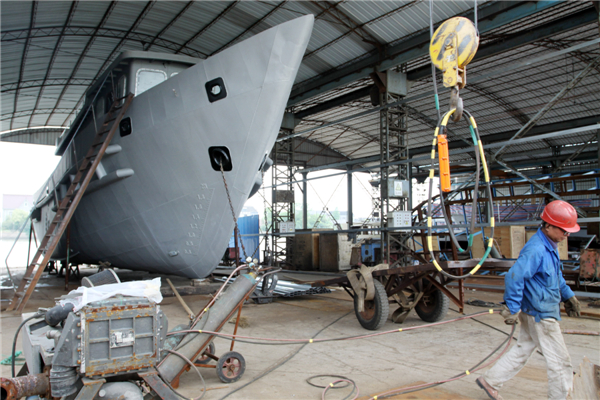
Employees working on a new vessel at a profitable small shipyard in Jiashan county, Zhejiang province. [Photo by Hu Lingxiang / for China Daily] |
The only saving grace in the oil shipping business is China. Chinese companies are buying up new ships as oil imports continue to rise.
"(China) is a great engine for demand growth," said Illingworth. "The reason to be cheerful about China is that the country is increasing its seaborne imports of crude dramatically."
China is increasing its crude imports by about 17 percent per year, according to Clarkson. The extra demand is welcome at a time when the US is reducing seaborne imports.
The silver lining may be that most industry insiders expect 2013 to be the absolute bottom of the shipping rates cycle, while some companies have figured out ways to stave off the bad times by raising their rates and slowing down their ships, in effect cutting supply.
By the end of the year, supply growth could slip below demand growth. That would be the beginning of the turnaround and good news for the industry - the first in a long time, according to Peter Wijaya Surya, managing director of Aptus Maritime Ltd.
"We have gone through the biggest bust in the history of shipping," he said.
Related:
Shipyards battle to stay afloat