Comments
  Print
Print  Mail
Mail  Large Medium Small
 |
|
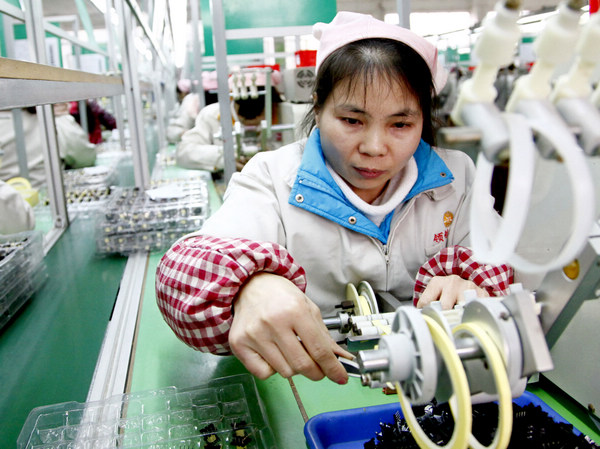
A woman works in a factory in her hometown in Huaying, Sichuan province, on Jan 22. After returning home for Spring Festival, the former migrant worker found a job closer to home. [ZHOU SONGLIN / FOR CHINA DAILY] |
Many inland provinces are successfully attracting migrants from coastal manufacturing hubs, raising fears of a more serious labor shortage in coming years.
One worker who found a new life at home is Ren Min, who had worked in toy and garment factories in Guangdong province for seven years before he returned to his hometown of Nanchong in southwestern Sichuan province in 2009.
In 2005, Ren married a woman who also worked in Guangdong. The couple had a baby the next year. When he reached 1 year old, they sent the boy back to Sichuan to be cared for by his grandparents.
Ren, 32, now works at a bottle supplier for Carlsberg in Jialing Industrial Park in Nanchong.
"We missed our son very much after we sent the baby back home, so we decided to go back and find a job near home," he said. "I now earn almost the same salary as I did in Guangdong. I feel satisfied about my current life because I can stay with my family and take care of them."
Another former migrant worker, Luo Haiqing, went to work in a water tap factory in Guangdong's Shenzhen city after he graduated from a technical school in Nanchong in 2004.
Luo could save at most only about 10,000 yuan ($1,600) a year during his four-year stay in Shenzhen due to the high cost of living. Luo returned to Nanchong and found a job in the industrial park in 2009.
"Now I earn more than 3,000 yuan, sometimes even 4,000 yuan, a month and I can save about 20,000 yuan a year," the 25-year-old said. "I earn almost the same or even higher wages at home than the sum I earned in Shenzhen, so why shouldn't I come back?"
Jialing Industrial Park was built in 2007 and is home to about 100 automobile and garment manufacturing and food processing enterprises, employing more than 30,000 workers.
Luo Deguo, who is in charge of employment at the State-run industrial park, said nearly half the workers in the park are locals who used to work in coastal regions.
Luo said migrants started to come back to work in 2008 when the global financial crisis hit many export-oriented manufacturers in coastal areas.
More than 2,000 people returned and found a job in the industrial park in 2012, Luo said.
Luo said that as an increasing number of migrants are going home for Spring Festival, his office is receiving more than 100 calls a day inquiring about job opportunities.
Luo said a reason many migrants return is that all enterprises in the park are asked to pay social security premiums for employees, while many small firms in coastal regions don't have such mandatory premiums.
Luo said his park will have about 2,000 vacancies after Spring Festival.
"We plan to hold a job fair during Spring Festival, and we are handing out pamphlets providing job information to every town and village in Jialing district hoping to attract more workers to stay and work at home," he said.
Southwest China's Chong-qing, a major labor source, is expected to see 300,000 migrants workers return to work this year, according to municipal authorities.
About 410,000 laborers returned to the city in the first 11 months in 2012, according to Wang Caizhi, a labor official with Chongqing's Human Resources and Social Security Bureau.
Of those returnees, 368,000 were employed and 43,000 started their own businesses, he said.
"Chongqing is attracting more world-famous enterprises to set up factories, so there are a large number of job opportunities for migrants," he said.
In addition to the shrinking wage differences between Chongqing and coastal provinces that lure locals back, the government is also making efforts to attract and keep workers.
The city provides skills training for workers and offers them low-rent housing, which costs around 10 yuan per square meter a month, Wang said.
However, as inland provinces' efforts to lure migrants are paying off, enterprises in coastal regions are feeling the pinch to retain employees.
Zhang Yi, an expert in labor economics at the Chinese Academy of Social Sciences, said that as the country's work-age population is decreasing and manufacturing industries are moving from coastal regions to inland provinces, the overall labor shortage will continue.

 Watermelons now come with scannable data
 Rubber Duck falls into Victoria Harbor
 Car wreck over car parts quality claim
 Gales, hailstorms batter villages in SW China
 Ram with artificial heart sets survival record
 The future of wearable computers
 Anniversary quake drill jolts students
 15,000 tour memorial hall on quake anniversary
Copyright 1995 - 2010 . All rights reserved. The content (including but not limited to text, photo, multimedia information, etc) published in this site belongs to China Daily Information Co (CDIC). Without written authorization from CDIC, such content shall not be republished or used in any form. Note: Browsers with 1024*768 or higher resolution are suggested for this site.
License for publishing multimedia online 0108263 Registration Number: 20100000002731