Comments
  Print
Print  Mail
Mail  Large Medium Small
3. It was recorded that in the early 7th century, Tubo held a grand ceremony after establishing its own written language and laws. Participants performed dances with masks playing lions, tigers, leopards and cattle. The ancient cliff paintings in Ritu County, Ali Prefecture, Tibet, also showed dancing scenes and masked dancers, drawn clumsily. They indicated that the mask art had appeared in the ancient witchery, Ben religious ceremony, Tibetan dance, and beast-imitating dance in Tibet. When Padmasambhava, an Indian eminent monk, entered Tibet, he absorbed the merits of early-stage Tibetan dance and integrated them with the Devaraja dance of the Esoteric Buddhism to gradually created the masks for Qiang Mu, the spell dance.
4. According to the records of Taer Temple and Biography of Dalai Lama VII, Kelzang Gyatso, the senventh Dalai Lama instructed the 20th abbot to set up Qian Ba Zha Cang (dance school) in Taer Temple in 1716, the 55th year of Emperor Kangxi of Qing Dynasty. He sent the dance master of Potala Palace to impart dancing skills. He also gave 34 masks for the roles of Dharmaraja and horse-head thunderbolt, and other dance robes and rirual implements. When it was established, the religious dance Qiang Mu in Taer Temple was improved by absorbing the merits of Drum Dance, Beast-imitating Dance, and Folk Custom Dance of local Tibetan cultures, and the witchery dance of the Ben Religion. They eventually developed into the present mask dance to express metempsychosis through imitating beasts. It is seen as the cradle of the Qiang Mu mask dance in Qinghai Buddhism temples.
 |
As shown in the above materials, the first three sayings presented how Qiang Mu originated. The fourth source illustrated that Qinghai Qiang Mu masks were delivered from Tibet Qiang Mu, projecting a line on the origin of Qinghai Tibetan masks. As Tibetan Buddhism culture spread to other parts of the country, Qingkang and Anduo took the initiative to absorb the merits of all schools of Tibetan masks, integrated them with local Tibetan culture. During the period, generations of artists kept enriching and improving them, with innovations. They subsequently cultivated the unique plastic art system of Qinghai Tibetan masks.
Qinghai masks are classified into the religious and folk types. Religious masks constitute the bulk. Qinghai masks fall into three modes, which are Qiang Mu masks, Tibetan drama masks, and folk dance masks. They have projected all the features of the Qinghai mask art.
Qiang Mu masks
Tibetan Buddhism temples spread all over Qinghai province, with diversified religious sects. Therefore, the temples in all these areas present various features in performed Qiang Mu and masks.
Tsong Khapa, founder of the Gelug Sect, was born in Taer Temple, one of the six most famous temples of the Gelug Sect. The temple was a holiest site in Buddhism and a palace of art, exerting influence of religion, culture and art at home and abroad. The Qiang Mu of Taer Temple is also a typical representative of the Gelug Sect Qiang Mu. Its masks are complete in varieties, graceful in style, presenting unique artistic quality. In the regional dialect, Tiao Qian is also termed Ga Er Qian, sharing a same origin with Cha Ma of the Mongolian region. They are all Buddhism maintenance rites. Qiang Mu of the Taer Temple has witnessed great changes in performance styles, compared with what it was introduced from Tibet.
The folks would compare Qiang Mu of the Taer Temple vividly as a patient. It shows great changes have taken place in Qiang Mu of the temple, from temperament of the masks, emotions in performances, and rhythm. When Qiejia Dharmaraja (wearing ox head mask) and Danzheng Dharmaraja (also known as horse-head Dharmaraja or horse-head thunderbolt), in angry look, come on the stage, followers would kowtow, present a hada and donations, posing a solemn and forbidding scene. For a long time, Qiang Mu has attracted followers to come and worship, because of its unique artistic charms. The followers would “bow to see the image,” and “nod when hearing the sound.” It projects that people regard the disguised deities from the masks with reverence. In this sense, Qiang Mu deepens piety of monks and common people towards Buddhism, contributing to promote Buddhism and the dogma. Qiang Mu masks are embodiment of deities. They represent the images of certain divine beings in the mysterious world. It makes a great impact on people with aesthetic forms for all tastes, playing an enlightenment role beyond chanting Buddhism sutras.
 |
The Yushu Tibetan region of Qinghai belongs to the Kangba language area. In the early stage, Tibetan Buddhism was dominated by the Sakya Sect. Along with the rising of the Gelug Sect, some temples converted to the Yellow Sect. In the temples of all these sects, Qiang Mu masks are of various forms. Some dart fierce looks of hate and reveal the ferocious features of an ogre. Some look benevolent, earnest and calm. The mask of Qiejia Dharmaraja shows in spell dance, full of power and grandeur. Jiuxie (Four Thunderbolt) is a spectacular collective mask dance, exhibiting emotionally charged and solemn atmosphere.
Among the Qiang Mu performed in the temples of the Yushu Tibetan region, masks are represented by peacocks, the god of longevity, and five-color deer. They are known as masks to perform Han cultures. The sculpts resembling the senile god of longevity of the Han nationality are basically mirrors of the Central Plain. As shown in documents, the Qinghai-Tibet Plateau barely witnessed any fierce political and religious fights since the Yuan Dynasty. The political and social structures were stabilized. During the period, the art images trasferred from the Han culture, such as the God of Longevity, monks, arhats, immortals, and monkeys, were admitted by Tibetan esoteric Buddhism masks. Some temples in the Tibetan region remain to keep providing for almsgivers, big and small monks, and celestial beings. Because of the mutual impacts and penetration of Han and Tibet cultures, there emerged the splendid Kangba facial makeup art.
Tongren is a representative region hosting the Anduo Tibetan culture. Tibetan Buddhism sects are advanced here. Qiang Mu becomes a splendid legacy in all the temples, featuring exquisitely processed, brilliant facial makeup of diversified styles. The temples have special dressmakers to produce garments to fit every role of the masks. The masks are meticulously procesed by skillful sculpture craftsmen from the temples or the society. The roles as expressed by the facial makeup are largely guardian gods of the temples, who are presented in sculptures and paintings in all halls. The facial makeup is equally sacrificed as the deities themselves. To incarnate the deities with facial makeup means to vividly manifest static deity and Buddha sculpts with the Qiang Mu (dance) artistic form. It materializes the abstract stories in Buddhist sutra to reach the objective of promoting the Buddhism doctrines. This is a unique function of the facial makeup hardly accessible by other means and forms.

 Grannies turn streets into strange dance floors
 Beating the heat with mahjong, water fights and massage
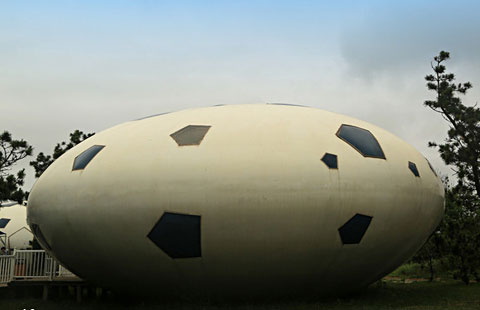 Architect's dream ... or nightmare
 Mother hens for newborn peacocks
 Students out to make their mark in Chinese calligraphy
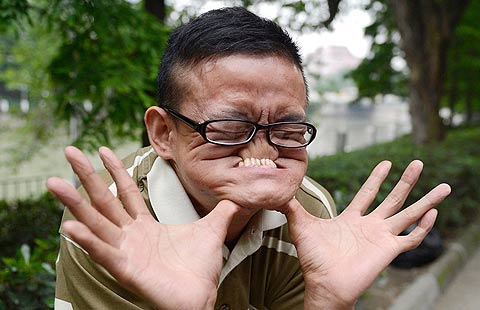 Strange, offbeat and really silly stunts
 Samba heats up Hangzhou
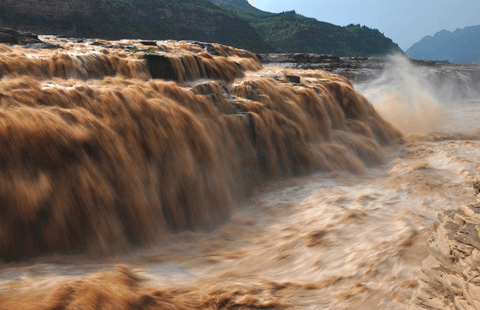 Yellow River churns with seasonal rainfall
Copyright 1995 - . All rights reserved. The content (including but not limited to text, photo, multimedia information, etc) published in this site belongs to China Daily Information Co (CDIC). Without written authorization from CDIC, such content shall not be republished or used in any form. Note: Browsers with 1024*768 or higher resolution are suggested for this site.
License for publishing multimedia online 0108263 Registration Number: 20100000002731