Comments
  Print
Print  Mail
Mail  Large Medium Small
|
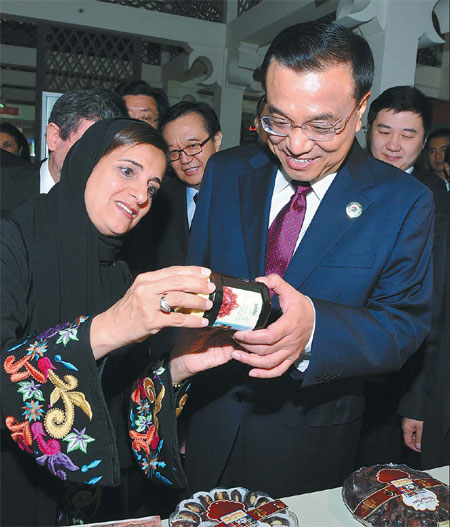
Vice-Premier Li Keqiang and UAE Foreign Trade Minister Sheikha Lubna bint Khalid bin Sultan Al Qasimi inspect goods at the China (Ningxia) International Investment and Trade Fair in Yinchuan on Wednesday. Su Baowei / for China Daily |
Vice-premier envisions greater cooperation in key sectors
China should enhance cooperation with emerging Arab markets in investment, trade and energy to fend off the global financial crisis, Vice-Premier Li Keqiang said on Wednesday.
"There are a wide range of sectors where China and Arab states could cooperate more deeply," as China is committed to further opening its western regions, Li said during a keynote speech at the third China-Arab States Economic and Trade Forum in Yinchuan, capital of Northwest China's Ningxia Hui autonomous region.
China has approved the establishment of "an inland opening-up trial zone" in Ningxia and "a comprehensive tax-free zone" in Yinchuan as part of a major effort to promote economic opening-up of the region, home to more than 2.2 million Muslims of the Hui ethnic group.
Trade between China and Arab states reached $200 billion in 2011, up 35 percent from a year earlier. Two-way investment grew eightfold during the last decade.
"China welcomes companies from Arab countries to invest in China, particularly in the finance, chemical and renewable energy sectors and those related to the daily lives of Chinese people," Li said.
China also encourages its domestic companies to "invest in manufacturing and infrastructure in Arab states," he said, adding that China is also wiling to buy and consume "competitive goods made in Arab countries".
While European debt woes deteriorate and US economic growth stalls, developing countries are the new growth engines.
"China is willing to partner emerging markets, infusing vigor and dynamism into the world economy," Li said.
Linking up with emerging markets is a good strategy, Wang Xiaolu, deputy director of the China Reform Foundation's national economic research institute, said, especially as China's exports to more traditional destinations weaken.
According to the General Administration of Customs, export growth slumped to 1 percent in July, and has been declining since the latter half of last year.
"We have noticed robust growth in trade" during the past few years between China and the Arab world, which spans nations in the Middle East and North Africa, Li said.
The "Arab Spring" has seen some countries focus more on the economy and improving living standards and China can help with industrialization, urbanization and developing a modern agriculture sector as it transforms its economy with a greater focus on consumption.
The government is prioritizing westward development by establishing special economic zones.
The latest is in Ningxia, where China plans to establish a trial zone for opening up the interior, and is also the location for the annual China-Arab States Economic and Trade Forum.
"China has the technology, market and well-developed industries," and as the Arab world undergoes transformation the potential for bilateral cooperation is huge, Li said.
Qiu Hong, assistant to the minister of commerce, agreed. "As both are in a crucial period of transformation, China and Arab states should deepen their cooperation to fend off global risks," Qiu said at the forum.
Both parties can improve cooperation and expand trade and investment, Qiu said.
The Ministry of Commerce sent trade delegations to 11 Arab countries in 2011.
In 2004, heads of China and the six Gulf Cooperation Council members announced the start of the China-GCC free-trade agreement talks.
Five rounds of talks have been held so far.
"China and the GCC should expand two-way investment and diversify the trade structure," said Bahrain Minister of Finance Ahmed Al Khalifa.
In 2011, China-GCC trade jumped 44.5 percent year-on-year to $133.8 billion, with Chinese exports to the region surging by 30 percent and imports increasing by 53.8 percent.
Heads of China and the Arab states set a trade target of $300 billion by 2014. "We are capable of reaching the target in two years," said Sheikha Lubna bint Khalid Al Qasimi, minister of foreign trade of the United Arab Emirates.
China is the second-largest trade partner for the United Arab Emirates, and in 2011, bilateral trade stood at $16 billion. "China is very important for us," the foreign trade minister said.
Contact the writers at dingqingfen@chinadaily.com.cn and lijiabao@chinadaily.com.cn
(China Daily 09/13/2012 page1)

 Continuous rainfalls affect millions of people across China
 First heat wave hits Shanghai
 Heartwarming stories during China's floods
 Torrential rains wreak havoc across China
 Dam's floodway blasted to discharge water in Hubei province
 In pics: Installation process of world's largest telescope
 How much spice can you take?
 Yangtze River reaches flood stage for first time this year
Copyright 1995 - . All rights reserved. The content (including but not limited to text, photo, multimedia information, etc) published in this site belongs to China Daily Information Co (CDIC). Without written authorization from CDIC, such content shall not be republished or used in any form. Note: Browsers with 1024*768 or higher resolution are suggested for this site.
License for publishing multimedia online 0108263 Registration Number: 20100000002731