 |
|
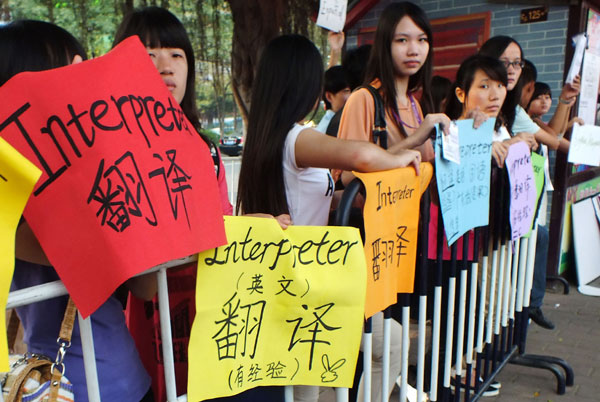
Part-time Interpreters wait for employers during the Canton Fair on Oct 23 in Guangzhou, capital of South China's Guangdong province. Liu Jiao / for China Daily |
China's translation industry will enjoy rapid growth during the 12th Five-Year Plan (2011-15) period, yet a shortage of talent will hinder that development.
That's the conclusion of a new report from the Translators Association of China, which on Thursday marked its 30th anniversary in Beijing.
The association released its first China Translation Industry Annual Report, which is also the first report released by a translation-industry authority in China. The association will publish the report yearly.
"The China Translation Industry Annual Report is significant because it provides a reference for the scientific planning of the industry," said Tang Jiaxuan, honorary president of the Translators Association of China.
According to the report, translation companies enjoyed an 18.4 percent annual increase in number between 2003 and 2011, and a 15 percent yearly growth rate is expected during the 12th Five-Year Plan period. China now has 640,000 people involved in the translation business.
"In the past 30 years, the translation industry achieved historic success in fields including politics, diplomacy, economics, military, science and culture," said Guo Xiaoyong, deputy secretary-general of the China International Publishing Group.
"In the past, most translation institutions were affiliated with government departments or State-owned companies, but more and more private translation companies emerged amid the booming industry," he said.
Guo said China's trade deficit in book copyrights narrowed year by year. In 1999, the import-to-export ratio of publications was 15-to-1, while in 2011, the ratio fell down to 2.1-to-1.
Also, China's translators translated 9,763 books into different languages between 1980 and 2009. Besides traditional translating and interpreting services, the industry also developed in movie subtitle translation production, sign-language interpretation and machine translation.
However, the overall capacity of China's translation industry still "has a considerable way to go" to meet the market demand, Guo said.
"Although we enjoyed great growth in numbers, the quality of translation is not good enough," Guo said.
Because the translation companies pay relatively low salaries to employees and set low recruitment standards, there is cutthroat price competition among the companies for their services.
"For example, an important tender document may need six to 12 months' preparation, but translators are given only several days to translate the document into another language, so the quality is usually inferior," Guo said.
The China Translation Industry Annual Report estimated that by 2015, the annual output of China's language services will reach 260 billion yuan ($41.8 billion), providing 2 million jobs. But by the end of 2010, there were only 27,000 certificated translators across the country.
"Adding the translators working for government institutions, the number of qualified translators across China is merely 560,000, less than 10 percent of the total number of translators currently working in China," said Yang Yingzi, acting director of the National Translation Test and Appraisal Center under the China International Publishing Group.
The center is in charge of the China Accreditation Test for Translators and Interpreters, a test established in 2003 to evaluate translators' proficiency qualification. But there is no compulsive regulation that requires companies to hire only translators who are accredited by the test.
"The lack of uniform standard for translators result in spotty quality of translators, but the good sign is that more and more people are taking CATTI, and more and more companies are using the test as their recruitment requirement or preferred qualifications," Yang said.



Copyright 1995 - . All rights reserved. The content (including but not limited to text, photo, multimedia information, etc) published in this site belongs to China Daily Information Co (CDIC). Without written authorization from CDIC, such content shall not be republished or used in any form. Note: Browsers with 1024*768 or higher resolution are suggested for this site.
License for publishing multimedia online 0108263 Registration Number: 130349