Comments()
  Print
Print  Mail
Mail  Large Medium Small
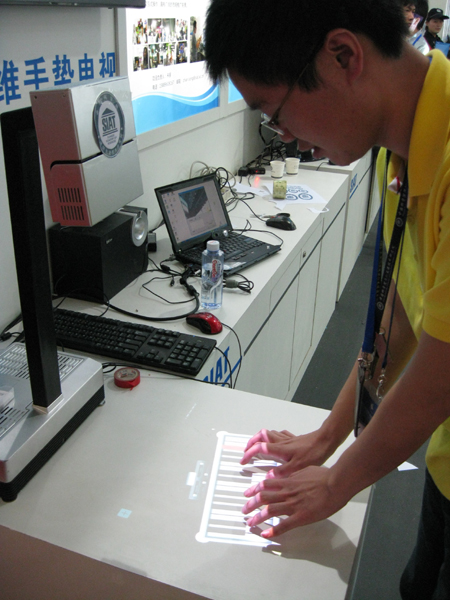
If you are bored sitting in front of your desk, staring at the computer, what you probably need is a new lamp — an intelligent lamp that projects onto your desk turning it into a large touch screen.
With such a lamp, you will be able to finish your work, surf the Internet, play games, or even play the piano by banging the "keys" on your desk — or on the wall if you wish — just connect the smart lamp to your phone or computer.
This is not the latest Apple gadget, but technology developed by the Shenzhen Institutes of Advanced Technology, one of the youngest research institutes under the Chinese Academy of Sciences.
"I used to have this stereotyped image that scientists at the Chinese Academy of Sciences were like those pedants who sit in front of their microscope, writing papers that people never understand, and brushing off interesting technologies," said Li Qing, a science reporter from Beijing, after seeing the lamp at a science and technology exhibition in Shenzhen.
 "I never expected they would develop such an interesting piece of technology."
The Shenzhen institute, together with some six other institutes, was established in the several years from 2006 to compliment the traditional role of the CAS. The new institutes focus on supporting the business sector with technologies.
The institutes are scattered throughout Ningbo, Guangzhou, Shenzhen, Xiamen, Suzhou, Qingdao and Yantai, and focus their resources on applied technologies, for example, breeding white shrimp in coastal regions of South China.
Having enjoyed some early success in the business world, the CAS authorized the establishment of three new institutes last week.
The three institutes, the Shanghai Advanced Research Institute, Tianjin Institute of Industrial Biotechnology, and Suzhou Institute of Biomedical Engineering and Technology, are set to meet the technical demands of local companies.
"The companies know exactly what kind of science and technology they need, and how to generate economic value from technology," said Shi Erwei, vice-president of the CAS.
"As China changes its development mode, it is essential to give companies more convenient access to high-quality sci-tech resources," Shi said.
Established in November 1949, the CAS is the highest-level scientific institution in China. It now has 60,000 employees working in 12 branch offices, more than 100 institutes, more than 100 national key laboratories and national engineering research centers, and about 1,000 field stations nationwide.
But the institutes, in most cases, place too much emphasis on fundamental research and lack the capacity for technology integration and product development.
"The institutes find no buyers for their innovations because their technology cannot be directly applied to production, while companies cannot find the technologies they urgently need," Shi said.
"The value chain linking the research and the production is so fragile."
Huang Weiguang, vice-president of the newly established Shanghai Advanced Research Institute, understands the "fragile" connection between scientist and businessman.
"In the past, when researchers made a breakthrough, their major concern was how to apply for research funds for government-sponsored projects, or how to win a prize. And they were certainly more anxious about publishing a SCI paper than applying the technology to products," Huang said.
Science Citation Index is a citation index published by Thomson Reuters, which covers 6,400 of the world’s leading journals of science and technology.
Huang has been a researcher at CAS’ Institute of Engineering Thermophysics since the 1990s and has had more than 30 papers published in international journals and won prizes granted by CAS.
"Now our goal is, that when a researcher has a new idea, the first thought in his or her mind is: which company will be interested? Rather than how to persuade the review committee of a government project," he said.
By the end of November, the institute had raised 740 million yuan ($118.7 million) for scientific research, 40 percent of the funds were from the business sector.
However, Pan Jiaofeng, deputy secretary-general of CAS, said the institutes should also give consideration to the demands of the nation.
"The establishment of the new institutes starts with the nation’s strategic layout," Pan said.
|
 |
|
A staff member shows how to use an intelligent lamp developed by the Shenzhen Institutes of Advanced Technology at a fair in Shenzhen, Guangdong province, in November. The lamp can project onto a desk and turn it into a touch screen. [Photo by JIAN JIE / FOR CHINA DAILY] |
"Currently, 90 percent of high-end medical equipment is imported from outside China, which contributes to the high medical expenses.
"The reason we established the new institute in Suzhou is that the region traditionally has supporting industries, so we connect the national strategy for sci-tech research with local capacity," he said.
"Our geographical distribution of sci-tech resources does not match with economic development in some regions, so we combine local demands with the national sci-tech strategy, and try to adapt our research to economic development," Pan added.
Similarly, the Tianjin Institute of Industrial Biotechnology received a warm welcome from local companies. Since the start of its construction in 2008, the institute has established eight joint laboratories with local enterprises, such as the King-york Group and China Oil & Foodstuffs Corp.
"During its construction, the institute received 30 percent of its research funding from local companies, which reflects that the scientific research it conducts is closely connected with the demands of local enterprises," said Bai Chunli, CAS president.
"The development of industrial biotechnology is crucial for industrial upgrading, as well as the revolution of the people’s lifestyle, so I hope the institute plays a larger role in enhancing the development of industrial biotechnology in Tianjin, and in the whole country."
Besides the three newly established institutes, at least two more institutes, the Chongqing Institute of Green and Intelligent Technology and the Haixi Institutes of Chinese Academy of Sciences, are in the process of being established.

 Modeling contest part of China-US exchange
 Specially fertilized tea
 Simulator to support A320neo commissioned
 China's cultural sector sees steady growth in 2011
 Travel chaos after snowstorm hits NE China
 Inflation expected to rebound in November
 Grain output grows for 9th consecutive year
 White House-like buildings in E China city
Copyright 1995 - 2010 . All rights reserved. The content (including but not limited to text, photo, multimedia information, etc) published in this site belongs to China Daily Information Co (CDIC). Without written authorization from CDIC, such content shall not be republished or used in any form. Note: Browsers with 1024*768 or higher resolution are suggested for this site.
License for publishing multimedia online 0108263 Registration Number: 20100000002731