|
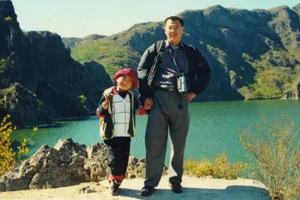
Yang Heping enjoys his life in Beijing, having previously lived in the United States. Kuang Linhua / China Daily |
Before Yang Heping realized he was really Fred Engst, he struggled with his American identity, something he only discovered when he went home for the first time at the age of 22. Han Bingbin tracks that journey.
When Yang Heping was 3, he noticed that he looked different from those around him and that people stared at him on the streets. Before he returned to the United States in 1974, Yang, whose Chinese name was given to him by Madame Sun Yat-sen, could only imagine what his homeland was like. He felt like an adopted child wondering what his natural parents were like.
For Yang, 70, his relationship with his own country and relatives was something intangible and abstract, just like the fact that he was really Fred Engst, son of two Americans who had come to China in 1949 to be a part of history.
Yang's father Erwin Engst, a young farmer, came to join the communist revolution after he was inspired by the book Red Star Over China written by Edgar Snow. Two years later in Yan'an, where he was serving as a farm equipment expert, he married Joan Hinton, also from the US.
Hinton was a physics scientist who had been involved in the Manhattan Project, the atom bomb program. But she resigned after seeing the horrifying destruction the bomb caused in Hiroshima and Nagasaki in 1945.
After refusing more profitable job offers, the Engsts later spent the rest of their lives on the suburban farms of Xi'an and then Beijing, devoting their energy and expertise to fueling China's agricultural development.
With the glowing tributes paid to his parents by both the people and the government, Yang says they were simply doing what they loved. Explaining why his parents chose to stay so long in China, Yang says it was the harmonious revolutionary atmosphere, where people were equal despite their differences and all were happily united in a concerted effort.
For Yang, his own road to accepting what he really is was a little bumpier.
Yang's grandmother used to send him clothes from the US, but he often found them too odd to wear. In 1962, the old lady came to visit her grandson and became the "first foreigner" young Yang had ever met. Barely speaking any English and reluctant to learn, Yang had little to say to her.
It was not until the late 1960s that Yang became more eager to learn his mother tongue, propelled by a strong desire to understand the speeches delivered by the leaders of the African-American Civil Rights Movement. But language is not genetically in-built, Yang says, and English was hard for him to learn. His parents, closely involved in the socialist revolution and the construction of the country, were too busy to teach him.
At a time when there was intense ideological conflict between China and the US, Yang was an active member of protests against US imperialism, although his classmates would often tease him by shouting, "Down with US imperialism!" in his face.
Yang has inherited the spirit of his parents, says Li Weimin, former Party secretary of the Chinese Academy of Agricultural Mechanization Sciences where Yang's parents had worked. Growing up at a time when people strove for a better future and disregarded personal interests, Li says Yang has become a man with sound ideals and social responsibility.
After moving to Beijing from Xi'an in 1966, Yang soon found his role in the "cultural revolution" (1966-76) after his mother joined the "rebel group" to challenge the authorities.
Responding to the call for youths in and outside Beijing to learn from revolutionary experiences, Yang went to Yangquan in Shanxi province in late December 1966 and came back in early February 1967, with most of the time spent "in a coal mine helping the rebels with their grievances".
While some educated youths grieved over being sent to the countryside for re-education, Yang offered to go. After his application was rejected, he ended up as a worker in a timber processing plant in Beijing in 1969.
In 1974, attracted by the descriptions of the US in a letter from his cousin, Yang finally visited his homeland out of curiosity. The new experiences began with amazement.
He was fascinated by the advanced machinery at his uncle's farm.
He later worked full time at a factory, earning $400 a month. His monthly salary at the Beijing plant was only about 38 yuan. Despite that gap in wealth, Yang says, his heart was still in China.
Whatever advancements he saw, his first thought would often be: What if China had that?
The hostility between workers and employers in the US often made him miss his days in the timber plant where people could communicate as equals. After a four-month nostalgic trip back to China in 1977, Yang again went back to the States. This time he started life on a different track.
He attended college part-time in 1981 and received his doctorate, after which he started teaching at college. He also got married, and had two daughters. But he still found it hard to totally assimilate into life in the US.
Having grown up on the antics of the Monkey King, he could not appreciate Donald Duck. He did not like rock 'n' roll and jazz, which for him, was "fingernails screeching against a blackboard". He had no interest in partying or alcohol. But the fundamental problem, he says, was the lack of like-minded friends.
"We cared about different things. I have always thought of America as an imperialist state, but obviously a lot of Americans don't think so. Besides, it's really complicated for me to think of anything with a careful racial perspective," he says.
He repeatedly considered moving back to China, but decided against it out of consideration for his family.
In 2007, his plan to come home became reality after he got divorced, and his two daughters entered college. Yang returned to Beijing, where he now teaches at the University of International Business and Economics.
For five years now, in addition to teaching, Yang has persevered in his studies of the politics and economics of the Mao Zedong era. He is also trying to trace the memories his parents left behind, which he says, is an important part of the reasons why he came back.
His unique experience growing up in a China of dramatic changes has also made Yang a popular guest at lectures in various universities and colleges, and he never tires of sharing his story with his young audience.
As China gradually regains its economic confidence, Yang says he hopes his story can inspire young Chinese to foster "a stronger sense of ownership", and a stronger sense of social responsibility.
Wu Guanghan, a former student, has remained in close contact even after graduation. Wu says nothing can be more inspiring than the admirable character Yang demonstrated.
"He knows what he wants and what happiness is. He has respect for labor and insists one should support oneself with one's own effort. He believes real happiness comes from harmonious interpersonal relationships and making contributions to society," Wu says.
|
From top: Yang Heping (right) with his parents, Erwin Engst and Joan Hinton, and his brother and sister. Yang (center), his cousin and their friend at Mount Langya, Hebei province, in 1967. Photos Provided to China Daily |




Copyright 1995 - . All rights reserved. The content (including but not limited to text, photo, multimedia information, etc) published in this site belongs to China Daily Information Co (CDIC). Without written authorization from CDIC, such content shall not be republished or used in any form. Note: Browsers with 1024*768 or higher resolution are suggested for this site.
License for publishing multimedia online 0108263 Registration Number: 130349