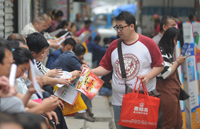
The biggest challenge facing Chinese cities is handling the massive, ongoing influx of rural residents, according to a top expert on urban management.
"It's a challenge for almost every country, but it's a big one for countries such as China and India because of their large populations," said Alain Le Saux, secretary-general of the World Association of Major Metropolises.
Speaking at the Board of Directors meeting, held in Guangzhou from Nov 14 to 17, he said that in a global financial crisis, it is difficult for city leaders to allocate sufficient funding for new settlements, transportation, job opportunities and other resources to satisfy the needs of a growing population.
Chinese cities use the permanent household registration system - hukou - to distribute their limited public resources.
Guangzhou Mayor Chen Jianhua said at a seminar on Nov 16, part of this year's Guangzhou Urban Innovation Conference, that most fundamental public services in his city are reserved for hukou holders.
He promised that the city will make arrangements in terms of transport, education, healthcare, water, and cultural activities so that migrants can receive basic public services and social security.
The United Nations predicts urbanites will account for 60 percent of the world's population by 2030, making it a challenge for all metropolises to ensure an even distribution of limited resources, experts say.
Diana Meirelles da Motta, project management director for Sao Paulo Metropolitan Planning Co in Brazil, said city leaders should estimate the number of migrants and increase their budgets for public services to provide newcomers with sufficient resources in areas such as housing, transportation, education and healthcare.
"Cities shouldn't turn away migrants with the excuse of limited resources," she said. "It's not difficult for a government to afford investment, but in Latin America it's often bureaucracy that delays approval of that investment."
While Sao Paulo welcomes more migrants, Dakar, the capital of Senegal, is helping migrants return to their rural homes with promising business projects.
"Many people come to cities because they can't find jobs in rural areas," said Ousmane Sambe, president of the city's regional council, at the plenary session of the association. "So we have set up business incubators to help migrants develop feasible business projects with which they can make a decent living back in their rural hometowns."
He Yanling, director of Sun Yat-sen University's Institute for Urban Governance and Development, said she does not think it is realistic for Chinese cities to keep adding investment for public services to meet the demands of newcomers.
"It will be too heavy a financial burden without the central government's help," she told China Daily. "There are many more people moving from rural areas to urban areas every year in China than in many other countries."
She said she prefers Dakar's approach, but has some concerns.
"People move from rural areas to cities not only for job opportunities but also for better education for their children, better medical care and more options for recreation," she said. "We have been concentrating on developing a few big cities. We need an even distribution of public resources among urban and rural areas and among big and small cities."
However, she pointed out that the hukou system is the fundamental cause behind unequal public services for native residents and migrants.
"The situation is, a person can access good public services in a city because he or she is an urban hukou holder, not because he or she is a citizen working and living in the city," she said.
"Migrant workers will feel wronged if they work and pay taxes but are unable to enjoy public services the same as urban hukou holders," she warned. "It can cause serious social problems if public services are disproportional to people's contributions."
xujingxi@chinadaily.com.cn



Copyright 1995 - . All rights reserved. The content (including but not limited to text, photo, multimedia information, etc) published in this site belongs to China Daily Information Co (CDIC). Without written authorization from CDIC, such content shall not be republished or used in any form. Note: Browsers with 1024*768 or higher resolution are suggested for this site.
License for publishing multimedia online 0108263 Registration Number: 130349