Villagers have someplace to live again in 2010 earthquake area
Kunsang Bartso will never forget the moment when Kunga Wangchen asked her to marry him after he pulled her out from a house in ruins on April 14, 2010, after a strong earthquake hit the Yushu Tibetan autonomous prefecture in Qinghai province.
Her house was in Gyegu town, which was severely hit by the magnitude-7.1 quake that claimed 2,698 lives and injured over 12,000 people.
One year later, the two got married. The wedding was a simple affair: Only members from the two families participated in a dinner, and the ceremony was held in a dusty blue tent.
 |
|
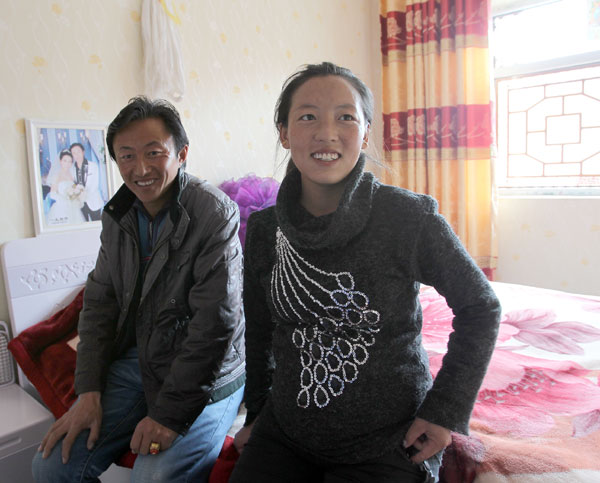
A couple, Kunsang Bartso (right) and Kunga Wangchen, live in a newly built house in Yushu. PHOTO BY ZHANG WEI / CHINA DAILY |
"I‘ve been dreaming of giving her a nice and comfortable house, especially now that she‘s seven months pregnant. It‘s the promise that I made on our wedding night," Kunga Wangchen said.
Thanks to the government‘s efforts, his dream came true.
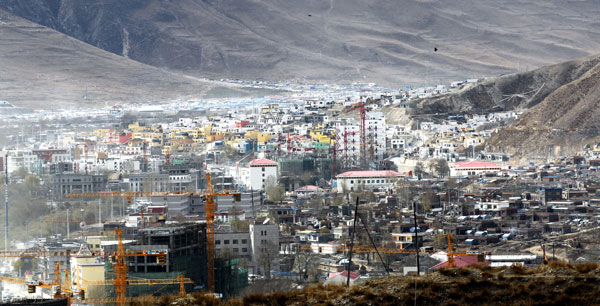
Kunga Wangchen, and more than 5,000 other people whose houses were almost razed, moved into their new homes in October, which are only about a 15-minute walk from the town center.
The blue tents and pre-fabricated houses where they were forced to stay for two years were replaced by rows of neat white buildings with traditional Tibetan pictures on the rooftops.
The reconstruction of the community began in July 2010. It was one of the 1,173 reconstruction projects in Yushu after the quake.
According to the Yushu reconstruction guidelines, each family is entitled to an 80-square-meter new house for free with two bedrooms, a sitting room and two small rooms.
 |
|
A bird's-eye view of the new Yushu Tibetan autonomous prefecture in Qinghai province on Oct 25. PHOTO BY ZHANG WEI / CHINA DAILY |
For Tibetans, there is also a special Buddhist prayer room in every house.
"Even before the house was finished, I came to check on its progress almost every day," said Kunga Wangchen, 30, who sells Chinese caterpillar fungus, a traditional herb that is said to be good for health.
"To tell you the truth, even if I had the money to build it myself, I wouldn‘t be able to build one of such good quality," he said.
"My old house was made of wood and earth, and it totally collapsed during the earthquake. We were traumatized by the earthquake, and I wouldn‘t let my wife move in if the house weren‘t solid," he said.
"When I first entered it, I couldn‘t help crying, I was really happy. It was utter desperation, staring at our ruined village after the earthquake, but two years later, I have my own house, and my baby will be here soon. Life is really amazing," he said.
He spent 40,000 yuan ($6,600) — almost all of his savings — to decorate one of the rooms with red quilts, curtains and Tibetan pictures on the ceiling.
"I owed her a wedding room. She deserves that," he said with a broad smile.
Outside in the sunshine, their neighbor Chimed Ragya sat on a shabby sofa that he retrieved from the debris after the quake, and kept rolling his Tibetan Buddhist prayer wheels.
His mother, wife and two sons were killed in the earthquake.
"My granddaughter was only 3 months old when it happened. She doesn‘t even remember her father," the 60-year-old said. "The new house is much stronger than the old one. If we had been living in a house like this before, they wouldn‘t have been killed."
"Earthquakes are natural disasters. The government didn‘t have to build houses for us. But we got a better house for free. I am satisfied. I will pray for my deceased relatives and for those who helped us," he said.
Relief workers
Lei Bo, who helped rebuild Kunga Wangchen‘s house, is a technician with China Railway Construction Corp.
The 25-year-old from Xi‘an, Shaanxi province, now has a difficult decision to make.
His girlfriend back home said that she will break up with him if he doesn‘t change jobs.
He‘s been working in Yushu since the reconstruction work began in July 2010, and went home only twice since then.
"I don‘t want to break up with her, but I also think that what I do now is meaningful. The more we work, the earlier Yushu people can move into new houses," he said.
As for his girlfriend, he said, he‘s using a delay tactic and he hopes it works.
"I have deep respect for our workers as they have to overcome so many unthinkable difficulties," said Bu Zongju, deputy director of China Railway Construction Corp‘s Yushu reconstruction project.
"Due to a tight work schedule, they have to be separated for a long time from their families and friends. Workers often have to postpone weddings, get divorces, break up with girlfriends or be absent when new babies are born," he said.
"The Yushu reconstruction project is, so far, the most difficult project that we‘ve done, and we‘ve had all kinds of problems," Bu said.
"Altitude sickness and harsh natural conditions are our biggest enemies," he said.
The average altitude of Yushu is above 4,000 meters, and the cold season lasts more than six months, which greatly reduces the working period.
The high altitude cuts the power of the construction equipment to only 60 percent of the normal level.
"Even the machines get sick, let alone the human beings," Bu said.
"Local residents often tell people coming from flat regions to walk slowly, eat less and speak less due to the thin air here, but construction workers can‘t always follow those suggestions," said Zhang Shengcheng, one of the project managers of China Railway Construction Corp in Yushu.
"Due to the long time working in the cold environment and living in tents, many people, even the young, suffer rheumatic arthritis," he said.
To make matters worse, since Yushu‘s electricity grid mainly depends on small hydropower plants, the supply is often suspended.
Each construction site needs to have a diesel generator.
"We once spent four months in a county with an altitude of 4,800 meters. I remember that my head was dizzy all the time, but we still had to work and carry heavy measuring instruments up the mountain. There were no cell phone signals. At the time, I fully understood what‘s loneliness," Lei Bo said.
Transportation is another big problem.
All the construction materials have to be transported from Xining, the capital of Qinghai province, which is more than 800 km away.
A truck once spent seven days on the road due to heavy snow, Bu said.
"My biggest wish is that warm weather can stay a bit longer, then more residents can move into their new houses and have a warm winter. And our workers can finish their work and go home to their families," he said.
Each completed house or building has a plate with the name of the team that built it.
"It‘s an award. But it‘s also a way to remind us that quality tops everything. Whenever I see students playing happily on the ground of the Yushu Prefecture Middle School, the first reconstruction project that we finished in Yushu, I feel that the efforts and hardship have paid off," he said.
New life
Ensuring the future of the new generations is also an important part of the reconstruction work, said Xu Fushun, executive vice-governor of Qinghai.
"So far, the reconstruction of 59 companies hit by the earthquake has been completed, and the majority of them have resumed operations. Nearly 2,000 newly built greenhouses have been put into use," said Xu.
Before the earthquake, collecting and selling Chinese caterpillar fungus, a popular ingredient in traditional medicine, was the main activity of almost every resident.
But now, many people, after getting training sessions in technology, begin to grow vegetables in greenhouses, and to breed cows, chickens and pigs.
Kunga Wangchen once planned to go to a big city, such as Xining, to start a new life because his dreams were destroyed by the earthquake.
"I changed my mind. Yushu is a completely new city now. We have almost everything that people living in cities have," he said.



Copyright 1995 - . All rights reserved. The content (including but not limited to text, photo, multimedia information, etc) published in this site belongs to China Daily Information Co (CDIC). Without written authorization from CDIC, such content shall not be republished or used in any form. Note: Browsers with 1024*768 or higher resolution are suggested for this site.
License for publishing multimedia online 0108263 Registration Number: 130349