Comments()
  Print
Print  Mail
Mail  Large Medium Small
China has surpassed the United States for the first time since 2003 to be the world's largest recipient of global foreign direct investment in the first half of 2012, showing that global investors are still confident in the world's second-largest economy despite its economic slowdown.
FDI inflows to China amounted to $59 billion in the first half of this year, despite a year-on-year decline of 3 percent from $61 billion in the first half of last year.
Meanwhile, FDI flowing to the US reached $57.4 billion, a decline of 39.2 percent from a year earlier, according to the Global Investment Trends Monitor released by the United Nations Conference on Trade and Development, or UNCTAD, on Tuesday.
"China's biggest attraction to global investment is now its huge market, contrasting the long-time low cost, which is now ranked third or fourth," said Zhang Xiaoji, director of the Foreign Economic Relations Development at the Development Research Center of the State Council, a top government think tank.
"The economy is, anyway, growing in China, outperforming the US and the European Union which are suffering medium- or long-term troubles."
Global FDI inflows reached $668 billion from January to June in 2012, a decline of 8 percent from the same period of 2011, as the economic recovery "suffered new setbacks in the second quarter of 2012", said the report.
"FDI flows will, at best, level off in 2012 at slightly below $1.6 trillion because the slow and bumpy recovery of the global economy, weak global demand and elevated risks related to regulatory policy changes continue to reinforce the wait-and-see attitude of many transnational companies toward investment abroad," the UNCTAD projected.
FDI inflows to the EU declined by 3.8 percent year-on-year to $175.9 billion for the first half of 2012 while inflows to North America were down by more than one-third due to a dramatic 39.2 percent year-on-year fall in inflows to the US, according to the report.
However, the UNCTAD also said that "FDI flows to the US might be stronger in the second half of 2012" in view of early indications.
The value of cross-border mergers and acquisitions in the US in the third quarter of 2012 were double those of the first half of the year, while some further acquisitions are "already taking place or announced in the fourth quarter", according to the report.
Developing economies for the first time absorbed half of global FDI in the first half of 2012, despite a decline of 5 percent year-on-year.
"China is experiencing structural adjustments in their FDI flows, including the relocation of labor-intensive and low-end market-oriented FDI to neighboring countries," said the report.
Members of the Association of Southeast Asian Nations demonstrated strong attraction for global foreign direct investment. FDI inflows to Cambodia surged by more than 165 percent year-on-year in the first half while inflows to Thailand rose by 62.1 percent and inflows to the Philippines increased by 10.6 percent, according to the report.
"For investment oriented with low costs, pulling out is normal and will continue in the future owing to China's rising costs and appreciation of local currency," Zhang said.
Shen Danyang, spokesman for the Ministry of Commerce, said that China is "adjusting its use of FDI, which is developing positively and healthily despite a slight decrease of FDI inflow this year".
FDI flowing to China stood at $83.42 billion from January to September, down 3.8 percent from a year earlier while September saw China's FDI drop 6.8 percent year-on-year to $8.43 billion, according to the ministry.
Meanwhile, the services sector used nearly $39.5 billion in FDI, or 47 percent of the country's total, a decline of 1.8 percent year-on-year in the first nine months, though it would be an increase of 1.6 percent if the real estate industry is excluded.
The HSBC preliminary manufacturing purchasing managers' index, a main economic indicator, rose to 49.1 in October, the highest level in three months, supported by recovery of domestic demand and business confidence while economists hold that China's economic growth is reversing its slowdown after registering growth of 7.4 percent in the third quarter, the slowest pace in 14 quarters.
However, Supachai Panitchpakdi, secretary-general of the United Nations Conference on Trade and Development, said that "the current trends of investment flows to developing countries, particularly to Asia, are worrisome and the challenge for channeling FDI into key development sectors such as infrastructure, agriculture and the green economy remains daunting".
lijiabao@chinadaily.com.cn

 Modeling contest part of China-US exchange
 Specially fertilized tea
 Simulator to support A320neo commissioned
 China's cultural sector sees steady growth in 2011
 Travel chaos after snowstorm hits NE China
 Inflation expected to rebound in November
 Grain output grows for 9th consecutive year
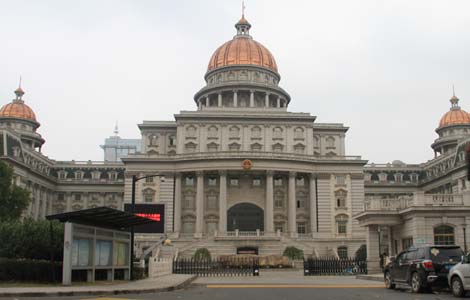 White House-like buildings in E China city
Copyright 1995 - 2010 . All rights reserved. The content (including but not limited to text, photo, multimedia information, etc) published in this site belongs to China Daily Information Co (CDIC). Without written authorization from CDIC, such content shall not be republished or used in any form. Note: Browsers with 1024*768 or higher resolution are suggested for this site.
License for publishing multimedia online 0108263 Registration Number: 20100000002731