Comments()
  Print
Print  Mail
Mail  Large Medium Small
BEIJING -- The newest edition of a government white paper on China's energy policy was issued Wednesday, detailing policies regarding energy development, conservation and the promotion of renewable power sources.
"China's Energy Policy 2012" was released by the Information Office of the State Council.
During the 1981-2011 period, China's energy consumption increased by 5.82 percent annually, underpinning the economy's 10-percent annual growth, the paper said.
China has built up a comprehensive energy supply system comprising coal, electricity, petroleum, natural gas, and new and renewable resources, according to the document.
Universal energy service and civil energy use conditions have markedly improved since the adoption of reform and opening-up policies in the late 1970s, it said.
CLEAN ENERGY DEVELOPMENT UNDERSCORED
Jiang Xinmin, a senior energy expert at the energy research center of the National Development and Reform Commission (NDRC), said the document attaches greater importance to new energy and the clean development of fossil fuels.
China's energy development must feature high technological content, low resource consumption, reduced environmental pollution, sound economic returns and energy security, the paper said.
Authorities issued a comprehensive work plan on energy conservation and emission reduction in 2007 that set precise targets for energy consumption in major sectors, including industry, construction and transportation.
By the end of 2015, China will lower its energy consumption per unit of GDP by 16 percent from 2010 and lower its carbon dioxide emission per unit of GDP by 17 percent, according to the country's 12th Five-Year Plan (2011-2015).
China will actively develop hydropower, solar power and wind power generation and seek safe and efficient ways to develop nuclear power, as well as utilize biomass energy and other types of renewable energy, according to the white paper.
China plans to increase the share of non-fossil fuels used for primary energy consumption to 11.4 percent and increase that of non-fossil fuels to 30 percent by the end of 2015, the paper added.
In 2011, China's installed generative hydropower capacity reached 230 million kilowatts (kw), ranking it first in the world. Fifteen nuclear power-generating units have gone into operation with a total installed capacity of 12.54 million kw. Another 26 units currently under construction will have a total installed capacity of 29.24 million kw.
Chinese wind power reached an installed generative capacity of 47 million kw, the paper said.
From 2006 to 2011, China's energy consumption for every 10,000 yuan of GDP dropped by 20.7 percent, saving energy equivalent to 710 million tons of standard coal.
ENERGY CRISIS UNLIKELY
The paper said energy development still faces many challenges, as rapidly increasing energy consumption has strained supplies, while the massive exploitation of fossil fuels has damaged the environment.
Industrialization and urbanization will continue to accelerate, which will push up demand, the paper said.
China's energy resource endowment is not high and its per capita share of coal, petroleum and natural gas is low, it said.
However, experts said an energy crisis is not likely.
"China can now supply itself with more than 90 percent of the energy it needs," Jiang said.
Jiang said China has become more capable in coping with risks caused by fluctuating global crude oil prices.
Jiang Liping, deputy director of the State Grid Energy Research Institute, said a sustainable development approach is needed in the energy sector.
Authorities will reinforce research and development for energy technology, promote related technological progress, launch major technological demonstration projects and introduce greater innovation in the sector, said the paper.h The government will also boost energy development in rural areas and enhance it in border regions. By 2015, the government aims to establish 200 green-energy counties and 1,000 villages that use solar energy as demonstrative areas.
Wang Zhen, a professor at the China University of Petroleum, said the paper's emphasis on new and renewable energy is in line with the country's future development orientation.
"While guaranteeing production, we also need to control consumption and make more efficient use of energy," said Wang.
According to the paper, China's primary energy output equaled 3.18 billion tons of standard coal in 2011, ranking it first in the world.
Natural gas output ballooned to 103.1 billion cubic meters. Installed electricity generating capacity reached 1.06 billion kw, while annual electricity output reached 4.7 trillion kilowatt-hours.

 Modeling contest part of China-US exchange
 Specially fertilized tea
 Simulator to support A320neo commissioned
 China's cultural sector sees steady growth in 2011
 Travel chaos after snowstorm hits NE China
 Inflation expected to rebound in November
 Grain output grows for 9th consecutive year
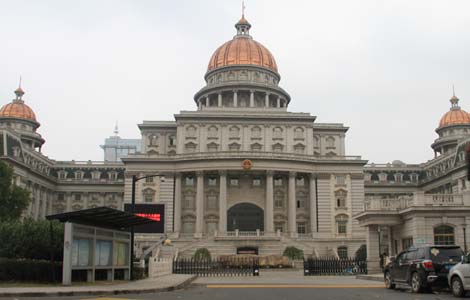 White House-like buildings in E China city
Copyright 1995 - 2010 . All rights reserved. The content (including but not limited to text, photo, multimedia information, etc) published in this site belongs to China Daily Information Co (CDIC). Without written authorization from CDIC, such content shall not be republished or used in any form. Note: Browsers with 1024*768 or higher resolution are suggested for this site.
License for publishing multimedia online 0108263 Registration Number: 20100000002731