
The explosive growth of China's e-commerce industry has led mobile phone sellers, both at home and abroad, to shift their attention to online channels, and analysts say the change may signal a revolution in the mobile phone industry.
Xiaomi Corp, a Beijing-based mobile phone manufacturer that dreams of success like that enjoyed by Apple Inc, has received a lot of attention by selling devices through the Internet since Aug 16, 2011 - the date that Xiaomi introduced its first handset model. Xiaomi is the first major Chinese mobile phone company that has adopted e-commerce channels as its major product distribution platform.
By Aug 16, the company had sold 3.52 million Mi-One devices, the first generation of Xiaomi mobile phones. Seven out of every 10 Mi-One were purchased online, according to the company.
After Xiaomi's huge success in online marketing, most mobile phone brands in the Chinese market have thronged to the e-commerce market to compete for Web buyers.
"All of a sudden, you find mobile phone brands acting like sharks, rushing into the online venue because they smell blood," said Deng Kuibin, deputy general manager of SINO Market Research Co.
Huawei Technologies Co Ltd, the world's second-largest telecom equipment maker, which in recent years looked for the terminal business to be its new revenue driver, launched a business-to-customer e-commerce website (www.vmall.com) in March to sell its own consumer electronics, especially smartphones.
In early July, the Shenzhen-based company introduced the 2,499-yuan ($397) Ascend D1, the first Huawei smartphone that can be purchased only online. In addition to Huawei's Vmall.com, customers can find the product on 360buy.com and Alibaba Group's Tmall.com as well.
Seeing the great potential of online channels, Huawei even set up an e-commerce business unit this year.
Huawei aims to ship 60 million smartphones across the globe in 2012, with its total mobile phone shipment reaching 100 million units during the period, said Wan Biao, CEO of Huawei Device Co Ltd, a mobile phone subsidiary of Huawei.
"We have seen e-commerce rising as a very important way for mobile phone sales, and Huawei will take further steps in developing the e-commerce business," Wan told China Daily.
ZTE Corp, the world's fourth-largest mobile phone vendor by shipments, will earn 300 million yuan ($47.6 million) in revenue from selling mobile phones online this year, up from 10 million yuan last year, said He Shiyou, the company's executive vice-president.
ZTE started to use e-commerce channels to promote mobile phone sales in 2010, He said.
Taiwan-based HTC Corp, which officially entered the Chinese mainland market two years ago, has lowered its target of constructing 4,000 branded counters in China by the end of this year. Ray Yam, president of HTC China, said the company slowed the pace of opening brick-and-mortar stores because it noticed the significant rise of e-commerce sales on the mainland.
"More people are turning to the Internet for mobile phone purchases, which forced us to change our marketing strategy," Yam said. HTC is going to have about 3,000 branded counters by year-end, reduced greatly from the previous goal of 4,000.
Trend: Go to Web
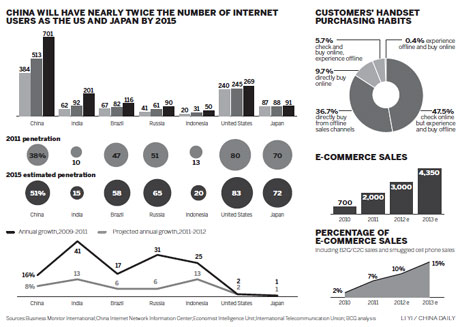
About 30 million mobile phones are expected to be sold online in China this year, up 68 percent from 2011, according to a report issued by SINO Market Research. The growth rate is more than 10 times that of mobile phones sold in offline outlets during the period, the report estimated.
The online sales will account for 10 percent of total handset purchases this year, up from 2 percent two years ago. It is expected to increase to 15 percent next year, the report said.
More than half of Chinese mobile phone buyers purchased or gathered information about certain handsets over the Internet. "The most important reason for choosing a device online is because mobile phones are cheaper on the Web," said Deng, of SINO Market Research.
The prices of handsets selling online is on average about 10 percent cheaper than in brick-and-mortar stores, Deng said. Meanwhile, it is convenient for customers to look around on the Web for various device information, and ordered products can be delivered directly to one's home, he said.
The growing number of Internet users in China, combined with an increasing consumer acceptance of e-commerce, is driving the online sales surge of mobile phones.
China is expected to have 700 million Internet users by 2015, nearly 200 million more than now, and twice the online population of Japan and the US combined.
At 193 million online shoppers, the Chinese market is the world's largest, including the US at 170 million, according to a report issued by the Boston Consulting Group.
China is likely to surpass the US as the world's biggest online retail market around 2015, as the nation's online retail sales will triple to more than $360 billion that year, the report estimated.
At present, most mobile phone vendors choose to expand their online presence by cooperating with major e-commerce website, such as Tmall.com and 360buy.com.
Tmall.com, the nation's biggest business-to-customer shopping website by market share, said its mobile phone sales had a dramatic year-on-year rise of 250 percent in the first nine months of this year.
"Many mobile brands, including Nokia, HTC and Motorola, have all operated flagship stores on Tmall.com," the company said in an e-mail reply to China Daily.
As one of the most popular consumer electronics websites in China, 360buy.com signed procurement agreements with about 20 mobile phone manufacturers in September to purchase handsets worth 100 billion yuan in the following three years.
360buy.com, which has 60 million registered users, said its sales of mobile phones will reach 10 billion yuan this year, up from a mere 30 million yuan in 2007.
Lan Ye, chief marketing officer of 360buy.com, said the fast development of China's e-commerce industry is very similar to that of the United States in the early 2000s. Beginning in 2000, the transaction amount of US online retail business grew by 800 percent, while the country's offline retail sales increased by only 46 percent during the same period, Lan said.
Traditional consumer electronics chain stores, such as Gome Electrical Appliances Holdings Ltd and Suning Appliance Co, have also vowed to take big shares in China's e-commerce industry. Mobile phones will be one of the top categories to sell online, according to Gome and Suning.
Meanwhile, Chinese telecom operators, which distribute almost half of Chinese mobile phones through their self-owned channels, are gradually starting to focus more on expanding their online reach.
China Mobile Ltd, the world's biggest telecom operator by subscriber numbers, aims to sell up to 30 percent of its customized mobile phones through e-commerce channels over the next three years, according to Ma Jingxin, deputy general manager of China Mobile Terminal Co, a mobile phone subsidiary of China Mobile.
"China Mobile is about to launch a self-operated online mobile phone store to help boost handset sales," Ma said in September in a Beijing forum, without disclosing a specific date.
Benefits, challenges
The current change in China's marketing of mobile phones may have results beyond people's expectations, analysts said.
Cheney Ji, telecom analyst with KPMG China, said online mobile phone retail is going to introduce some big changes to the industry. Supported by e-commerce channels, mobile phone makers may have the capability to provide customers with personalized products, he said.
"The traditional offline channels have a natural limitation for mobile phone vendors - they are only able to offer standardized products and cannot know about clients' diversified demands," Ji said.
In the future, if online sales increase in China, device sellers will have an in-depth understanding of customers' requests through direct communications and are likely to differentiate their products to cater for detailed segments of the population, he said.
Xiaomi may probably set an example, as the company holds trials to sell cell phone-related peripheral products on its website, including a cartoon mascot, colorful handset cases and T-shirts. The next step for Xiaomi may be to offer tailored mobile phones, Ji said.
The other benefit of online retail is the greatly expanded reach of customers. Latecomer companies such as HTC could benefit most from the e-commerce business, as it lags behind Samsung Group and Nokia Oyj in its number of physical stores, but online outlets may help HTC narrow the distribution gap with its rivals.
"The online platform can easily reach customers in tier 2, tier 3 cities, areas where HTC has not much presence," said Ray Yam of HTC.
For domestic rivals such as Huawei and ZTE, which hope to become international brands, the e-commerce platform may help them gain bigger market shares outside China.
However, challenges do exist with the process of going to the Web.
Wang Ying, analyst with Beijing-based research company Analysys International, said online marketing will further shorten the product life span and amplify pros and cons of every mobile phone model.
"The e-commerce platform is not only a sales outlet, but also a place for branding and conveying product information to customers," Wang said. Mobile phone players are very likely to be pressured by online opinions, she said.
Chen Limin contributed to this story.
shenjingting@chinadaily.com.cn
(China Daily 10/11/2012 page13)



Copyright 1995 - . All rights reserved. The content (including but not limited to text, photo, multimedia information, etc) published in this site belongs to China Daily Information Co (CDIC). Without written authorization from CDIC, such content shall not be republished or used in any form. Note: Browsers with 1024*768 or higher resolution are suggested for this site.
License for publishing multimedia online 0108263 Registration Number: 130349