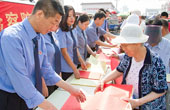
BEIJING - The 81st anniversary of the "September 18 Incident," which directly preceded Japan's invasion of northeast China, will be remembered amid tension caused by the Japanese government's so-called "purchase" of the Diaoyu Islands.
There have been repeated commemorations of what happened between China and Japan at the time of the signing of the unequal Treaty of Shimonoseki and during World War II (WWII). They show that the history between the two countries is so dense that, without a correct and shared understanding of the past, they can not move forward.
On September 18, 1931, Japanese troops blew up a section of the railway under its control near Shenyang, then accused Chinese troops of sabotage as a pretext for war. They bombarded the barracks of Chinese troops near Shenyang the same evening, thus starting a large-scale armed invasion of northeast China.
Four months later, Japanese troops occupied 1.28 million km of Chinese territory in northeast China, 3.5 times the landmass of the whole of Japan.
The incident was also followed by Japan's full-scale invasion of China and the rest of Asia, and a 14-year war of resistance against Japanese aggression.
The brutal invasion plunged China into an unprecedented disaster, in which half of its territory was enveloped in the fire of war and more than 35 million soldiers and civilians were killed.
Although Japan as the invader initiated the conflict, its people suffered a lot from the war. The two peoples are all victims of militarism and fascism.
Today's Chinese can not reverse time and alter the past, but they feel responsible for preventing history from repeating itself. They expect the Japanese and their government to join in the cause.
An important gesture from Japan to show its commitment to peace is to stick to the promises it made and treaties it signed on the occasion of the country's surrender at the end of WWII, including those about the territorial issues.
However, the recent Diaoyu Islands "nationalization" plan by the Japanese government is a clear violation of what it had accepted in 1945.
After the end of WWII, in accordance with the Cairo Declaration and the Potsdam Proclamation, China recovered Taiwan, the Penghu Islands and other territories which Japan had occupied, meaning the Diaoyu Island and its affiliated islets were returned to China in terms of international law.
The Diaoyu Islands "nationalization" is just the latest provocation from Japan to have strongly reminded Chinese of the wartime past.
Sino-Japanese relations soured in the early 2000s with an interruption of the exchanges of high-level visits, due to then Japanese Prime Minister Junichiro Koizumi's repeated visits to the Yasukuni Shrine, which honors class-A WWII war criminals.
The bilateral ties began to mend after Koizumi's successor, Shinzo Abe, made positive gestures on historical issues.
In September 2010, a Chinese trawler collided with Japanese Coast Guard patrol boats near the Diaoyu Islands. The collision, and Japan's subsequent detention of the trawler captain, resulted in a major diplomatic dispute between the two nations.
Over the past four decades, Sino-Japan relations have made steady and constructive progress only when the two sides both stuck to the understanding of common ground they reached on the normalization of diplomatic ties in 1972 and in the Sino-Japanese Treaty of Peace and Friendship in 1978.
This understanding should continue to work on handling the issue of the Diaoyu Islands, as well as other barriers standing between the countries in the future.
The "purchase" of the Diaoyu Islands has stirred anger across China and triggered protests in several cities. The Japanese government should take note of mainstream Chinese public opinion, as voiced in those protests, and think twice about its illegal activities.
In a joint statement signed by Chinese President Hu Jintao and then Japanese Prime Minister Yasuo Fukuda in 2008, China and Japan agreed to "face history squarely, look forward to the future and make continuous joint efforts to open up new prospects in their strategic mutually beneficial relations."
Taking history as a mirror and looking into the future will continue to be the political prerequisite for ensuring stable and healthy development of Sino-Japan relations.


Copyright 1995 - . All rights reserved. The content (including but not limited to text, photo, multimedia information, etc) published in this site belongs to China Daily Information Co (CDIC). Without written authorization from CDIC, such content shall not be republished or used in any form. Note: Browsers with 1024*768 or higher resolution are suggested for this site.
License for publishing multimedia online 0108263 Registration Number: 130349