More than 30 percent of China's kindergartens refuse to enroll children who are infected with the hepatitis B virus, according to a Beijing Yirenping Center report released on Thursday.
To make the survey, the non-governmental organization, which works for social justice, made a random selection from a database of nearly 40,000 kindergartens and 2,329 maternity and child-care institutions in 22 provinces, five autonomous regions and four municipalities. One hundred were chosen.
 |
|
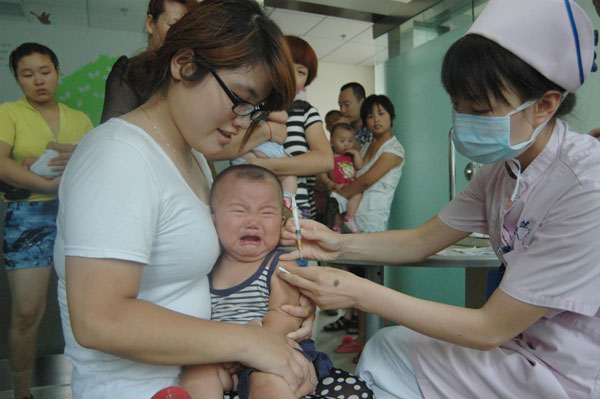
A baby receives a hepatitis B vaccine in Liaocheng, Shandong province, in July. Zhang Zhenxiang / for China Daily |
The survey found that half of the nation's hospitals and physical examination facilities provide hepatitis B screening tests for kindergarten enrollment, and 31.4 percent of kindergartens have turned away children with hepatitis B.
The report was sent to the Ministry of Education and the Ministry of Health on Thursday.
Ju Zi (not her real name), a mother of a 4-year-old boy with hepatitis B, said her child had a hepatitis B screening test during enrollment last year and had been identified as a carrier of the virus.
"I have to make a fake physical examination record for my son to enter a kindergarten," the Jiangxi mother said, adding that she worried about what would happen at the regular examination later this year.
The mother, who is also a hepatitis B carrier, said: "I've had to go through all the discrimination, and I don't want my son to have to suffer that."
There are 93 million hepatitis B carriers in China. The viral infection, which attacks the liver and can cause acute and chronic disease, is transmitted through contact with infected blood or other body fluids, but cannot be transmitted through casual contact, according to the World Health Organization.
State authorities issued a notice in 2010 clearly banning discrimination against hepatitis B carriers in school enrollment.
In addition, hospitals and physical examination facilities may not provide hepatitis B screening for school and kindergarten enrollment and employment, said Wang Zhao, vice-president of the China Foundation for Hepatitis Prevention and Control.
"Local governments should better manage local hospitals and physical examination facilities to ban such examinations," said Lu Jun, a lawyer at the Beijing Yirenping Center.
About 70 percent of kindergartens comply with the notice.
Li Yan, director of Shenyang Golden Hope Kindergarten, a private kindergarten in Northeast China's Liaoning province, said children stopped taking hepatitis B screening tests in 2010.
"But some parents are still concerned about teachers' health," Li said, adding that all teachers in her kindergarten have health certificates showing they are not hepatitis B carriers.
However, carriers are allowed to work at kindergartens, under a guideline released in May.
Li said all of her teachers were hired before 2010.
Some parents, however, want the screening to resume.
Liu Hong, an accountant in Shenyang and mother of a 5-year-old boy, said she would feel more comfortable if children were screened for the virus before enrollment.
"Then I would be more clear about what my baby should watch out for at kindergarten," she said, adding that it is also a good time for them to know her son's health condition.
"If he is a carrier, I'd love to know earlier and get him treatment."
A great majority of kindergarten children aged 6 and younger on the mainland are immune to the virus because since 2002, nearly all newborns received free vaccinations.
Liu remembered her son had many vaccinations as an infant, but could not remember whether hepatitis B was among them.
Contact the writers at luowangshu@chinadaily.com.cn and liuce@chinadaily.com.cn


Copyright 1995 - . All rights reserved. The content (including but not limited to text, photo, multimedia information, etc) published in this site belongs to China Daily Information Co (CDIC). Without written authorization from CDIC, such content shall not be republished or used in any form. Note: Browsers with 1024*768 or higher resolution are suggested for this site.
License for publishing multimedia online 0108263 Registration Number: 130349