Comments()
  Print
Print  Mail
Mail  Large Medium Small
Six out of 10 Chinese people will live in cities by 2020 as the exodus from rural areas continues to boost the migrant population, a report said.
China reached a landmark moment last year when 51.27 percent of the population was classified as urban dwellers.
At the end of 2011 there were about 230 million people classified as migrants, accounting for about 17 percent of the population, and 80 percent of these came from rural areas, the National Population and Family Planning Commission said in its third annual report.
Migrants are defined as people who live away from their registered place of hukou, or residence permit.
"Providing services for the colossal migrant population is related to economic development and social stability," Wang Qian, who heads the commission’s migrant services and management department, told China Daily on Tuesday.
Over the past three decades the migrant population increased annually by about 10 million.
Migrants stay at a work location for five years on average, making a major contribution to the economy, the report said.
However, they miss out on social services like insurance and welfare programs, which are linked to the hukou, Yuan Xin, a professor at Nankai University’s population and development institute in Tianjin, said.
Welfare priorities are work-related benefits and their children’s education, Wang said.
According to the report, less than 30 percent of migrants are covered by local insurance.
Only 51.3 percent of migrants hold fixed-term contracts and they work an average of 54.6 hours a week, far above the 40-hour legal limit.
The average monthly pay for migrant workers under 35 was 2,513 yuan ($400) in 2011, which hardly covered housing and healthcare expenses.
The figure, however, represented a 29.4 percent increase from 2009.
The monthly pay is obviously better for migrants with a degree, averaging 4,608 yuan, it said.
Zhao Min, a sales manager who earns nearly 10,000 yuan a month in Beijing, has just applied for a master’s degree program at the Central University of Finance and Economics in Beijing.
"Once I get the degree I might get a job offer that can give me a Beijing hukou and then my son could land it too," she said.
"Without the hukou my 1-year-old son will hardly secure a place at a good kindergarten, elementary or middle school," Zhao said.
The commission’s Wang said the government recognizes the problem.
Many counties and small cities have already loosened hukou regulations allowing migrants the same social services as residents.
Reform of the system is under discussion in large cities such as Beijing and Shanghai.
"It’s a priority to offer all the social services to migrants regardless of hukou,’’ Wang said.
shanjuan@chinadaily.com.cn

 Modeling contest part of China-US exchange
 Specially fertilized tea
 Simulator to support A320neo commissioned
 China's cultural sector sees steady growth in 2011
 Travel chaos after snowstorm hits NE China
 Inflation expected to rebound in November
 Grain output grows for 9th consecutive year
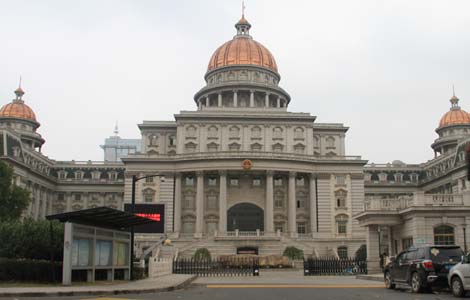 White House-like buildings in E China city
Copyright 1995 - 2010 . All rights reserved. The content (including but not limited to text, photo, multimedia information, etc) published in this site belongs to China Daily Information Co (CDIC). Without written authorization from CDIC, such content shall not be republished or used in any form. Note: Browsers with 1024*768 or higher resolution are suggested for this site.
License for publishing multimedia online 0108263 Registration Number: 20100000002731