Comments()
  Print
Print  Mail
Mail  Large Medium Small
The president of Haier America explains what it takes for a Chinese company to crack an overseas market
It's been 10 years since Haier America bought the wonderful former head office of Greenwich Bank.
But there's been no fanfare within the imposing 1920s, six-story limestone and sandstone building at the intersection of Broadway and West 36th Street in Midtown Manhattan in New York.
Instead, Haier quietly celebrated by acknowledging the series of milestones the company has hit since first entering the United States 13 years ago.
It was in 1999 that Haier Group — a company based in Qingdao, a coastal city in East China's Shandong province — first arrived in the US with a clear objective in mind.
|
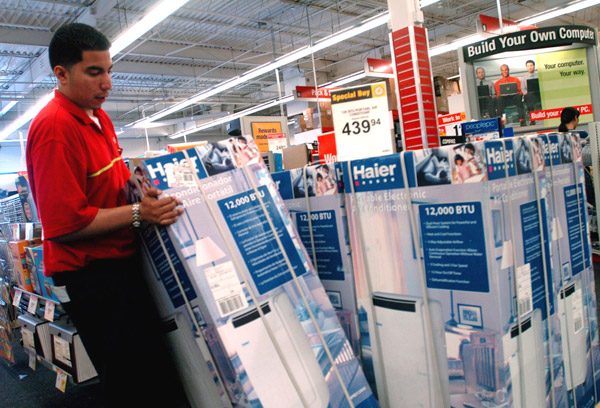 A shop assistant adjusts a Haier air conditioner in a store in Queens, New York. Provided to China Daily |
Unlike many of its Chinese counterparts which aim to export massive volumes of goods to the US and elsewhere, Haier was here to create a brand, which the company hoped would appeal around the world.
The company may be a household brand in China, well-known and respected as one of the world's leading manufacturers of refrigerators, air conditioners and other appliances — but its name was virtually unknown when it first broke into the US.
But today, its products can be widely found on the shelves of major US retailers such as Wal-mart, Target and Home Depot.
And by partnering with the National Basketball Association, it has gained considerable leverage through advertisements and other endorsements with one of the highest profile sports in the US.
Haier's CEO Zhang Ruimin has always emphasized that for its international business to succeed, it needed to create a localized brand name.
"We had to make Americans feel that Haier is a localized US brand instead of an imported Chinese brand," Zhang said.
|
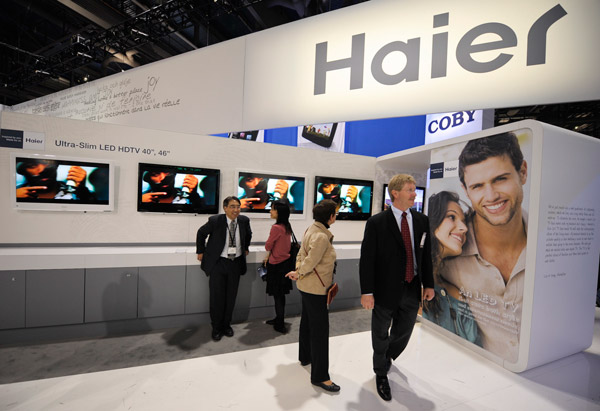 People visiting Haier’s pavillion at the 2010 International Consumer Electronics Show in Las Vegas. [Photo/Xinhua] |
The company's commitment to establishing a US bridgehead for expansion into the country was firmly underlined from the start with the decision to build a factory in Camden, South Carolina — it marked Haier out as the first Chinese company to actually invest in the bricks and mortar of a manufacturing plant in the US.
The Haier Industrial Park broke ground a month after Haier set up its US office in March 1999.
The $40 million facility on 110 acres land was opened in March 2000, and soon began producing its first refrigerators.
"The factory was meant to communicate our commitment to the American marketplace," Shariff Kan, president of Haier America, told China Daily.
To fully integrate into American society, he said, the company realized from day one that it was vital local people were running the business.
Today, the Haier park employs 250 workers, and its headquarters in New York — which also functions as a sales and marketing office — has another 220 staff.
Kan, who was named one of the "50 Most Outstanding Asian American Businessmen" in 2002, has been key to Haier's success, and has been with the company since it began in 1999.
He took over the reins from former Haier America president Michael Jemal in 2009 after being his right hand man for a decade.
Kan insists that Haier America is "very much American" in terms of its employees composition and work culture.
The company celebrates Chinese New Year just as it celebrates the Fourth of July and every US holidays.
While most Chinese companies chose to enter other Asian markets before attempting to penetrate the more unfamiliar markets of the US and Europe, Haier's strategy has been exactly the opposite.
Kan said that it firmly believed that if it could succeed in the West, it would then be able to do well in other Asian markets.
Although Asian players such as Samsung and LG Electronics started their US businesses much earlier, Haier doesn't view them as threats but "strong Asian brands that we can emulate".
"They represent the Asian community. So we try to learn from the best. But we are very confident of our own approach," he added.
Carving out a niche market has proved to be key part of its strategy in a US home appliances market dominated by American companies, such as GE Appliances, Whirlpool and Maytag (before it was acquired by Whirlpool).
One of its best opening moves was to win over American customers, and Haier found early success with mini-fridges for hotels and offices and for home use, a segment that the big players had avoided due to its relatively small size.
But for Haier, it was an ideal opportunity to gain consumer trust, he said.
After establishing itself with its mini-fridges, Haier then began to move into higher-end refrigerators and other appliances such as air conditioners, washing machines, and dishwashers.
Another key area in its US success has been R&D and thorough market research.
To understand its customers' needs, Haier invested heavily in a program of sending its own R&D people out to talk directly to customers and salespeople in stores right across the country to get their feedback on its products.
Not only are its full-size refrigerators produced in-market, but a design center in Los Angeles makes sure all products are tailored for the US market.
"We are continuously looking to differentiate ourselves so we can create our own part of the US appliance market," Kan said.
He adds that Haier prides itself in its ability and speed to convert ideas into products in the shortest possible time.
However, the Haier Industrial Park only has the capability to produce full-sized refrigerators, and other appliances are still made in China. The factory also ships some of its US-made top-end refrigerators back to China, as well as other countries.
In 2011, Haier was ranked the world's No 1 global major- appliance brand for a third consecutive year by Euromonitor International, a London-based business intelligence company.
Its global brand market share grew by 1.7 percent to 7.8 percent last year, according to the report.
Due largely to the sheer size of its home Chinese market, Haier Group's total sales grew about 15 percent to $23.8 billion last year.
Its in the US, on the other hand, that its individual product market shares are still tiny in comparison: for room air conditioners that's 16 percent; portable air conditioners 22 percent; and compact refrigerators 20 percent.
According to Kan, the company's ambition remains clear: to overtake Whirlpool and GE in the US — far from over ambitious, as it's certainly well-known for tackling major obstacles.
In 1984, Haier Group — then known as Qingdao General Refrigerator Co — was on the verge of bankruptcy when CEO Zhang Ruimin took the reins and returned it to profit in just a year.
According to a recent profile in Fortune magazine, "you'd be hard pressed to find a manager who is more innovative or fearless than the head of the Chinese appliance giant".
It called Zhang a "national hero" in China; the man who turned the failing factory into Haier, "a galloping enterprise with revenue of $20 billion and one of China's first global brands".
After saving the company, Zhang quickly acquired other businesses and expanded the product line to include other appliances such as freezers, dishwashers and microwaves. In 1991, these businesses merged to form Haier Group.
Today, Haier has 29 manufacturing bases and 16 industrial parks in the US, Europe, Asia, the Middle East and Africa. It also has eight R&D centers in the US, Germany, Japan and South Korea.
Its success story in going overseas could certainly be described as an object lesson for many Chinese companies struggling with what remains the key obstacle for many — brand building in an international market.
Kan's advice is clear: "Understand that what works in China may not work in America.
"And the first thing they need to do is to understand their consumers," he said.
"We are always learning about what our customers want."
atung@chinadailyusa.com

 Modeling contest part of China-US exchange
 Specially fertilized tea
 Simulator to support A320neo commissioned
 China's cultural sector sees steady growth in 2011
 Travel chaos after snowstorm hits NE China
 Inflation expected to rebound in November
 Grain output grows for 9th consecutive year
 White House-like buildings in E China city
Copyright 1995 - 2010 . All rights reserved. The content (including but not limited to text, photo, multimedia information, etc) published in this site belongs to China Daily Information Co (CDIC). Without written authorization from CDIC, such content shall not be republished or used in any form. Note: Browsers with 1024*768 or higher resolution are suggested for this site.
License for publishing multimedia online 0108263 Registration Number: 20100000002731